


 15
15 “Through the new PTAB processes, the Office is trying to send a message to stakeholders—do not wait to file an IPR.”

Acting USPTO Director Coke Stewart speaking at IPWatchdog LIVE. March 4, 2025.
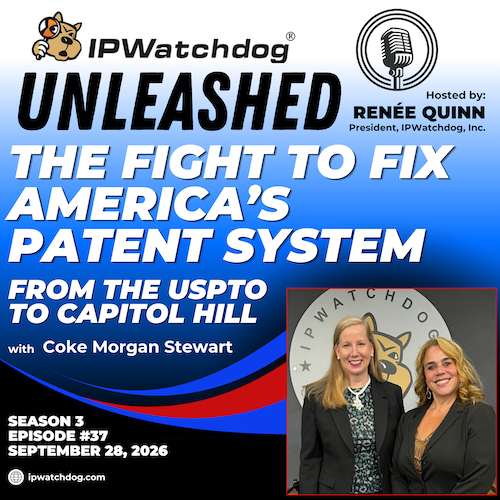
Earlier today, Acting U.S. Patent and Trademark Office (USPTO) Director Coke Morgan Stewart addressed the Intellectual Property Business Congress (IPBC) Global 2025, telling those in attendance that the Office is already making headway by chipping away at the record backlog inherited from the Biden Administration. Not surprisingly, however, much of Stewart’s remarks focused on new Patent Trial and Appeal Board (PTAB) initiatives and a desire on the part of the Office to see patent challengers migrate away from filing inter partes review (IPR) challenges and toward filing third-party submissions of prior art during examination so examiners can be presented with the best prior art, which will lead to better examination and fewer mistakes.
Leaning into the Inherited Patent Backlog
During her remarks, Stewart discussed how the Trump Administration inherited an historic backlog of unexamined patent applications, with the peak just over 838,000 applications in January of this year. She reported that as of last Friday the Office has already brought that number down to 806,000 unexamined applications.
Ultimately, the goal is to bring the inventory of unexamined patent applications down into the 500,000 range, which is where it was during the first Trump Administration under the leadership of then USPTO Director Andrei Iancu. To achieve this goal the Office is prioritizing examination activities over other activities and rewarding examiners and supervisors who work on more applications than required. Indeed, the Office has returned nearly 200 patent examiners to examining applications from various “special assignments” that were unrelated to examination. And the Office has instituted a new bonus plan where examiners and supervisors who examine more applications each quarter can earn bonuses over and above what has traditionally been available.
Significantly reducing the backlog of unexamined applications is not the only goal. Stewart explained that the Office wants to get to an average of 12 months to a first office action on the merits, and to get to an average of 24 months for disposal of patent applications, which she explained the Office was close to reaching at the end of the Trump Administration.
Encouraging Early Submissions and Challenges
While continually working to improve quality internally, through the use of AI tools that help examiners with Section 101 and 112 rejections, Stewart explained the Office is also considering how to best incentivize third-party submissions of prior art, which would help ensure the best prior art is being considered during examination. Unfortunately, post-grant review (PGR), which can be used during the first nine months after a patent has issued, and third-party submissions, which notify examiners of prior art during examination, are both seldom used. Challengers prefer to wait until an infringement suit is filed before first challenging what they believe to be improvidently granted patents. Through the new PTAB processes the Office is trying to send a message to stakeholders—do not wait to file an IPR. Use third-party submission opportunities and PGR to address concerns about pending patent applications and recently issued patents. Filing an IPR many years after a patent has been granted should not be the primary mechanism for addressing patent quality, or correcting errors.
Stewart said she is not placing blame on IPR petitioners who have not filed earlier challenges but acknowledged that the Office must make judgment calls on what IPR petitions to institute. The Office needs to focus on important cases, Stewart explained, and patents that have been in force 10, 12, 15 years or more may not be the best cases for the Office to be instituting.
![[Advertisement]](https://ipwatchdog.com/wp-content/uploads/2026/10/Questel-Oct-22-2026-sidebar-700x500-1.jpg)
![[Advertisement]](https://ipwatchdog.com/wp-content/uploads/2026/10/ClaimHit-Oct-28-2026-sidebar-700x500-1.jpg)
![[Advertisement]](https://ipwatchdog.com/wp-content/uploads/2026/09/Life-Sciences-2026-sidebar-early-bird-ends-Oct-25-700x500-1.jpg)
![[Advertisement]](https://ipwatchdog.com/wp-content/uploads/2026/09/WE-BUY-PATENTS-SIM-IP-Ad-1-revised-on-Sep-28-2026-700x500-1.jpg)
![[Advertisement]](https://ipwatchdog.com/wp-content/uploads/2024/09/Patent-Prosecution-Training-sidebar-700x500-2025-03-27.jpg)




![[Advertisement]](https://ipwatchdog.com/wp-content/uploads/2021/12/WEBINAR-336-x-280-px.png)
![[Advertisement]](https://ipwatchdog.com/wp-content/uploads/2021/12/Ad-4-The-Invent-Patent-System™.png)





Join the Discussion
15 comments so far.
George
June 19, 2025 03:00 pmAll inventors should read this book (written over 20 years ago) before even thinking of filing a patent, especially if they hope to ever get anything for their work & public disclosure. If it’s just to hang something on a wall, then maybe it’s worth around $100. The USPTO is just a scam now and Congress allows it to continue.
https://www.amazon.com/Steal-This-Idea-Intellectual-Confiscation/dp/0312294085
George
June 18, 2025 02:09 pmAI(s) will soon be able to determine validity … in MINUTES (for free) … not YEARS for MILLIONS.
And inventors will be able to check that themselves, even before submitting a patent application! They’ll also get a ‘relevant’ list of prior art to submit with their application and help in drafting them too. Will be as easy as using a word processor (with compliance with all laws & statutes – and even patent CASES – checked automatically in seconds).
Will happen in less than 20 years. Maybe even in 5! Ask Sam Altman (lol). What will happen then, and what country will be the first do let AI decide (most cases)?
Not sure, but China doesn’t care so much about lawyers or their job security. They like efficiency and being able to plan for the future. You can’t plan for the future with our current ‘messed up’ and ‘super-expensive’ patent system. We need a much faster and much cheaper one. One that 21st technology can now provide. So, why stick to the ‘tired’ and ‘expensive’ old ways? China won’t, that’s for sure.
Yes, it’s IMPOSSIBLE to plan now. Can’t know if a patent is valid or not (for years), and also can’t get ‘broad’ patents anymore that have actual value. Also our government doesn’t help protect patent rights – you’re on your own when it comes to that. That’s just stupid, since they issue the patents, supposedly for the purpose of encouraging innovation and helping to grow the economy – as quickly as possible – not hinder this growth and ‘new’ wealth creation. What happened to the ‘innovation economy’ lifting all boats, especially among the middle class and poor?
AI will be able to solve those serious questions of ‘invention ownership’ too. Will even permit ‘extremely broad’ patents to be issued again like Bell, Edison & Tesla got, along with all the past great inventors in America – 100’s of them – during the first industrial revolution! It’s clear (& now easily proven) that ‘broad patents’ are SECRETLY and UNCONSTITUTIONALLY being denied by examiners (under USPTO orders). This secret PTO ‘policy’ began with the 20-year SAWS program but continues to this day, in unwritten form.
Large companies & ‘monopolies’ especially don’t like broad claims & patents, so the USPTO made them go away. Can’t get them anymore (even though the Constitution never prohibited them). That’s because large entities basically ‘own’ the USPTO (and Congress) now. The USPTO (and Congress) ANSWER TO THEM, not ordinary Americans and ‘powerless’ inventors & innovators anymore. The USPTO (and Congress) doesn’t protect them anymore.
AI will change that! Bring it on! The sooner the better for America and the world of innovation and ‘fair’ wealth distribution! Enough with the IP ‘con’ that we have now.
George
June 17, 2025 01:30 pmAll this will become moot and totally pointless once AI is allowed to examine & ‘decide’ most patent issues, using ‘logic’ and ‘rules’ ALONE, rather than endless subjective, often biased and contrived, protracted and financially ruinous ‘human debates’. They would be able to do this all in MINUTES not YEARS – for free!
Opposing parties could then raise all the objections and arguments against validity they might want, and it won’t matter, since the AI would almost always be right, as opposed to the extremely fallible and strictly money-motivated ‘humans’ (that includes lawyers).
Infringement would then also be easy to decide – in hours or days – not YEARS. The days of million dollar lawsuit will then be over as well. Try maybe a few thousand dollars, at most. So it won’t matter if you’re an Apple or a homeless person – the AI’s decision will be the same – EXACTLY the same!
Such an ‘incontrovertible’ AI will already have had access to ALL possible prior art, in all languages, from anywhere in the world and not not just prior patents, but books, magazines, scientific articles, movies, art, etc., with which to consult and use to deliver its LOGICAL and RULE BASED decision, as to validity of a patent (that would also be drafted ‘and corrected’ with the help of such an AI, prior to submission). It’s decisions would ONLY be based on facts, the rules/statutes pertaining to IP, and ‘unassailable’ LOGIC, so as to almost always (with very few exceptions) arrive at the ‘correct conclusions’ and ‘decisions’ based on the law (not opinions).
When that happens, good luck trying to go up against a patent-specializing AI! Good luck! We’ll then once again have a functioning, efficient and ‘economical’ patent system that would also ensure ‘economical litigation’ as well (if even needed), as was intended by the Founders.
The Founders could never have imagined the intractable disaster and ‘mess’ we have now (mainly created by lawyers and wealthy corporations). They envisioned IP to be a fairly easy concept and ‘right’, just like ordinary property was (especially for a limited time).
This is not a ‘fantasy’ any longer. It WILL happen and fairly soon; if not in the U.S. then in China! So who’s for the U.S. being the FIRST to develop a bullet-proof, logically unassailable, and super-efficient patent system in the 21st century (especially before China creates one)? Who’s for such patents being able to be issued in as little as a week, for very little money, and with little involvement of humans, so that EVERY American can ‘once again’ afford to get and enforce, potentially ‘very valuable’ IP, and so be able to actually profit from IP, once again (as was the case 100+ years ago)? I know I am!
I predict this will definitely happen within the next 20 years (or sooner). So get ready for the ‘mess’ we have now to go away, and maybe forget studying patent law too (lol). Patent law will no longer be the lucrative area of practice it is now (as will be the case for most other law as well). Congress will make the laws and AI’s will interpret and help in adjudicating them, efficiently and economically! I for one can’t wait for that day to come. Only ‘facts’ will then matter again, not wealth or ‘legal schemes’ meant to deprive patent holders of their rights and benefits. We could then also get back to ‘First to Invent’ (not first to rip off), as the Founders clearly intended.
Anon
June 13, 2025 02:33 pmPeteMoss,
Thank you for your detailed reply – that being said, nothing of what you add answers my question as to having some type of de facto withdrawal of rights only because of an act of filing (as opposed to that filing having material on point). If the material being filed is on point, then YOU (the royal you) have lost nothing. If it is not on point, there is exactly zero reason why you should benefit.
Stephen Schreiner
June 12, 2025 10:07 amSeems that Director Stewart is signaling that the “settled expectations” category announced in her March 2025 Workload memo and first applied in the recent iRhythm decision (June 6) is a stand-alone basis for discretionary denial. It makes some good sense, too. For a patent that has been in force for 10 or more years and that has not been challenged, the patent owner has settled expectations that, if challenged, its validity will be adjudicated in a district court per the Seventh Amendment and subject to a C&CE presumption of validity per Section 282(a).
PeteMoss
June 12, 2025 09:13 am@anon,
Pre-MedImmune v Genentech, a patentee would send my client a cease-and-desist. In turn, I would assemble prior art and a claim chart, showing why the patented claims are invalid, not infringed, or both. If all prosecution was closed and the 2-year reissue window was closed, I would then send the art and the claim chart back to the patentee with a strongly worded response. 100% of the time, the patentee failed to sue my client.
Post-MedImmune, many patentees shifted to filing, but not serving, an infringement complaint. This leaves some time to negotiate before legal bills start to get out of control. I still assemble prior art and create a claim chart, but I do not send the uncited art to the patentee unless the patentee agrees not to sue my client with any new claims that the patentee obtains over the art that I provide. This agreement allows the patentee to obtain “better” claims through continuations/reissues and sue others, but not my client. Admittedly, this approach works best when both sides know each other.
Absent an agreement not to sue, if a potential infringer submits prior art during prosecution of a pending third-party application, the potential infringer loses control of the art, and is potentially a sitting duck if the patentee convinces the Office that the claimed invention defines over the art.
Absent an agreement not to sue, PGR is also potential suicide for a potential infringer if the patentee proposes substitute claims or has a continuation pending. The patentee can potentially navigate its way around the prior art provided by the potential infringer in a continuation and still cover the potential infringer. Moreover, most infringement lawsuits are brought well after the 9-month PGR deadline so PGRs are not generally attractive until well after the 9 month PGR bar.
Taking all of this together, if the goal of the Office is to knock out invalid claims early, I think that a covenant not to sue should be imputed between a patentee and a prior art submitter where the submitter provides an uncited, novelty destroying or strong 103 references + a claim chart to the patentee or the Office early during prosecution or during PGRs. The patentee should be enjoined from enforcing an invalidated claim, and any amended version of the invalided claim, against the submitter who provided the novelty destroying art. This encourages the submission of 102 art early in the process. Any other claim not touched by the prior art submission can still be asserted against the submitter. The public (other competitors) benefits from unpatentable claims being issued. A submitter of killer art is rewarded a little bit more, but in a limited fashion, for doing the extra work. The patentee gets a stronger, but perhaps narrower, patent on the front end. It is a balancing act, but everyone gets something of value.
mike
June 12, 2025 02:31 amPatent applicants have “settled expectations” when they pursued the patent bargain and disclosed their invention to the public in pursuit of a patent. As such, retroactive application of IPRs/PGRs on pre-AIA patents violates those expectations.
It therefore makes sense for the Director to deny institution on any patent having a pre-AIA priority date, as those patent applicants did not subscribe to the AIA when they originally disclosed their invention to the public. Especially given that the Director takes an oath to support and defend the Constitution, and therein lies the takings, due process, and ex post facto clauses.
I know of many inventors who would have never sought a patent and disclosed their invention to the public in the first place, had they known that IPR/PGR challenges would later be introduced, thus changing the risk factor in their issued and “trusted” IP asset.
Anon
June 11, 2025 01:08 pmPeteMoss,
I am not sure that I understand your point (correcting “assured against” to read “asserted against”).
One cannot – nor should not – remove the element of being correctly on point in any waiver of assertable rights. That simply makes no sense whatsoever.
Jeff A
June 11, 2025 08:12 amThe proper way to eliminate the backlog might entail doing away with restriction requirement and limiting each application to the first claimed invention. You could have as many dependent claims as you so desire but the examiner will only examine claim 1 for patentability.
Josh Malone
June 10, 2025 11:02 pmAnd if big tech and their affiliate Unified Patents don’t like it, they don’t even have to pound sand. They can file a reexam or challenge the patent in court. PTAB is not the only way to challenge a patent.
PeteMoss
June 10, 2025 10:15 pmNo one submits art via PGRs and third-party submissions because if the patentee gets claims over the art, the submitter has no more dry powder. I think the rule should be that if submitted art knocks out at least one issued or pending claim (evidenced by a claim chart), that patent family cannot be assured against the submitter. People will trip over themselves to submit relevant art early and often. Patent attorneys will be motivated to get claims that survive instead of reflexively drafting really broad claims that may or may not find adequate support in the specification. Everyone will be incentivized to search.
F22strike
June 10, 2025 10:05 pmThe Director of the USPTO cannot amend any statute in Title 35 of the US Code. Her new PTAB “initiatives”, whatever they might be, will not stop the flood of IPR petitions. Big-Tech is not bound by any such initiatives. They will not rely on submitting prior art via third party “early submissions” when they can’t argue the merits and don’t even know if a patent will ever be granted. The potential for some flavor estoppel against them in such third party filings would be very concerning to Big-Tech. I suppose they might file them through straw-men. Why would they bother with PGRs when they can wait and see if they are charged with infringement, and then pay the USPTO $40K or so in fees to have an 80-90% chance to have the asserted claims cancelled?
The APJs of the PTAB are greatly incentivized to grant IPR petitions to maintain the PTAB’s workload and their own lucrative employment. In addition, they are aware of the substantial fee revenue that IPR proceedings generate for the USPTO. The APJs are also incentivized to cancel claims in IPR decisions to induce more accused infringers to file IPR petitions. They know that even if their decisions are appealed, the CAFC will affirm in a Rule 36 “decision” in a significant percentage of such appeals due to the anti-patent bias of the CAFC. Moreover, APJs face no personal monetary consequences if their decisions to cancel patent claims are overturned by the CAFC. I doubt that the USPTO Director could legally set an artificial limit on the number of IPR petitions that are granted.
The USPTO has a huge conflict of interest. Each year it receives billions of dollars to both issue patents and cancel patent claims. Adding insult to injury, none of the USPTO’s patent fees that have been paid, including maintenance fees, are refundable when there is a final legal determination that patent claims were supposedly erroneously allowed.
Something is seriously wrong with the US patent system as evidenced by Caltech’s recently concluded seven (7) year odyssey to license its Wi-Fi patents. That scientific research-focused university likely incurred tens of millions of dollars in legal fees in defending at least seventeen (17) serial IPR petitions filed against its Wi-Fi patents and in pursuing federal court lawsuits to enforce those patents. Please don’t tell me that Caltech’s patents were “poor quality” patents. Please don’t tell me that Caltech is a “patent troll.” There is nothing in Title 35 that prevents this abuse. Big-Tech will lobby to make sure that Congress never amends the IPR statute in Title 35 to limit the serial filing of IPR petitions and to require clear and convincing evidence of invalidity in order to cancel patent claims.
As for the backlog of patent applications, since US patents can almost never be enforced, new filings will decline and the backlog will shrink significantly when US and foreign companies realize they are mostly worthless. How about the Director issuing an “initiative” to force examiners to follow the MPEP’s prohibition against moving target rejections. My clients experienced this plague many, many times. Each time I successfully overcame a prior art rejection the examiner gamed the count system and entered new rejections based on newly cited prior art even when the scope of the claims had not been amended. So-called “compact prosecution” of US patent applications is now a fantasy in many cases.
Pro Say
June 10, 2025 09:43 pmBravo Coke!
No more hiding the ball until years-to-decades-later IPRs and PGRs.
No. More.
You say you’ve got killer prior art? Then prove it when it matters most to America’s innovation engine.
Before the many-new-jobs-creating company and its investors rely on their patent(s) to protect their innovations.
BEFORE.
George
June 10, 2025 09:11 pmThe system they now have is ‘hopeless’ – period. Something new must be tried. Patent applications must be put on ‘rocket sleds’ if the U.S. economy is to ever benefit from patents again. Should take at most 1-year to get solid, ‘valid’, patents that can stand up to scrutiny and be as broad as possible, to prevent essentially duplicates from getting allowed. Also all inventions should be required to work ‘as claimed’ before being allowed! Enough with worthless ideas that can’t work, defy physics, and maybe would have a market of 100 people, at best! Those are for Etsy, not the USPTO! And, for sure, no more perpetual motion machines, or flying saucer patents using ‘alien technology’. REAL inventors are the ones that need more attention and time. not ‘loonies’. They will go nowhere and contribute nothing in the end. Make them PROVE their ideas can work, before giving them a patent, like was required in the 1800’s. Patents should not only be valid, but work as claimed. Otherwise they can be used to commit investor fraud too (like Elizabeth Holmes did to the tune of $10B). “Sure it works, we have 10 patents on it!” “The USPTO wouldn’t give us patents on it, if it didn’t work!”
George
June 10, 2025 08:34 pmReplace most USPTO employees and the (stupid, unfair & ‘European’) AIA with a ‘specialized’ AI-driven system requiring only limited human oversight and intervention! Could then maybe issue ‘bullet-proof’ patents in a WEEK – not YEARS. Maybe for as little as $200 too! Would also make enforcement very quick & easy. That’s how we get a 21st century patent system that is fair & equitable to ALL inventors, not just large corporations & monopolies. If a company wants your invention, they’ll have to pay for it again.
That could save the country BILLIONS every year in salaries and legal fees and especially help prevent the ‘theft’ of American IP and the loss business opportunities and formation of new companies that go with that (and the creation of many new jobs too). 1000’s of business and entrepreneurs are now prevented or even ‘intentionally BLOCKED’ by the USPTO (as was the case with ‘SAWS’), from moving forward & being able to compete with ‘greedy’ and ‘anti-competitive’ businesses, like Google, Amazon, Microsoft, IBM, Apple & 100’s of others.
Let’s get back to what the Constitution intended! Patents for ‘anyone’ deserving to get one (regardless of wealth or income). Powerful & broad patents too – if an AI says so – rather than ‘humans’ with their large egos, biases and ‘ulterior motives’ (like just BLOCKING all broad claims & patents, regardless of merit, even if the statutes & Constitution forbids that). The USPTO now just makes up its own rules. It’s basically a rogue agency now. The Constitution & Congress be damned. They do as they please.
AI would just base its decisions on ‘exhaustive searches’ (of EVERYTHING in the world – in any language – not just patents), then use the statutes, MPEP and ‘objective logical analysis’ to render its decisions regarding claims and perhaps even to make suggestions to inventors on how to make their claims as broad as possible (without infringing on prior art) or point out mistakes applicants can quickly fix (with questions answered and examples given immediately). Could do all that in MINUTES too, much better than any lawyer ever could. Indeed MUCH BETTER (since lawyers and even judges don’t have infinite knowledge & reasoning abilities, nor infinite patience or desire to rack up unlimited billable hours). They’re in a hurry to get paid & make their clients happy.
An AI wouldn’t care about any of that. An AI doesn’t need to get paid at all (except maybe for electricity) and they could also do all of the above in minutes, not MONTHS or YEARS! What’s not to like?
No, for inventions and their ‘proper protection’ and enforcement in the 21st century, AI’s would be best, especially since they will be doing more and more in 21st century! That can’t be stopped. So, why stick to a 19th century system, when you can go AI? Law has to ‘drastically change’ to compete with everything else in the world now and that has to start FAST, lest China does it first and mops the floor with our stodgy and decrepit 19th century system. Just wait and see.They don’t care so much about lawyers, they just like speed & efficiency. The AIA certainly didn’t bring us that!
If cars can drive themselves, then AI systems should be able to examine, evaluate, reason-about & decide-about patents & their validity and also help to greatly speed enforcement of those patents (for much less money and in far less time too). There’d be almost no possibility of challenging their logic and knowledge of the law either, since they’d have complete knowledge of patent law and ALL cases ever decided (even erroneous ones), but most importantly the very latest ones. Almost instant enforcement of patents could then become feasible and even easy, since an AI could consider all ‘possible’ legal arguments and decisions, and chose the best ones in order to arrive at an ‘unassailable one’.
No more attorney ‘tricks’, ‘stall tactics’, endless motions, intentional obfuscation of facts & claims, or ‘infinite debates’ about the ‘meaning’ of a single term. An AI wouldn’t care about any of that. An AI would just figure out what an invention is all about and how works (or is supposed to) and it’s truly new & original and likely useful to society. It would also determine if its claims are ‘adequate enough’ to be understood at least by experts and legally sufficient & valid so as to be enforceable at a later date (and not able to be rendered invalid later on). That’s clearly what the Founders intended. Patents that actual meant something and were enforceable, just as regular property was at the time. The Drafters of the Constitution didn’t intend for patents to be ‘perfect’ – just adequate enough to protect new ideas & products so they could be quickly commercialized to grow the economy of the U.S. (and not in 10-20 years either).
As an example of what I’m talking about here, I contend that a single ‘string-trimmer’ patent should have been sufficient to cover ALL similar string-trimmers (regardless of minor changes introduced). Same for the CRISPR patent (that wasn’t written right). Same for most block-chain patents and AI models too (no huge differences). That was all that was needed 200 years ago! We shouldn’t need 1000 patents that are basically all the same. How can you create a company if you immediately have 1000 competitors, or inventors wanting royalties on 1000 patents? You can’t do anything with a system like that. It’s just a traffic jam – all the time! Elon Musk recognized that right from the beginning. He’s not big on patents & doesn’t really care about even getting them.
How many patents did Bell need? How about Tesla? Edison? Bessemer? 100’s? So, why would they have to now? We need far fewer but far stronger patents and therefore far more valuable ones (maybe even 50x fewer) . We need ‘broader’ patents again too, and the USPTO should ‘help inventors’ get them, no hinder them, stall them, or ‘intentionally prevent’ them from ever getting one! The MPEP even states that they can do that – but they never do! That’s bad for America and greatly hurts our economy.
It’s just too easy to steal American inventions now. Far too easy! AI systems wouldn’t allow that anymore! They’d flag those cases right away & side with the inventor (maybe even automatically). Steal someone else’s idea (even through plagiarism) and you pay for it! No different than shoplifting. Theft of IP can’t be allowed anymore. That’s why every patent must be more distinct from others, to make determining differences far easier. It’s become totally impossible now. The Venn diagrams for patents & their claims almost completely overlap now. Why did we allow that to happen? Too many ‘similar patents’, claiming to do similar things, that’s why! It’s why we have to eliminate the clutter that makes IP theft so easy. We need ‘distinct’ patents that almost everyone can agree are distinct! Maybe only 50K patents/year? Maybe even less! We need a test for ‘significance’ not just ‘tiny improvements’ (like time-release capsules). We need to eliminate ‘junk patents’ that are worthless on their face! What we have now is just attorney and judicial ‘job security’! This SHOULDN’T be that hard! It wasn’t in the 1800’s!