
![[IPWatchdog Logo]](https://ipwatchdog.com/wp-content/themes/IPWatchdog%20-%202023/assets/images/temp/logo-small@2x.png)
 0
0 “Apple’s significant negotiating strength leads some parties to agree lower rates than would be agreed between a willing licensor/willing licensee.” – Lord Justice Birss, Court of Appeal
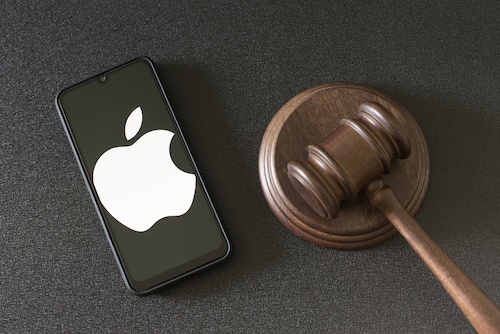 The UK Court of Appeal today ruled that Apple must pay Optis Cellular Technology LLC $502 million for a worldwide fair reasonable and non-discriminatory (FRAND) license to its 4G standard essential patents (SEPs) patents. With interest and fees, the total amount exceeds $700 million.
Optis sued Apple in 2019, and a May 2023 ruling by Mr Justice Marcus Smith at the High Court of England and Wales awarded $56.43 million to Optis as a lump sum reasonable royalty for Apple’s infringement of the SEPs, a total that pales in comparison with damages verdicts that Optis has earned in litigation against Apple elsewhere. Although currently stayed on appeal at the U.S. Court of Appeals for the Federal Circuit (CAFC), the Eastern District of Texas ordered Apple to pay $300 million in damages after the tech giant failed to win a motion for a third trial in the case in May 2022.
Smith’s lower ruling was controversial, particularly the methodology employed to arrive at his $56.43 million reasonable royalty, a figure which Smith determined himself without crediting expert testimony from either Optis or Apple. Excluding comparable licenses provided by both parties in the case, including those that reflected past holdout from Apple, the royalty rate determined by Justice Smith included “heavy discounting for the past[, which] is the paradigmatic feature of a real life license that is not FRAND,” counsel for Optis told the UK Court of Appeal in March.
During those arguments, and in briefs on appeal, Optis argued that the court’s FRAND rate should have unpacked the comparable licenses into dollar values per unit, then multiplied by Apple’s sales volume, which Optis contends would result in a billion-dollar lump sum royalty. On the bench, at least Lord Justice Guy Newey seriously questioned why Justice Smith would have disregarded the damages methodologies proposed by either side in the case. In response to Justice Smith’s conclusion that certain aspects of determining a FRAND license were outside of the experts’ expertise, Lord Justice Newey noted on the third day of hearings that, “[Justice Smith] does it himself, and he is not an expert and even if he were an expert, he would not be entitled to treat himself as one.”
Today’s judgment included two separate rulings by Justices Birss and Arnold, both of which Newey agreed with. Birss addressed the royalty calculation while Arnold discussed the parallel litigation in Texas, among other issues.
Birss explained that two of Justice Smith’s conclusions were fundamental to the appeal: 1) the conclusion that both Apple and Optis were taking an “exclusionary” approach to comparable licenses, i.e., “picking out the best comparable licences from the pool of available evidence” and thus excluding all others, and 2) the conclusion to reject the evidence of both parties’ accountancy experts, which Smith explained as being necessary because “the nature of the comparables in this case has taken both experts far outside the zone of their proper expertise.”
On the latter point, Birss faulted Smith for failing to tell either expert that they had strayed outside their zone of expertise. Birss explained:
“For that reason alone the judge’s conclusions to that effect were unfair and unjustified. If nothing else these allegations ought to have been put. Nor does it help to say in the next breath (at [316]) that the judge did not intend this to be critical of either expert. These are serious criticisms and for that reason alone I do not accept Apple’s submission that this course was open to the court.”
Ultimately, “the right approach,” said Justice Birss, is to “adopt a comparables based approach (ground 2) in the sense of being one based on identifying the best comparable or comparables, excluding others and working from there.”
Birss also went on to discuss the realities of “hold up” and “hold out” and their role in SEP/FRAND negotiations:
“When one is explaining the reasons why the FRAND system has been introduced, part of that explanation involves the identification of the twin concepts of hold up and hold out. In the language of the Supreme Court in UPSC hold out is a “mischief” ([10]). Furthermore at [12] the Supreme Court describes the purpose of the FRAND undertaking given by a SEP holder as being to protect (my emphasis) implementers and ETSI from hold up, while [59] also explains there is a balance: to protect implementers from hold up and SEP holders from hold out. In other words both hold up and hold out are behaviours by one party, mischiefs, which the other party is to be protected from; and this underpins the FRAND system itself. However each is plainly a matter of degree and this use of negative language is different from the question whether either mischief is intrinsically unlawful or illegitimate. In this context that is an irrelevant question.”
Birss went on to say that a finding that hold up or hold out took place in a negotiation “is not a finding that either party has acted in an unlawful manner.” The judgment continued:
“It is simply a finding that that outcome cannot be taken as the FRAND rate. It may be close to it or far away, and if a view can be taken about the degree of hold up or hold out involved that might shed some light, but these are different issues in a way that increases the damages for patent infringement that are ultimately awarded to Optis.”
Birss also acknowledged that “Apple’s significant negotiating strength leads some parties to agree lower rates than would be agreed between a willing licensor/willing licensee.” Birss declined to submit the case for a retrial and instead determined the FRAND rate himself, based on the comparable licenses and the experts’ data, ultimately concluding that “$0.15 per Apple unit for Optis is FRAND.” Using a different approach than Justice Smith to converting the dollar per unit (DPU) data into a lump sum, the judge arrived at a final figure of $502 million before interest and fees.
Justice Arnold dealt chiefly with the potential inconsistency between the U.S. litigation in the Eastern District of Texas and the UK proceedings. He found that “[i]f Apple had undertaken to take a licence to the global Optis portfolio on the terms determined to be FRAND by the English courts at the outset of the English proceedings, the EDTX proceedings would have been unnecessary,” and he had no reason to believe Optis would have still pursued the litigation in Texas. However, if it had, Apple would have had options to deal with that in both the UK and U.S. courts. Since Apple only abandoned its refusal to commit to a license as of September 15, 2023, “it is clear that the responsibility for the present situation lies at Apple’s door” up to that point, said Justice Arnold. As such, though he agreed Optis is not entitled to double recovery should the $300 million jury verdict be reinstated, once the final judgment in the Texas litigation, which is currently on appeal to the CAFC, is handed down, “the least-worst solution to the problem which Apple has caused is for the US final judgment to be treated as a floor for the royalties payable by Apple under the licence determined by the English courts in the manner proposed by Optis.”
In a statement sent by Optis, a spokesperson said they are “pleased the UK Court of Appeals has recognized and corrected a clearly flawed prior ruling and has made meaningful progress toward affirming the true value of our patents to Apple devices.”
Gary Moss of EIP Europe LLC, who represented Optis, added that the “judgment will go some way to reestablishing the English courts as an appropriate jurisdiction in which SEP holders can litigate FRAND issues.” An EIP press release also said the judgment represents “the highest value court determined license of its type on record.”
Apple has said in statements to the press today that “Optis makes no products and their sole business is to sue companies using patents they buy,” and that the company “will continue to defend against their attempts to extract unreasonable payments.”
Image Source: Deposit Photos
Author: SomeMeans
Image ID: 417444284
![[Advertisement]](https://ipwatchdog.com/wp-content/uploads/2026/07/IP-Author-Aug-13-2026-sidebar-700x500-1.jpg)
![[Advertisement]](https://ipwatchdog.com/wp-content/uploads/2026/08/LexisNexis-Aug-18-2026-banner-1500x500-1.jpg)
![[Advertisement]](https://ipwatchdog.com/wp-content/uploads/2026/07/Womens-IP-Forum-2026-sidebar-register-early-bird-now-700x500-1.jpg)
![[Advertisement]](https://ipwatchdog.com/wp-content/uploads/2026/07/ClearstoneIP-Varsity-Ad-2026-Ad-1.jpg)
![[Advertisement]](https://ipwatchdog.com/wp-content/uploads/2026/07/Juristat-Varsity-Ad-2026-IPW-ad-FreeTrial_2-UPDATED-on-Jul-15-2026.png)
![[Advertisement]](https://ipwatchdog.com/wp-content/uploads/2024/09/Patent-Prosecution-Training-sidebar-700x500-2025-03-27.jpg)



![[Advertisement]](https://ipwatchdog.com/wp-content/uploads/2021/12/WEBINAR-336-x-280-px.png)
![[Advertisement]](https://ipwatchdog.com/wp-content/uploads/2021/12/Ad-4-The-Invent-Patent-System™.png)




Join the Discussion
No comments yet.