
![[IPWatchdog Logo]](https://ipwatchdog.com/wp-content/themes/IPWatchdog%20-%202023/assets/images/temp/logo-small@2x.png)

 0
0 “The CAFC found that Provisur’s expert witness received access to certain HMI screens from Weber’s technicians that are not available to customers buying SmartLoader products.”
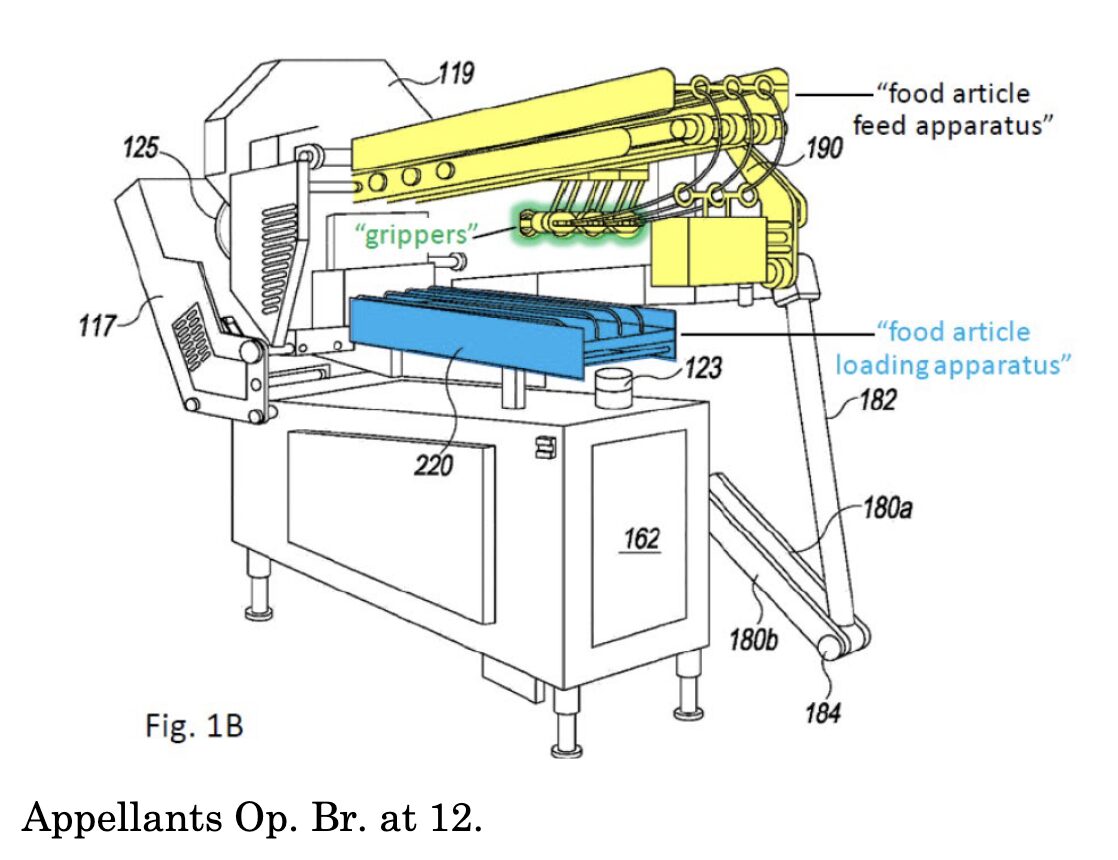 On October 2, the U.S. Court of Appeals for the Federal Circuit issued its latest precedential decision in a multi-year patent battle between food processing equipment rivals Provisur Technologies and Weber involving the assertion of patent claims covering meat and cheese slicer inventions. The Federal Circuit reversed the district court’s denial of judgment as a matter of law (JMOL) of noninfringement for one of three Provisur patents asserted in the case. The decision also reversed the lower court’s denial of Weber’s motion for JMOL of no willfulness, and remanded for a new trial on damages due to the improper use of the entire market value rule to calculate a reasonable royalty.
Expert Testimony Fails to Establish Accused Advance-to-Fill Functionality
Provisur sued Weber in the Western District of Missouri, asserting claims from three patents: U.S. Patent No. 10639812, High Speed Slicing Machine; U.S. Patent No. 10625436, same title as the ‘812 patent; and U.S. Patent No. 7065936, Fill and Packaging Apparatus. At trial, a jury found that Weber had willfully infringed the ‘812 and ‘436 patents through multiple models of food slicers, as well as the ‘936 patent through Weber’s SmartLoader line of automatic food loading units, awarding about $10.5 million in damages to Provisur. Following the verdict, the district court denied Weber’s motions for JMOL on willfulness and infringement, and a new trial on those issues and damages.
The Federal Circuit affirmed the Western District of Missouri’s denial of JMOL of noninfringement on the ‘812 and ‘436 patents. While Weber conceded its noninfringement arguments related to these two patents, it argued on appeal that Provisur had failed to prove that its SmartLoader products meet the claimed advance-to-fill limitation of claim 14 of the ‘936 patent. While Weber’s SmartLoader products are marketed as retract-to-fill conveyor products, Provisur argued at trial that Weber’s products could be reprogrammed by consumers so that the shuttle conveyor would deposit sliced food into the conveyor belt’s pockets by advancing rather than retracting.
The Federal Circuit reversed the district court’s denial of JMOL on the ‘936 patent after finding that Provisur did not establish its infringement theory by substantial evidence. At trial, Provisur relied on its expert witness who testified that the human machine interface (HMI) of Weber’s SmartLoader products could be used to adjust the parameters of the conveyor to either advance or retract.
Under Federal Circuit decisions like Fantasy Sports Prop v. Sportsline.com (2002), an accused device is capable of producing an infringing capability if that device is readily configurable to function in that way. Here, however, the Federal Circuit found that Provisur’s expert witness received access to certain HMI screens from Weber’s technicians that are not available to typical consumers. Further, the appellate court noted that Provisur’s expert witness only testified that the SmartLoader could be reconfigured, not that the witness actually reconfigured the conveyor to advance rather than retract.
Patented Features Did Not Sufficiently Drive Consumer Demand for Damages Calculation
Weber was also successful in its appeal from the district court’s denial of JMOL on willfulness. The Federal Circuit found that testimony from another expert witness for Provisur was admitted in violation of 35 U.S.C. § 298, which establishes that a defendant’s failure to obtain advice of counsel with respect to allegedly infringing patents cannot be used to establish willfulness. Provisur’s witness at trial testified that Weber failed to consult a third party to conduct a freedom to operate analysis or otherwise evaluate the asserted patents. Although Provisur argued that this testimony related to industry standards for intellectual property management, the Federal Circuit found that this testimony did not properly distinguish legal and non-legal services.
Finally, the Federal Circuit found that the district court abused its discretion by allowing Provisur to use the entire market value rule for the damages calculation it presented to the jury. As the appellate court noted, Provisur’s infringement allegations only targeted certain functionalities for the slicer or automation components of a multi-component food slicer line. At trial, Provisur did not present sufficient evidence that the patented features at issue in the case drove consumer demand for the entire slicer line as required by Federal Circuit case law under Lucent Technologies v. Gateway (2009). Although expert testimony alone can establish that patented features drive sales of a multi-component product, the Federal Circuit found that Provisur did not establish that other features of the slicing line, such as the slicing blade or guards, did not drive consumer demand.
The Federal Circuit’s reversal and remand is just the latest decision in Provisur and Weber’s patent battle resulting in precedential case law from the appellate court. In September 2022, the Federal Circuit reversed the Patent Trial and Appeal Board’s (PTAB) invalidation of Provisur patent claims for failing to provide obviousness analysis meeting the Administrative Procedure Act’s (APA) standard for meaningful appellate review. Then in February of this year, the Federal Circuit clarified the public accessibility standard for printed publications qualifying as prior art, finding that Weber’s operating manuals constituted prior art even though those manuals contained confidentiality provisions and were only sent to ten unique entities.
![[Advertisement]](https://ipwatchdog.com/wp-content/uploads/2026/06/Patently-Jun-23-2026-sidebar-700x500-1.jpg)
![[Advertisement]](https://ipwatchdog.com/wp-content/uploads/2026/06/Patent-Bots-Jun-25-2026-sidebar-700x500-1.jpg)
![[Advertisement]](https://ipwatchdog.com/wp-content/uploads/2026/06/IP-Copilot-Jun-30-2026-sidebar-700x500-1.jpg)







![[Advertisement]](https://ipwatchdog.com/wp-content/uploads/2021/12/WEBINAR-336-x-280-px.png)
![[Advertisement]](https://ipwatchdog.com/wp-content/uploads/2021/12/Ad-4-The-Invent-Patent-System™.png)






Join the Discussion
No comments yet.