
![[IPWatchdog Logo]](https://ipwatchdog.com/wp-content/themes/IPWatchdog%20-%202023/assets/images/temp/logo-small@2x.png)
Posts Tagged: "patent"
Tesla Partially Succeeds at CAFC with Ruling Finding Some EV Charging Claims Obvious
The U.S. Court of Appeals for the Federal Circuit (CAFC) issued a decision today in Tesla, Inc. v. Charge Fusion Technologies, LLC, affirming in part, reversing in part, and vacating in part a final written decision of the United States Patent and Trademark Office’s Patent Trial and Appeal Board (PTAB). The CAFC determined that the PTAB improperly construed a limitation of one independent claim but correctly construed limitations of other independent claims. The court reversed the finding of non-obviousness for claim 1, vacated the judgment regarding its dependent claims, and affirmed the finding of non-obviousness for the remaining claims.
CAFC Upholds Ineligibility of Targeted Ad Claims in Win for TikTok
In a win for TikTok, the U.S. Court of Appeals for the Federal Circuit (CAFC) today affirmed a district court’s grant of a Rule 12(c) motion holding 10Tales, Inc.’s targeted content patent claims invalid as ineligible under Section 101. The opinion was authored by Judge Reyna. 10Tales sued TikTok and ByteDance in the U.S. District Court for the Western District of Texas, alleging infringement of its U.S. Patent No. 8,856,030, which generally covers “a system for customizing or personalizing content based on user social network information.”
WIPO in Focus: Beyond Treaties, Toward a Market-Driven IP System | IPWatchdog Unleashed
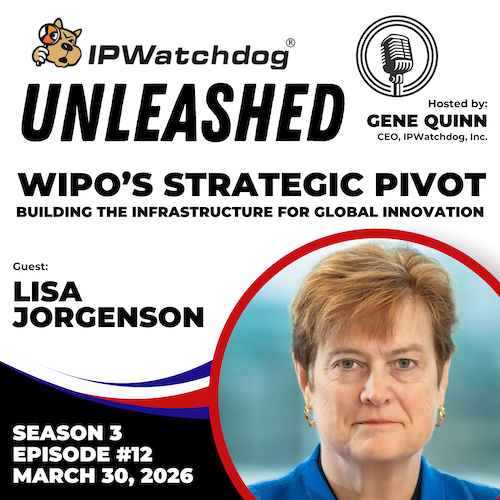
This week on IPWatchdog Unleashed, I spoke with Lisa Jorgenson, who is Deputy Director at the World Intellectual Property Organization (WIPO). Jorgenson had just attended IPWatchdog LIVE 2026 and spoke on our final panel along with former U.S. Patent and Trademark Office (USPTO) Director David Kappos, former USPTO Director Andrei Iancu, and former International Trade Commission (ITC) Commissioner Scott Kieff. She joined me immediately following the conference at IPWatchdog Studios for a wide-ranging discussion that pulled back the curtain on an institution many in the IP community think they understand—but often do not really appreciate.
Amicus, Sanofi Urge USPTO Appeals Panel to Uphold Ex Parte Baurin’s Approach to ODP Analysis
Amicus briefs in the U.S. Patent and Trademark Office’s (USPTO’s) review of issues raised by a 2025 Patent Trial and Appeal Board (PTAB) rehearing decision regarding the judicially-created doctrine of obviousness-type double patenting (ODP) were due on Friday, March 27. At least one amicus is urging the Office to affirm the decision’s holding and clarify that the focus should be on “whether there is any unjustified extension of term when determining if an ODP rejection is appropriate” in order to create more consistent outcomes in examination and to harmonize the approaches of the PTAB and examining corps.
Ninety-Eight Percent of Apple, Nvidia, Costco, Lilly and MasterCard Market Value are IP-Related Intangible Assets
The strength of many of today’s most valuable companies is based significantly on intangible assets, like trademarks, patents, trade secrets and brand reputation. Hard-assets or “tangibles,” like real estate and equipment, are a relative blip on many large businesses value radar. What is surprising is the extent to which these companies are dominated by intangible assets and what that means for how they are understood and financed.
PTAB Upholds Priority Win for Broad Institute in CRISPR Patent Case
On remand from the U.S. Court of Appeals for the Federal Circuit (CAFC), the Patent Trial and Appeal Board (PTAB) on Thursday reaffirmed its decision that The Broad Institute, Inc., Massachusetts Institute of Technology, and President and Fellows of Harvard College (“Broad”) were the first inventors of the use of CRISPR-Cas9 gene editing in eukaryotic cells.
CAFC Affirms District Court’s Denial of Mandatory Stay for ITC Respondent Who Voluntarily Dismissed Complaint
The U.S. Court of Appeals for the Federal Circuit (CAFC) today issued a precedential decision in Ascendis Pharma A/S v. BioMarin Pharmaceutical Inc., affirming a district court order that upheld the U.S. District Court for the Northern District of California decision denying Ascendis’s motion for a mandatory stay under 28 U.S.C. § 1659(a)(2). The ruling concluded that Ascendis was not entitled to a mandatory stay because Ascendis voluntarily dismissed its original complaint and filed a virtually identical refiled complaint to restart the statutory deadline. Judge Stoll authored the opinion, joined by Judges Lourie and Chen.
IPWatchdog LIVE 2026: What Big Tech Actually Wants from Your Patent, and What Sends It Straight to the Back Burner
A panel on day three of IPWatchdog LIVE 2026 offered the IP community a candid look at how large operating companies actually evaluate and respond to patent assertions. The answers carry direct implications for every practitioner advising clients on the sell side of a transaction. The session, titled The Big Tech View on Patents and the Patent Market, featured Russell Binns (Allied Security Trust (AST)), Ola Adekunle (Google), Caroline Pinkston (Hewlett Packard Enterprise (HPE)), and Dean Geibel (Samtec).
Calculating the Patent Liabilities of the ‘Magnificent Seven’
Nearly every operating company valued at greater than $20 billion in market capitalization is likely to be accused of patent infringement at some point. The high likelihood of utilizing another person or company’s patented technology led to an explosion of patent litigation activity over the last 30 years. Often, inventions emerge without a specific product in mind, and the strategy for the invention-turned-patent lacks a clear vision. This has been the way of invention since the patent offices were first formed and legal IP protection became a constitutionally ordained government program.
SCOTUS Grants Solicitor General Divided Argument in Hikma Induced Infringement Case
The U.S. Supreme Court on Monday granted the Solicitor General’s motion for leave to participate in oral argument as amicus curiae and for divided argument in Hikma Pharmaceuticals USA Inc. v. Amarin Pharma, Inc., a case concerning induced patent infringement in the pharmaceutical skinny label context. The order followed the filing of a merits response brief by Amarin on March 20, defending the U.S. Court of Appeals for the Federal Circuit (CAFC) decision that found Amarin plausibly alleged that Hikma Pharmaceuticals actively induced infringement of patents covering uses of Amarin’s cardiovascular drug Vascepa.
IPWatchdog LIVE Panel Asks Whether Patent Licensing Still Works — The Answer Is Complicated
A panel on day one of IPWatchdog LIVE 2026 didn’t mince words: the voluntary patent licensing ecosystem is functionally broken, and the IP community needs to understand why. That was the diagnostic consensus from the panel titled Patent Dealmaking, Monetization & Licensing: An Examination of Capital, Risk, and Deal Flow, moderated by Brian O’Shaughnessy (Dinsmore & Shohl) and featuring Michael Gulliford (Soryn IP Capital), Louis Carbonneau (Tangible IP), and Dan Kesack (WTW Insurance).
IPWatchdog LIVE: From ‘Sneaky AI’ to ‘Ontology’, What IP Attorneys Need to Know About Contracting for AI Acquisition
As artificial intelligence adoption accelerates across both commercial and government sectors, traditional contracting frameworks are being stretched beyond their limits. That tension was the focus of a panel at IPWatchdog Live 2026 today, featuring Judge Ryan T. Holte of the U.S. Court of Federal Claims; Stephanie Curcio, co-founder and CEO of NLPatent; and TJ Whittle, Legal Counsel at Anduril Industries.
SCOTUS Denies Pro Se Inventor Challenge to Conflicting, Unexplained Section 101 Rejections
Today, the U.S. Supreme Court issued an order list denying a petition for writ of certiorari filed by inventor Noah Healy to challenge rulings upholding a patent examiner’s subject matter eligibility rejection under 35 U.S.C. § 101 at the U.S. Patent and Trademark Office (USPTO). Healy’s pro se petition challenged the U.S. Court of Appeals for the Federal Circuit’s decision to affirm the examiner’s rejection as violating the meaningful review requirements of the Administrative Procedures Act (APA) due to conflicting statutory theories on patentability that were never sufficiently explained by the agency.
IPWatchdog LIVE 2026: Judge Newman and Michel Present Awards, Panelists Outline Uphill Battle for Global IP and Drug Patents
On day one of IPWatchdog LIVE 2026, panelists discussed the global IP landscape, the economics of patent portfolios, patent dealmaking and the ins and outs of drug patent critiques, before U.S. Court of Appeals for the Federal Circuit (CAFC) Judge Pauline Newman and Retired CAFC Judge Paul Michel introduced the recipients of their respective eponymous awards for 2026.
The Problem of Abusive Serial Challenges Using Reexaminations Needs to Be Addressed by the USPTO
The current U.S. Patent and Trademark Office (USPTO) leadership has made its position on serial patent challenges crystal clear. USPTO Director Squires warned that “even extremely strong patents” cannot survive repeated rounds of review. See NPRM Comments (10/16/2025)…. Once again, Director Squires and Deputy Director Stewart are right on the mark. Allowing excessive serial challenges to patents is unfair to patent owners and undermines the patent system.
Varsity Sponsors
![[Advertisement]](https://ipwatchdog.com/wp-content/uploads/2026/03/NLPatent-Apr-2-2026-sidebar-700x500-1.jpg)
![[Advertisement]](https://ipwatchdog.com/wp-content/uploads/2026/02/Junior-Apr-7-2026-sidebar-700x500-1.jpg)

Latest IPW Posts
Tesla Partially Succeeds at CAFC with Ruling Finding Some EV Charging Claims Obvious
March 31, 2026 @ 04:28 pmCAFC Upholds Ineligibility of Targeted Ad Claims in Win for TikTok
March 31, 2026 @ 01:14 pmWIPO in Focus: Beyond Treaties, Toward a Market-Driven IP System | IPWatchdog Unleashed
March 31, 2026 @ 11:00 amAmicus, Sanofi Urge USPTO Appeals Panel to Uphold Ex Parte Baurin’s Approach to ODP Analysis
March 30, 2026 @ 04:48 pm
Latest Podcasts


IPWatchdog Events
Webinar: Unlocking New Capabilities – The Real ROI of AI in Patent Practice
April 2 @ 12:00 pm - 1:00 pm EDTCLE Webinar: All in the Prompt – Crafting AI Prompts for Precision Outputs
April 7 @ 12:00 pm - 1:00 pm EDTPatent Masters™ 2026 – Portfolios, Licensing and Enforcement
June 8 @ 8:00 am - June 10 @ 5:00 pm EDT
Industry Events
24th Annual Rocky Mountain Intellectual Property & Technology Law Institute
May 28 @ 8:30 am - May 29 @ 4:30 pm MDTFrom IPWatchdog
![[Advertisement]](https://ipwatchdog.com/wp-content/uploads/2021/12/WEBINAR-336-x-280-px.png)
![[Advertisement]](https://ipwatchdog.com/wp-content/uploads/2021/12/Ad-4-The-Invent-Patent-System™.png)