
![[IPWatchdog Logo]](https://ipwatchdog.com/wp-content/themes/IPWatchdog%20-%202023/assets/images/temp/logo-small@2x.png)
Posts Tagged: "INTA"
INTA Virtual Legal Clinic – Empowering Female Entrepreneurs
In celebration of International Women’s Day, INTA’s Pro Bono Committee is hosting a Virtual Legal Clinic to support female-driven small- to medium-sized enterprises, nonprofits, and charitable organizations. About the Clinic: Qualified applicants will have the opportunity to consult with volunteer trademark attorneys on a pro bono basis. Volunteers will: Answer legal questions Explain the trademark registration process Provide guidance on…
INTA Urges EUIPO Grand Board to Confirm Human Face Marks are Not Excluded from Trademark Registration
The International Trademark Association (INTA) announced today that it has filed an amicus brief in a referral to the Grand Board of Appeal of the European Union Intellectual Property Office (EUIPO) that asks for clarification on registering human faces as trademarks. INTA urged the Grand Board to confirm that “signs consisting of photorealistic facial images of people, including famous ones, are not per se excluded from trademark protection.”
INTA’S Pro Bono Virtual Program
The INTA Pro Bono Committee is hosting a Virtual Legal Clinic on Tuesday, October 29, 2024, at 11 AM EST, in celebration of International Pro Bono Week. This clinic is open to entrepreneurs, SMEs, nonprofits, and charitable organizations worldwide. Participants can consult with volunteer trademark attorneys on trademark clearance and prosecution matters, including how to: Register and protect a trademark…
Amici Urge SCOTUS to Scrap Fourth Circuit Approach to Disgorgement of Non-Party Affiliates’ Profits
Several amici weighed in late last week on a trademark petition to the U.S. Supreme Court that asks whether “an award of a ‘defendant’s profits’ under the Lanham Act…can include an order for the defendant to disgorge the distinct profits of legally separate non-party corporate affiliates.” The Supreme Court granted the petition in Dewberry Group, Inc. v. Dewberry Engineers Inc. in June, after the U.S. Court of Appeals for the Fourth Circuit endorsed a disgorgement remedy that reached into profits earned by affiliates of the petitioner, who were not included as defendants in the case, without any regard to principles of corporate veil piercing.
TRUMP TOO SMALL Amici Weigh in as High Court Readies for Another Trademark Fight
Amici have submitted briefs and a response has been filed in recent weeks with respect to U.S. Patent and Trademark Office (USPTO) Director Kathi Vidal’s petition to the U.S. Supreme Court for review of a decision that said the USPTO was wrong to reject a trademark application for the mark TRUMP TOO SMALL. The February decision of the U.S. Court of Appeals for the Federal Circuit (CAFC) held the Office’s application of Section 2(c) of the Lanham Act to reject TRUMP TOO SMALL was unconstitutional. Specifically, the CAFC panel held that “applying section 2(c) to bar registration of [Steve] Elster’s mark unconstitutionally restricts free speech in violation of the First Amendment.”
INTA Urges CJEU to Find No Legal Interest in EU Opposition to Pre-Brexit Trademark Applications
Today, the International Trademark Association (INTA) published an amicus brief filed with the Court of Justice of the European Union (CJEU) in a case that should have major implications for the effects of Brexit on EU trademark law. INTA’s brief asks the CJEU to reverse a lower court’s decision and rule that the EU Intellectual Property Office (EUIPO) was correct in determining that UK trademark law can no longer provide a legal interest to sustain an opposition to an EU trademark application filed before Brexit.
Jack Daniel’s Will Get Its Shot at SCOTUS Review Against Dog Toy Maker
The U.S. Supreme Court yesterday granted a petition filed in August this year by Jack Daniel’s Properties, Inc. seeking clarification on whether the First Amendment protects VIP Products, LLC, a maker of dog toys that made humorous use of Jack Daniel’s trademarks for commercial purposes, against claims of infringement and dilution. The High Court previously denied Jack Daniel’s petition in January of 2021, and the U.S. Court of Appeals for the Ninth Circuit “summarily affirmed” the district court’s summary judgment ruling for VIP on remand. In its ruling in 2020, the Ninth Circuit said VIP’s dog toy mimicking a Jack Daniel’s whiskey bottle was an expressive work entitled to First Amendment protection, reversing the district court’s initial holding that the toy infringed and diluted Jack Daniel’s marks and remanding the case back to the district court for a determination on the merits of the infringement claim.
INTA Asks Second Circuit to Limit Rogers’ Definition of ‘Expressive Work’ to Prevent Application of Test on Ordinary Consumer Products
On June 24, the International Trademark Association (INTA) filed an amicus brief in Vans, Inc. v. MSCHF Product Studio, Inc., a case currently on appeal from the Eastern District of New York to the U.S. Court of Appeals for the Second Circuit. In the brief, INTA urges the Second Circuit to clarify the kinds of “expressive works” to which the Rogers test may be applied, and in such a way that the use of Vans trade dress on sneakers sold by MSCHF Product Studio would be actionable for infringement and not protected by the First Amendment simply because MSCHF claims the sneakers are works of art.
Tax, Metaverse, and Sustainability in Focus at INTA Annual Meeting—Plus Speeches by Tang and Vidal
An understanding of tax issues is increasingly important for trademark practitioners—and a new report by the International Trademark Association (INTA) focusing on the European Union, Switzerland and the United Kingdom aims to help them achieve that. The “Report on the Taxation of Trademarks and Complementary Rights in Europe” was unveiled at the 144th INTA Annual Meeting Live+, which was held in Washington, D.C. and online from April 30 to May 3. There were more than 6,700 registrants from 130 countries.
IP in the Crosshairs: Government Agencies Terminate Relationships with Russian IP Entities as Kremlin Sanctions IP Theft
The United States Patent and Trademark Office (USPTO) announced last week that it will terminate engagement with the Russian IP Office (Rospatent) as well as the Eurasian Patent Organization (EAPO) and the IP Office of Belarus, which has been cooperating with Russia in the lead-up to and during the Russian invasion of Ukraine. The USPTO also said on Wednesday that, effective March 11, it is no longer granting requests to participate in the Global Patent Prosecution Highway (GPPH) at the USPTO when those requests are based on work performed by Rospatent as an Office of Earlier Examination. And, in pending cases where the Office granted special status under the GPPH to applications based on work performed by Rospatent, “the USPTO will remove that status and return those applications to the regular processing and examination queue, meaning that they will no longer be treated as GPPH applications at the USPTO,” said a USPTO statement. “Like so many, we are deeply saddened by the events unfolding in Ukraine,” said the USPTO. “We hope for the restoration of peace and human dignity.”
INTA Weighs in at CJEU on EU Parallel Imports Case
The International Trademark Association (INTA) has made an amicus submission before the EU Court of Justice (CJEU) in a case concerning parallel imports and EU trademark law. (Case C-175/21 Harman International Industries, Inc. v. AB SA.) In the case at hand, Harman, which makes audiovisual equipment, brought trademark infringement proceedings in Poland against AB, a distributor. AB had put on the market goods featuring Harman’s trademarks, which it had obtained from a third party. Europe operates a system of regional exhaustion, as set out in Article 15(1) of the EUTM Regulation, and in parallel imports cases national courts have referred to “goods which have not been put on the market within the European Economic Area (EEA) by the right holder or with his consent.” (Gender-neutral language has not yet become established in EU jurisprudence). In this case, Harman argued that the goods had been imported into Poland and had not been put on the market within the EEA by Harman or with its consent. AB claimed it had received assurances when it bought the goods that the trademark rights were exhausted.
INTA Brief to CJEU Says Locally Significant Unregistered Trade Names Can Co-Exist with Later Registered National Trademarks
The International Trademark Association (INTA) last week submitted an amicus brief to the Court of Justice of the European Union (CJEU) providing its input on the topic of whether earlier unregistered rights of local significance, like trade names, can coexist with later registered national trademarks. The case was referred by the Dutch Supreme Court.
Amici Ask SCOTUS to Correct Third Circuit’s ‘Overly Simplistic’ Formulation of Trademark Functionality in Ezaki Glico
On July 29, several IP organizations and one global snack conglomerate filed amicus briefs at the U.S. Supreme Court asking the nation’s highest court to grant a petition for writ of certiorari to take up Ezaki Glico Kabushiki Kaisha v. Lotte International America Corp. At issue in the appeal is a ruling from the U.S. Court of Appeals for the Third Circuit regarding the definition of “functionality” in trademark law. In finding the stick-shaped, chocolate-covered Pocky cookies sold by Ezaki Glico to be “functional” because of the usefulness of their design, amici argue that the Third Circuit erred in its application of functionality doctrine in a way that threatens trade dress protections for any product when any part of the product’s design provides some usefulness.
INTA Submits Comments to CJEU on Non-Challenge Clauses
Filing a request for revocation of a trademark, despite a non-challenge clause in a trademark agreement, constitutes an act of bad faith—according to an amicus submission filed by INTA in a case pending before the Court of Justice of the EU (CJEU). The German Federal Supreme Court has referred two questions to the CJEU in a dispute between two formerly related companies. (Case C-62/21, Leinfelder Uhren München.) They had signed agreements in which the defendants in this case undertook not to attack the plaintiff’s trademark, nor to assist a third party to do so. However, a lawyer acting on behalf of the defendants subsequently filed revocation actions for non-use against the plaintiff’s EU trademarks. In response, the plaintiff asked the German courts for an order requiring the defendants to instruct the lawyer to withdraw the revocation actions, and also for damages.
On World Anti-Counterfeiting Day, Organizations Highlight Proliferation of Online Fakes Amid Pandemic and Offer Solutions
Yesterday was World Anti-Counterfeiting Day (though there’s not much available online to prove it). Of course, counterfeits have proliferated over the last year, as people stayed home and shopped online more than ever before. A January 2021 report by Digital Commerce 360 found that U.S. ecommerce sales grew by 44% last year over 2019—” the highest annual U.S. ecommerce growth in at least two decades.” As part of a report released yesterday on how to address the sale of counterfeits online, the International Trademark Association (INTA) said that—even in more normal times—a 2020 Department of Homeland Security report found that “e-commerce year-over-year retail sales grew by 13.3 percent in the second quarter of 2019 while total retail sales increased by only 3.2 percent as brick-and-mortar retail continued its relative decline.”
Varsity Sponsors
![[Advertisement]](https://ipwatchdog.com/wp-content/uploads/2026/02/Junior-AI-Feb-10-2026-sidebar-CLE-700x500-1.jpg)
![[Advertisement]](https://ipwatchdog.com/wp-content/uploads/2026/02/Anaqua-Feb-12-2026-sidebar-700x500-1.jpg)
![[Advertisement]](https://ipwatchdog.com/wp-content/uploads/2025/12/LIVE-2026-sidebar-regular-price-700x500-1.jpg)

Latest IPW Posts
CAFC Agrees Content Sharing Patents are Ineligible in Win for Walmart
February 5, 2026 @ 01:32 pmFederal Circuit Affirms Noninfringement Finding in Ladder Patent Dispute
February 5, 2026 @ 12:15 pmCAFC Affirms Summary Judgment Ruling in Patent Suit Against NASA Mars Helicopter Subcontractor
February 4, 2026 @ 03:15 pmJudge Wolson Issues Key Summary Judgment Ruling on Eve of Trial in Arbutus v. Moderna
February 4, 2026 @ 01:15 pm
Latest Podcasts
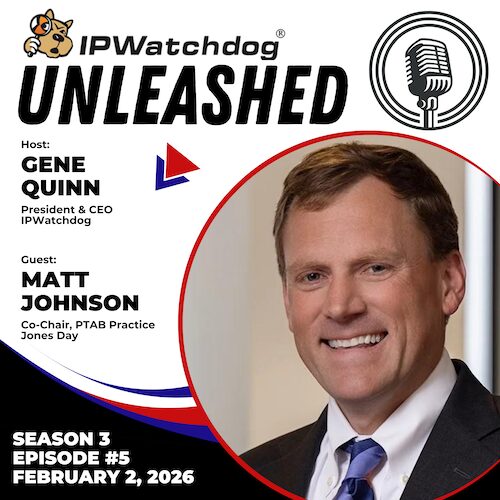

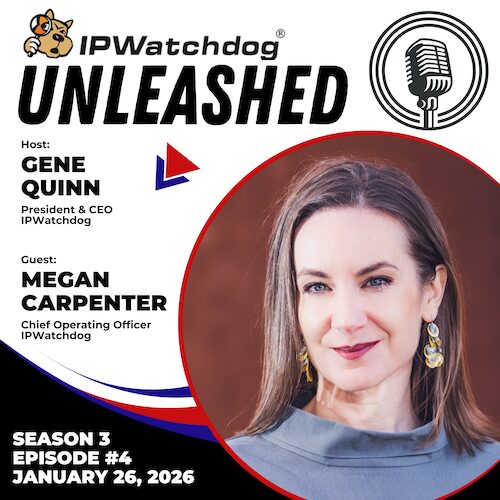
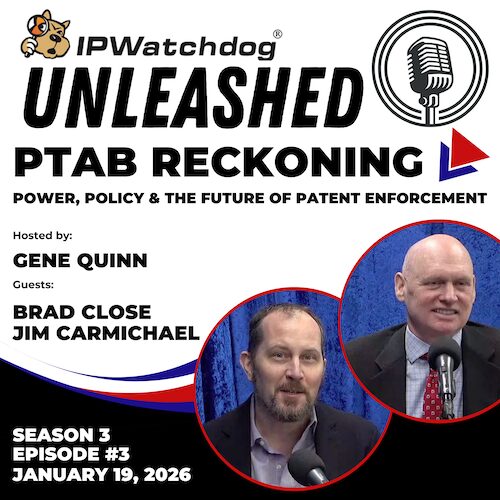


IPWatchdog Events
CLE Webinar: How to Prompt AI – A Hands-On Workshop for Patent Prep and Pros
February 10 @ 12:00 pm - 1:00 pm ESTWebinar: IP at Risk – Avoiding Costly Compliance Mistakes in Export Controls
February 12 @ 12:00 pm - 1:00 pm ESTWebinar: Optimizing the Chemistry Drafting Process – Where AI Actually Helps
February 17 @ 12:00 pm - 1:00 pm ESTWebinar: Resurrecting Antibody Genus Protection – Allowed Claims Through CDR-Scanning
March 5 @ 12:00 pm - 1:00 pm ESTIPWatchdog LIVE 2026 at the Renaissance Arlington Capital View
March 22 @ 1:00 pm - March 24 @ 7:00 pm EDT
Industry Events
From IPWatchdog
![[Advertisement]](https://ipwatchdog.com/wp-content/uploads/2021/12/WEBINAR-336-x-280-px.png)
![[Advertisement]](https://ipwatchdog.com/wp-content/uploads/2021/12/Ad-4-The-Invent-Patent-System™.png)