
![[IPWatchdog Logo]](https://ipwatchdog.com/wp-content/themes/IPWatchdog%20-%202023/assets/images/temp/logo-small@2x.png)

 0
0 “The growth of intangible assets as a component of company market value is up 35% since 1995, and almost five-fold since 1975.”
 The strength of many of today’s most valuable companies is based significantly on intangible assets, like trademarks, patents, trade secrets and brand reputation. Hard-assets or “tangibles,” like real estate and equipment, are a relative blip on many large businesses value radar.
What is surprising is the extent to which these companies are dominated by intangible assets and what that means for how they are understood and financed.
Nvidia, Apple and Broadcom are the leaders in the Information Technology industry when it comes to the value of intangible assets—those you cannot necessarily see or touch. Ninety-eight percent of their value is attributed to Intangible Asset Market Value (IAMV), mostly IP rights. For Microsoft, intangibles comprise 90% of its value. The difference can be attributed at least in part to perceived company value and standardized public company financial reporting that favors hard assets.
Compiling this data is part of a research project, “Comparing Intangible Asset Market Value of Leading S&P 500 Companies and Industries,” conducted by the Center for Intellectual Property Understanding (CIPU), the nonprofit I chair that tracks trends in IP awareness, education and rights.
“Today’s corporations are learning to embrace the value rotation from an industrial economy built on tangible assets to a knowledge economy built on intellectual property, Brian Hinman, former Chief IP Officer at Philips and a licensing executive at IBM, InterDigital and Verizon, told the Intangible Investor. “For most businesses, patents, brands, data and know-how are the primary drivers of corporate value and must be understood in the context of their industry.”
Tangible company assets are items like real estate, product inventory and equipment. Intangibles include more difficult to value but nonetheless foundational assets, like patents, trademarked brands, copyrights, trade secrets, institutional knowledge, customer lists and reputation.
Specific Companies, Key Industries
For the past 20 years, Ocean Tomo, an intellectual property merchant bank and consulting firm, now owned by J.S. Held, has tracked overall Intellectual Asset Market Value (IAMV) of the S&P 500 Index of public companies. Ocean Tomo reported that, in 1975, only 13% of market value attributable to intangible assets; in 1995 the figure had risen to 68%; in 2005 it was 2025 80% and in 2025 it had grown to 92%.
The CIPU research endeavors to drill down on the latest figures by providing the asset allocation percentages for specific companies in key industries. This enables investors, lawyers and others to compare the role that intangible assets play in market value. Intangibles are often thrown into “goodwill” because of the difficulty recording them.
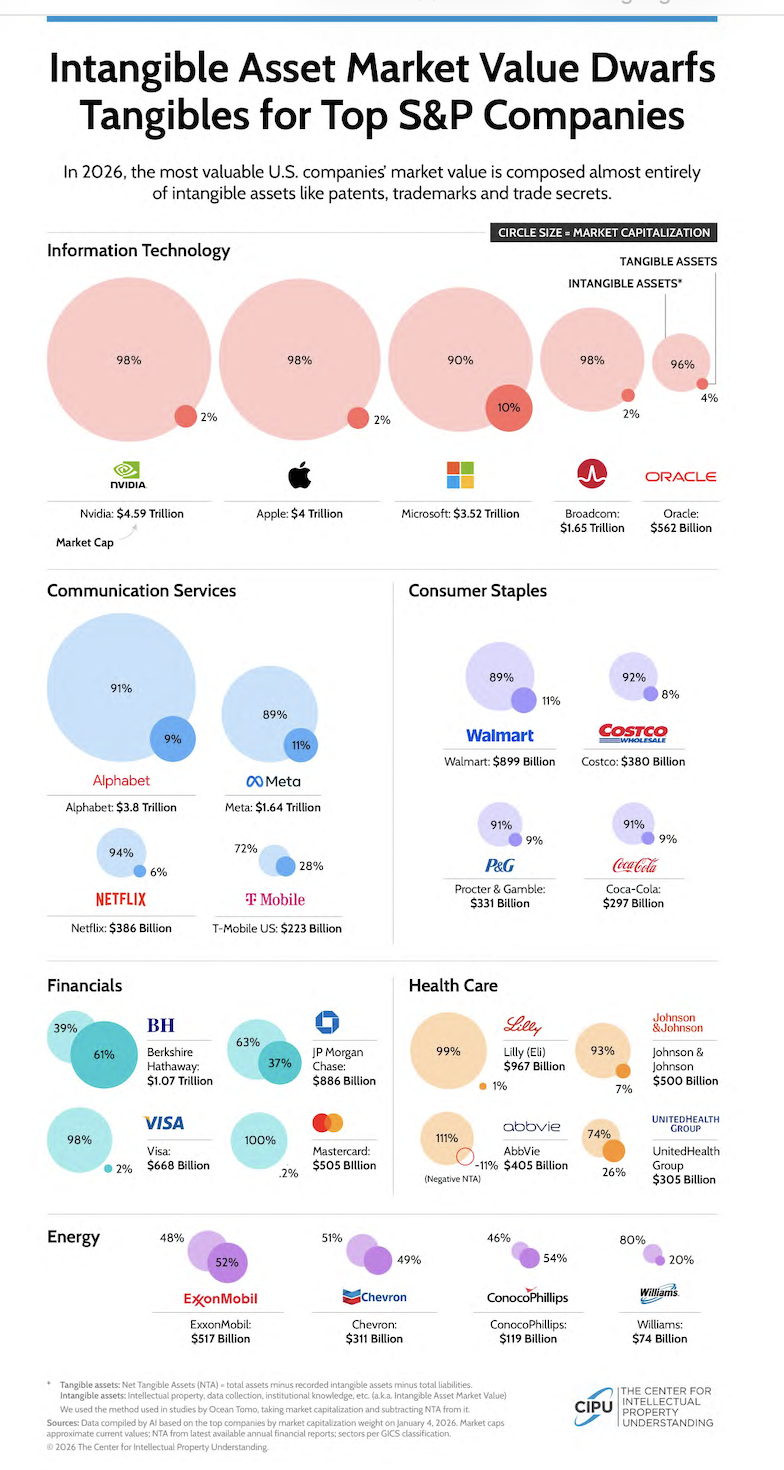
Source: CIPU
Information Technology is a leader when it comes to IAMV. But even within IT there are differences (see illustration). For example, Microsoft’s IAMV is 90% vs. 98% for Nvidia, Apple and Broadcom. Identifying which components within intangible assets are the most valuable, patents vs. brand vs. trade secrets vs. customer lists, would be a worthy but challenging task that can help discern what underlies company value today. (The current project is the first step toward what CIPU hopes will become regular coverage of the role intangible assets plan in specific company value.)
For Nvidia, for example, patents likely mean a great deal and brand considerably less; for Apple, patents are certainly important, but it is brand – or, more accurately, brands – that are the more significant driver of market value.
The growth of intangible assets as a component of company market value is up 35% since 1995, and almost five-fold since 1975. Tangible assets today account for 2% or less of the market cap of IT and other companies. Successful businesses no longer live in a world dominated by hard assets, like real estate. IP rights and reputation fuel share price.
“This CIPU intangible research project provides important data for understanding the foundation of the U.S. innovation economy and the key role of intellectual property in securing inventions and creative works that drive jobs and economic growth,” Adam Mossoff, a leading IP and innovation expert whose research has been relied on by the Supreme Court and by federal agencies, said in response to the findings.
Market Value is Often Perceived Value
It is important to remember that these value estimates are thumbnails that illustrate the increased relative importance of IAMV. They are not precise calculations and are not intended for M&A, accounting or financial purposes, but an affirmation of the increasingly small part tangible assets play today in company value. Market capitalization is effectively perceived company value as expressed in equity share price. Intangibles like IP rights and human capital are playing a greater role than many realize.
It is more essential than ever to get one’s arms around contributions to a business’ source of market value, even if it is elusive and defies GAAP accounting. Better understanding their value and the role they play in market cap and stock price is highly important and will continue to be. AI, using the right LLM or SLM, may be just the resource needed to make that happen.
The method used in the CIPU research is the same one used by Ocean Tomo in its summaries since they were first introduced in 2006: company market capitalization (market cap) minus net tangible assets (NTA) equals Intangible Asset Market Value (IAMV).
For comparison purposes, the other industries CIPU includes in its analysis are Communication Services, Consumer Staples, Financials, Healthcare and Energy (see illustration). Communications Services leaders include Alphabet, Meta and Netflix, while in Consumer Staples, Walmart, Costco, P&G and Coca-Cola all have around 90% intangible asset value, surprisingly close to Communications Services.
When we look at Financials, Health Care and Energy, the balance begins to change, no doubt because of emphasis on different types of intangible assets in different industries. At Visa and MasterCard, 98% and 100% of their market value is attributed to intangible assets. For Health Care, it’s 99% for pharmaceutical company Lilly, which relies heavily on patents, vs. 74% for United Health Care Group, primarily a service provider.
Energy Sector Balance
For the Energy sector, ExxonMobil, ConocoPhillips and Chevron were all around 50-50 between IAMV and tangible value. Despite holding many formidable IP rights, the continued high price of their oil inventories, a tangible asset like no other, likely plays a part.
Forthcoming from CIPU is a deeper dive that will help identify large and small company intangible assets to determine how much of a role components like trade secrets, brand and reputation play in market capitalization and stock price. It is likely considerably more than many investors and executives would like to believe.
![[Advertisement]](https://ipwatchdog.com/wp-content/uploads/2026/02/LexisNexis-Mar-31-2026-sidebar-700x500-1.jpg)
![[Advertisement]](https://ipwatchdog.com/wp-content/uploads/2026/03/NLPatent-Apr-2-2026-sidebar-700x500-1.jpg)
![[Advertisement]](https://ipwatchdog.com/wp-content/uploads/2026/02/Junior-Apr-7-2026-sidebar-700x500-1.jpg)








![[Advertisement]](https://ipwatchdog.com/wp-content/uploads/2021/12/WEBINAR-336-x-280-px.png)
![[Advertisement]](https://ipwatchdog.com/wp-content/uploads/2021/12/Ad-4-The-Invent-Patent-System™.png)





Join the Discussion
No comments yet. Add my comment.
Add Comment