
![[IPWatchdog Logo]](https://ipwatchdog.com/wp-content/themes/IPWatchdog%20-%202023/assets/images/temp/logo-small@2x.png)

 0
0 “If you don’t show the willingness and economic ability to litigate, it’s very hard to engage in friendly licensing deals.” – Michael Gulliford
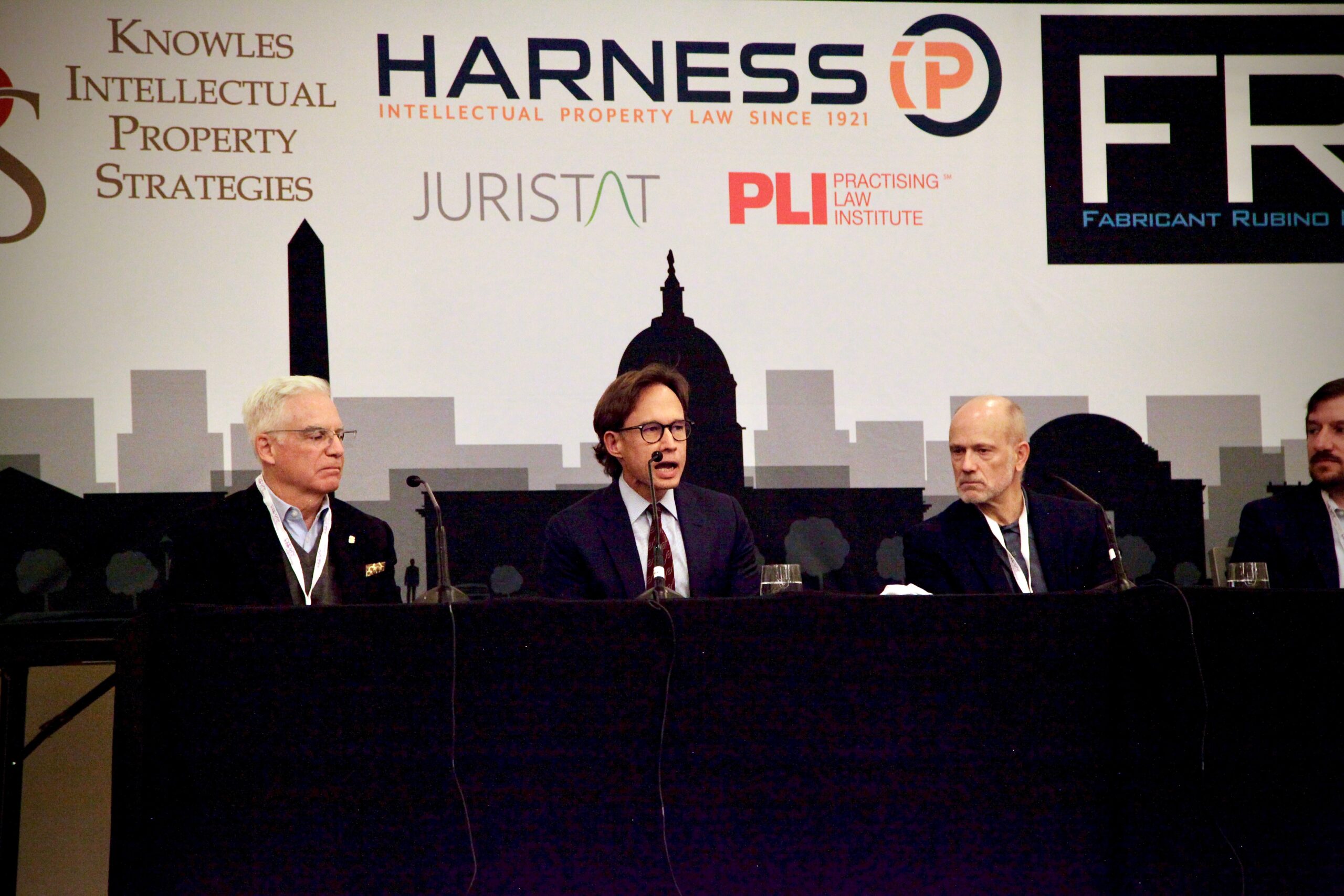
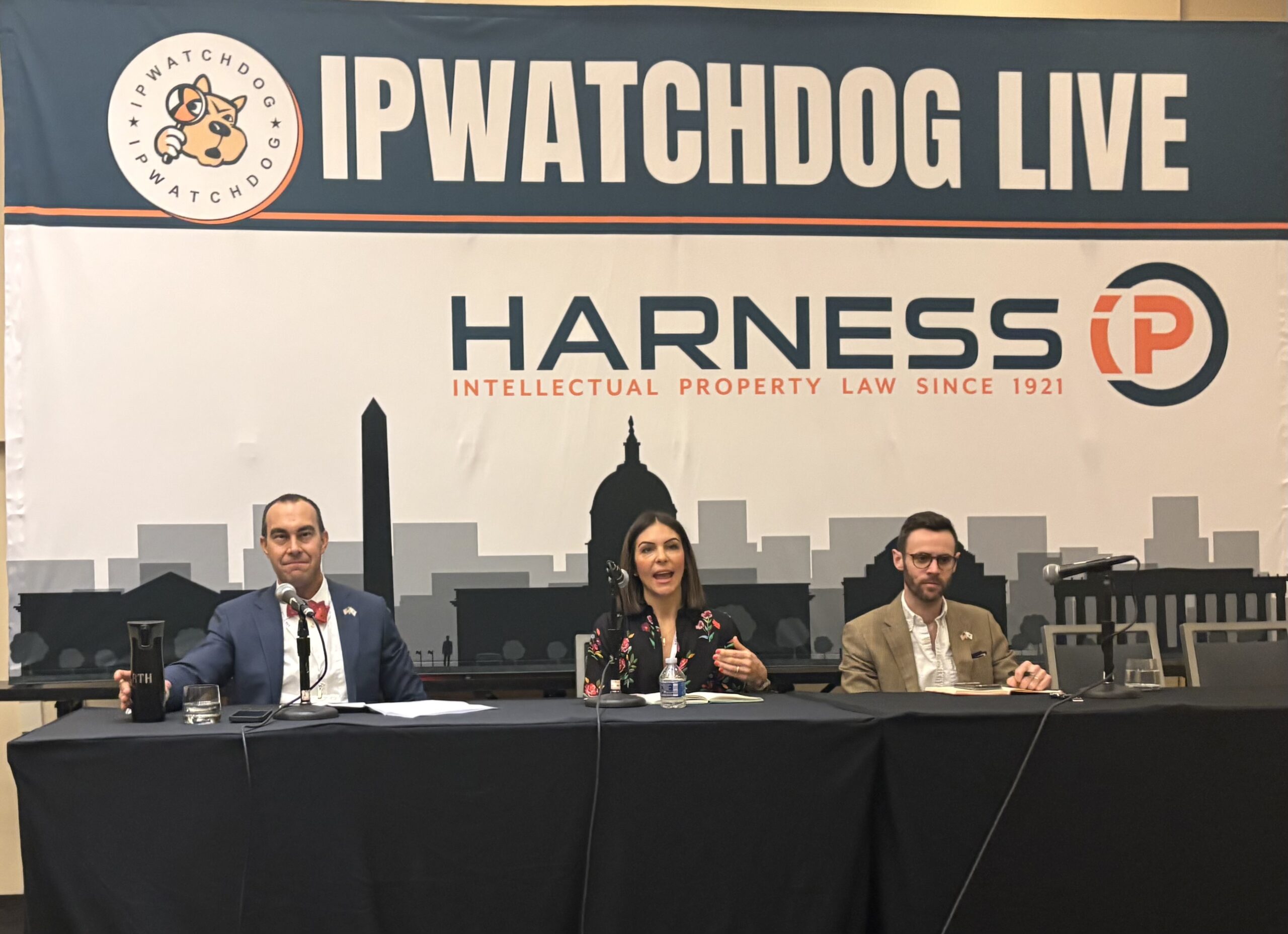
From left: Brian O’Shaughnessy, Michael Gulliford, Louis Carbonneau and Dan Kesack
A panel on day one of IPWatchdog LIVE 2026 didn’t mince words: the voluntary patent licensing ecosystem is functionally broken, and the IP community needs to understand why.
That was the diagnostic consensus from the panel titled Patent Dealmaking, Monetization & Licensing: An Examination of Capital, Risk, and Deal Flow, moderated by Brian O’Shaughnessy (Dinsmore & Shohl) and featuring Michael Gulliford (Soryn IP Capital), Louis Carbonneau (Tangible IP), and Dan Kesack (WTW Insurance). The session was a candid autopsy of market dysfunction and an examination of structural forces that have systematically disincentivized voluntary patent licensing and left patent owners without enforcement infrastructure increasingly exposed.
How Infringement Became a Calculated Business Decision
For much of the 20th century, patent licensing operated on a foundation of commercial good faith. That framework has eroded, not because market participants are acting unlawfully, but because the enforcement environment has made waiting the economically rational choice for sophisticated defendants.
The calculus is straightforward: taking a license requires an immediate cash outlay and potentially recurring payments. Infringing the same patented technology costs nothing until a patent owner demonstrates a credible willingness and financial capacity to litigate. For corporate legal teams evaluating patent infringement claims as line-item risk, delay and attrition are often the least expensive path forward.
O’Shaughnessy named this dynamic plainly, describing a posture he observes across the industry: “It will cost me money to make a licensing deal, so sue me.” The panel treated this not as advice, but as a symptom, evidence that the incentive structures governing patent monetization have drifted far from healthy market function.
The 80% Problem: How Defendants Have Learned to Wait
Gulliford offered the session’s most pointed description of current market behavior, a pattern he characterized as a symptom of broken enforcement economics, not a model to emulate.
Observing the behavior of sophisticated corporate defendants, Gulliford described a posture that has become widespread: companies facing cease-and-desist letters and licensing demands increasingly decline to engage until the asserting party demonstrates a genuine credible ability to litigate. The practical effect is that roughly 80% of infringement claims resolve through attrition, not because they lack merit, but because most patent owners lack the capital or litigation infrastructure to follow through.
“If you don’t show the willingness and economic ability to litigate, it’s very hard to engage in friendly licensing deals,” Gulliford said.
This is a market reality Gulliford identified as the central obstacle facing patent owners pursuing IP monetization, not a strategy he endorsed. The implication for practitioners advising those owners is direct: a licensing campaign that doesn’t signal enforcement credibility will be systematically ignored by defendants who have optimized their response protocols around exactly this dynamic.
Where patent owners do establish credible enforcement posture, resolution rarely resembles a negotiated licensing agreement, it looks like a settlement, typically catalyzed by the threat of an International Trade Commission (ITC) action. The ITC’s import exclusion authority remains one of the few levers that reliably changes a defendant’s calculus. “When the ITC action is ready to come,” Gulliford observed, “that’s when the deals get done.”
Structural Disincentives and the Litigation Prerequisite
The panel’s collective diagnosis was precise: voluntary patent licensing has been replaced by a litigation-prerequisite model. Taking a license acknowledges infringement and creates ongoing financial obligations. Waiting costs nothing. Until that asymmetry is addressed structurally, good-faith licensing will remain the exception.
Carbonneau identified five macro forces shaping the current patent transaction market: supply and demand for IP assets, U.S. Patent and Trademark Office regulatory changes, legal developments (particularly the Unified Patent Court’s [UPC’s] emergence as a credible injunction venue in Europe), the availability of litigation finance capital, and the all-in cost of patent enforcement across jurisdictions.
He also raised a pointed concern about litigation funding transparency proposals: mandating disclosure of IP financing arrangements could inadvertently harm the patent owners such policies claim to protect. “You paint a big target on the unfunded party’s back,” Carbonneau warned, allowing well-resourced defendants to deploy disproportionate legal force against parties who lack comparable backing.
On a more constructive note: with inter partes review (IPR) proceedings facing potential rollback, Carbonneau observed that more patent owners are expected to engage in voluntary licensing, as the Patent Trial and Appeal Board’s role as a low-cost invalidation mechanism diminishes. If that shift materializes, the economics of non-litigation licensing may partially recover.
Insurance, Valuation, and the Capital Problem
Panelists noted that approximately 25% of financed patent deals are now insured, providing alternative collateral, reducing investor exposure in settlement scenarios, and extending enforcement financing to a broader range of patent owners. Understanding how parties manage litigation finance is now as important as understanding the underlying infringement claim.
On patent valuation, Carbonneau was equally direct: “Even the best valuation report may not have any correlation with the reality of the secondary market.” Reports premised on licensing programs that will never launch generate numbers that secondary market participants discount heavily, a persistent credibility gap that affects transaction advisory, IP due diligence, and enforcement campaign planning alike.
Gulliford added a structural frustration compounding the problem: the Federal Circuit’s track record suggests a practical ceiling on damages awards regardless of jury verdicts or entity revenue. The system demands litigation as a prerequisite to licensing, and then limits the damages that make that litigation economically justifiable.
What the Panel’s Diagnosis Demands
The panel was diagnostic, not defeatist. Kesack noted that improving patent quality overseas, particularly given the UPC expanding role, has made geographically diversified patent portfolios more resilient, with enforcement optionality across jurisdictions that purely domestic portfolios cannot replicate. Where patents are filed increasingly determines whether they function as credible enforcement tools.
Gulliford’s framing of patent value is worth sitting with: “The real value for a patent is ‘can it be licensed?’ The best-valued IP is the IP that is infringed.” This is a statement about systemic failure, the most commercially significant patents are those covering technology competitors have already decided to use, counting on the owner’s inability to enforce. Closing that gap is the work of the IP community, in practice, in policy, and in the courtroom.
![[Advertisement]](https://ipwatchdog.com/wp-content/uploads/2026/02/LexisNexis-Mar-31-2026-sidebar-700x500-1.jpg)





![[Advertisement]](https://ipwatchdog.com/wp-content/uploads/2021/12/WEBINAR-336-x-280-px.png)
![[Advertisement]](https://ipwatchdog.com/wp-content/uploads/2021/12/Ad-4-The-Invent-Patent-System™.png)



Join the Discussion
No comments yet. Add my comment.
Add Comment