
![[IPWatchdog Logo]](https://ipwatchdog.com/wp-content/themes/IPWatchdog%20-%202023/assets/images/temp/logo-small@2x.png)

 0
0 “Volkswagen asks the Federal Circuit to find unconstitutional exactly the kind of deliberate, bounded, historically grounded delegation that Learning Resources – VOS said Congress may and should provide.”
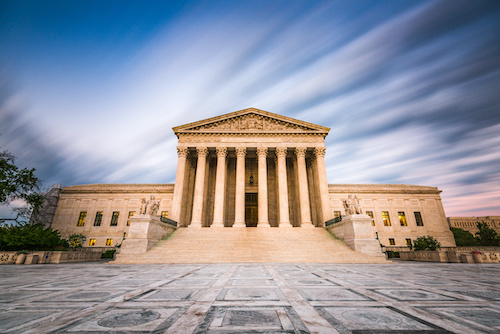 On February 20, 2026, the Supreme Court decided Learning Resources, Inc. v. Trump, 607 U.S. ___ (2026), affirming the Federal Circuit’s en banc decision in V.O.S. Selections, Inc. v. Trump, that the International Emergency Economic Powers Act (IEEPA) does not authorize the President to impose tariffs. And it means the Federal Circuit should rule in favor of Director Squires and against Volkswagen in one of the more constitutionally focused writs of mandamus challenging Squires and his use of discretion to decide institution of inter partes reviews (IPRs), In re Volkswagen Group of America, Inc., Federal Circuit No. 26-123. And there is no need for an oral argument.
What Learning Resources – VOS Means
The Learning Resources – VOS decision is three overlapping rulings with different coalitions, and the distinctions matter for Volkswagen.
The six-justice majority, authored by Chief Justice Roberts, held on statutory grounds that IEEPA’s authorization to “regulate . . . importation” does not encompass tariffs. The Court found no statute in the U.S. Code in which Congress used “regulate” to authorize taxation and noted that in IEEPA’s nearly 50-year existence no president had read it to confer tariff authority.
Parts II-A-2 and III — the major questions analysis requiring “clear congressional authorization” for powers of vast economic and political significance — were joined only by Justices Gorsuch and Barrett alongside Roberts, making those sections a three-justice plurality. This plurality builds on the full-Court decisions in West Virginia v. EPA (2022) and Biden v. Nebraska (2023).
Gorsuch’s 46-page concurrence defends the major questions doctrine as “pro-Congress, not anti-administrative state” and identifies the taxing power specifically as the “core congressional power” whose delegation demands the most rigorous scrutiny. Barrett wrote separately to frame the doctrine as “an ordinary application of textualism”: Congress is expected to make major policy decisions itself rather than delegating them through ambiguous language. Both formulations, as shown below, favor Squires.
Justice Thomas dissented separately, writing solo to argue that Congress may freely delegate powers over “external affairs” and foreign commerce — powers he placed on the delegable side of the constitutional line alongside military funding and copyrights, because they do not involve “setting the rules for the deprivation of core private rights.” Thomas also highlighted that “[t]he Constitution gives Congress the power to grant patents, Art. I, §8, cl. 8, but Congress in 1790 delegated to executive officials the power to grant patents in their discretion.”
Justice Kavanaugh’s dissent, joined by Thomas and Alito, offered the most comprehensive defense of the government’s position.
The Federal Circuit’s Role — and What the Affirmance Means
The Supreme Court affirmed the Federal Circuit’s Per Curiam en banc decision in V.O.S. Selections (Aug. 29, 2025). The VOS majority — 7 of 11 judges — held on statutory grounds that “regulate importation” does not encompass tariffs and applied the major questions doctrine. Judge Cunningham’s concurrence, joined by Judges Lourie, Reyna, and Stark, engaged the nondelegation doctrine directly, holding that IEEPA, as the government read it, provided no intelligible principle limiting the President’s claimed tariff power. Chief Judge Kimberly Moore joined Judge Taranto’s dissent, also joined by Judges Prost and Chen, which advanced every argument the Supreme Court subsequently rejected.
The Volkswagen Case
Volkswagen’s petition for writ of mandamus is the most constitutionally ambitious of a now-crowded docket of mandamus challenges to Director Squires’ IPR institution decisions. According to Bloomberg Law’s mandamus tracker by Michael Shapiro, the Federal Circuit had denied 11 such petitions outright as of February 24 and another was denied on Februray 25. Six remain pending, of which Volkswagen’s appears to be the only one emphasizing the nondelegation doctrine as its primary constitutional hook.
Volkswagen’s petition argues that Congress violated the nondelegation doctrine by granting the Director what Volkswagen calls “unfettered discretion” to deny IPR institution even when a petition otherwise meets the statutory requirements — with no intelligible principle to guide that denial.
The Federal Circuit left open a narrow exception to Section 314(d)’s unreviewability bar for “colorable constitutional claims,” which is precisely why Volkswagen has framed its petition as a genuine nondelegation argument rather than a statutory ultra vires challenge. Getting past Section 314(d) required a constitutional frame. Prevailing on the merits is a different question entirely.
Why Learning Resources – VOS Favors Squires
The constitutional framework of Learning Resources – VOS resolves Volkswagen’s nondelegation argument at four levels simultaneously.
First, the clear congressional authorization test runs in favor of the America Invents Act (AIA), not against it. IEEPA failed Roberts’s test because the delegation was vague, unprecedentedly applied, and unconstrained. The AIA’s Section 314 is the structural mirror image: Congress expressly authorized institution discretion, made the Director’s decision “final and nonappealable” in Section 314(d), surrounded it with detailed statutory conditions in Sections 311–315, and funded the system through a cost-recovery fee structure. Under Barrett’s textualist formulation — does the statute clearly communicate the delegation? — the AIA answers with the most explicit language available, including an unreviewability clause that demonstrates Congress’s deliberate choice.
Second, Gorsuch’s core-power analysis identifies the taxing power as the domain requiring heightened scrutiny, not patent administration. “Americans fought the Revolution in no small part,” Gorsuch writes, “because they believed that only their elected representatives possessed authority to tax them.” IPR institution discretion is not the taxing power. It is enforcement discretion — the paradigm of executive authority. Heckler v. Chaney (1985) established that agency decisions not to bring enforcement proceedings are presumptively unreviewable because enforcement prioritization is a core executive function under the Take Care Clause. The Director’s decision to decline an IPR petition — a determination that adjudicatory resources are better allocated elsewhere, in a system Congress expressly made unreviewable — is the paradigm of that principle.
Thomas’s dissent reinforces this from the most demanding constitutional direction available. Even within his rigorous nondelegation framework, Thomas placed copyrights — the constitutional twin of patents under Art. I, § 8, cl. 8 — on the delegable side of the line, alongside military funding and foreign commerce. If copyrights and patents are, on Thomas’s own constitutional map, among the powers Congress has always been free to delegate, then Volkswagen’s premise — that the patent power is a “core legislative power” analogous to the taxing power — is undermined by the most nondelegation-skeptical justice on the current Court. Thomas separately highlighted that Congress since 1790 delegated to executive officials the power to grant patents “in their discretion.”
Third, Gorsuch’s historical-novelty analysis runs entirely against Volkswagen. Roberts’s majority relied heavily on the “telling” fact that no president had invoked IEEPA for tariffs in 50 years. Applied here, the principle runs the opposite way with equal force. IPR institution discretion has been exercised continuously since 2011 by multiple Directors under administrations of both parties, in thousands of decisions. The Supreme Court affirmed its broad and unreviewable character in Cuozzo Speed Technologies v. Lee (2016) and Thryv, Inc. v. Click-to-Call Technologies (2020). The Federal Circuit has now denied 11 mandamus challenges to institution decisions. This is historically settled executive practice. The novelty test that doomed IEEPA powerfully supports Squires.
Fourth, the AIA’s fee architecture provides the intelligible principle Volkswagen claims is missing. AIA Section 10, as extended by the SUCCESS Act of 2018, constrains the Director’s fee-setting authority to recover only “the aggregate estimated cost to the Office for processing, activities, services, and materials related to patents.” This cost-recovery mandate is the intelligible principle governing the system as a whole. The legislative record confirms it is constitutionally deliberate: on June 6, 2011, Appropriations Committee Chairman Harold Rogers and Budget Committee Chairman Paul Ryan wrote jointly to Judiciary Chairman Lamar Smith opposing the provision of H.R. 1249 that would have permitted U.S. Patent and Trademark Office (USPTO) fee collection and spending without congressional action. Their letter stated directly that “Oversight of the PTO belongs with the Congress, and should not be abdicated to the Executive Branch.” That provision was modified in response. Congress, when it enacted the AIA, explicitly preserved its constitutional oversight authority over USPTO fee power. Under Learning Resources – VOS, that is precisely the kind of documented, constitutionally self-aware legislative record that manifests delegation.
Volkswagen Asks the Wrong Constitutional Question
There is a structural problem with Volkswagen’s petition that Learning Resources – VOS illuminates directly. The tariff case was about executive power exceeding congressional authorization — the executive claiming more than Congress gave, with no clear statutory text conferring the claimed power. The remedy was to confine the executive to what Congress actually authorized. Volkswagen asks the opposite: whether Congress gave too much, and whether the delegation itself is unconstitutional regardless of how clearly Congress expressed it.
Moore publicly and forcefully defended executive authority to exercise congressionally delegated power in VOS. The Supreme Court affirmed the constitutional value of clear congressional authorization. Volkswagen now asks Moore and her colleagues to find that even clearly authorized, explicitly bounded, continuously exercised executive power is unconstitutional for want of a sufficiently crisp intelligible principle. That is a harder argument to make to a court that just watched the Supreme Court rule — on the authority that Moore publicly endorsed — that explicit congressional grants of executive power are constitutionally significant and must be respected.
A Constitutional-Avoidance Consideration the Court Should Not Ignore
The September 15–16, 2026, expiration of the Director’s fee-setting authority under AIA Section 10(i)(2) adds a constitutional-avoidance dimension. The AIA’s IPR system was designed as a self-funding architecture: the Director sets fees to cover costs and manages workload through institution discretion.
Stripping the Director of that discretion — compelling institution of petitions he has declined — would restructure that architecture at precisely the moment Congress must decide whether to extend, modify, or allow to expire the fiscal foundation that makes the system function.
The constitutional-avoidance canon, rooted in Ashwander v. TVA (1936) and endorsed by Gorsuch in Learning Resources – VOS, counsels against interpretations that create operational incoherence in a domain where Congress has expressly reserved the power to act. Congress, not the Federal Circuit, is the appropriate actor to restructure the institution discretion framework if restructuring is warranted.
And for the Loper Bright – Relentless fans of ending Chevron deference to agencies by courts, here is an important win on that, too, for Squires: the Federal Circuit must independently assess whether Congress authorized the Director’s use of discretion. On the papers themselves it is patently obvious that given the AIA’s explicit and unreviewable language, Squires wins.
Volkswagen Can Be Resolved on the Papers
Volkswagen covers a domain — patent administration — that Congress has delegated to the executive branch since 1790, unlike the taxing power that Americans fought a revolution to keep in legislative hands. It carries a sunset requiring Congress to act. And it rests on a documented legislative record showing that Congress deliberately preserved its oversight authority rather than surrendering it.
Volkswagen asks the Federal Circuit to find unconstitutional exactly the kind of deliberate, bounded, historically grounded delegation that Learning Resources – VOS said Congress may and should provide.
The Federal Circuit should resolve Volkswagen on the papers, without oral argument, in a short, written opinion that explains why, rather than a silent Rule 36 affirmance. On February 13, 2026, in a unanimous precedential opinion in Apple v. Squires (24-1864) by Judge Taranto (joined by Lourie and Chen), the Federal Circuit confirmed that the Director’s discretion over IPR is effectively absolute, absent a Constitutional infirmity. So, just one week before the Supreme Court ruled in Learning Resources – VOS, the Federal Circuit makes clear that the AIA’s architecture per Congress is clear. All the more reason why there is no need for oral argument in Volkswagen.
Since the Federal Circuit asked Squires during the Apple v. Squires case about the status of the USPTO’s “One Challenge NPRM” (90 Fed. Reg. 48335, docket number PTO-P-2025-0025), perhaps the court may wish to delay proceedings until after this much-anticipated rulemaking is finalized and published.
If the court prefers to invite supplemental submissions, counsel for Director Squires should file a Rule 28(j) letter directing the court’s attention to Learning Resources – VOS — the standard vehicle for post-briefing authority and the most precise way to place this decision before the panel before oral argument.
The Volkswagen case raises a genuine constitutional question. After Learning Resources – VOS, the answer is clear enough to state in a few pages. The Supreme Court has already done the analytical work. The Federal Circuit need only apply it.
Director Squires deserves that opinion. So does the patent system.
![[Advertisement]](https://ipwatchdog.com/wp-content/uploads/2026/02/Juristat-Feb-26-2025-sidebar-700x500-1.jpg)
![[Advertisement]](https://ipwatchdog.com/wp-content/uploads/2026/02/Integral-Molecular-Mar-5-2026-sidebar-700x500-1.jpg)
![[Advertisement]](https://ipwatchdog.com/wp-content/uploads/2026/02/LIVE-2026-sidebar-regular-price-new-700x500-1.jpg)




![[Advertisement]](https://ipwatchdog.com/wp-content/uploads/2021/12/WEBINAR-336-x-280-px.png)
![[Advertisement]](https://ipwatchdog.com/wp-content/uploads/2021/12/Ad-4-The-Invent-Patent-System™.png)



Join the Discussion
No comments yet. Add my comment.
Add Comment