
![[IPWatchdog Logo]](https://ipwatchdog.com/wp-content/themes/IPWatchdog%20-%202023/assets/images/temp/logo-small@2x.png)

 0
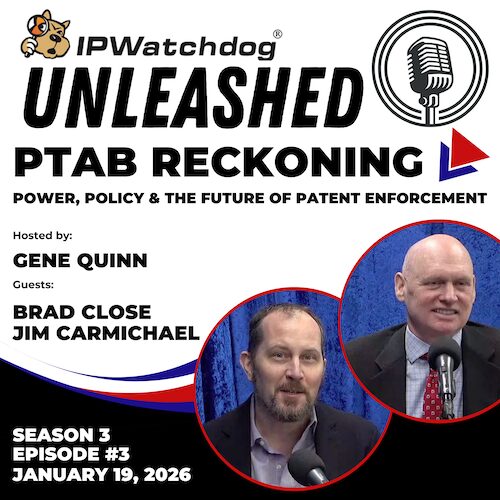
0 In the latest episode of IPWatchdog Unleashed, I sat down with my good friends Brad Close, who is the Executive Vice President of Transpacific IP, and Jim Carmichael, a former judge on the Board of Patent Appeals and Interferences and founder of Carmichael IP. Brad, Jim and I engaged in a candid conversation that provides our unvarnished assessment of the Patent Trial and Appeal Board (PTAB), where it started historically, where it is today, and where it may finally be headed.
Recent policy shifts have materially reduced institution rates, most notably with a significant drop in institution rates for patents owned by non-practicing entities. This signals a recalibration toward due process and quiet title for patents, which the United States Patent and Trademark Office (USPTO) is accomplishing through the “settled expectations” factor applied when deciding whether the Director’s discretionary denial authority should be exercised. While petitioners are increasingly shifting challenges to ex parte reexamination, the overall landscape at the USPTO is no longer structurally stacked against patent owners.
During our conversation we all agree, however, that meaningful patent reform remains incomplete. While the USPTO is doing as much as anyone on the patent owner side of PTAB disputes could reasonably want, the law has not changed, and the Federal Circuit has not changed. Indeed, the Federal Circuit continues to suppress damages, discourage enforcement, and reward delay, which means litigation incentives still favor efficient infringement. Without structural changes—potentially including specialized patent adjudication—the system will remain misaligned with the Constitution’s mandate to promote innovation.
Bottom line: the PTAB is no longer the automatic execution squad it once was, but durable patent rights will require reform well beyond the agency level.
The Original PTAB Design Flaw
From the outset, the PTAB suffered from a structural conflict. Administrative patent judges were hired to invalidate “bad patents, incentivized—implicitly if not explicitly—to find problems rather than neutrally adjudicate disputes. As Close put it, if you hire people to find witches, they will find witches. That incentive structure predictably produced sky-high institution rates and invalidation outcomes that defied economic logic and common sense. If the patent examiners are 96% to 98% accurate in any given year, how could it be possible that the patents worth fighting over were falling at such high rates?
For years, patents that survived rigorous prosecution, significant investment, and real-world commercialization were being wiped out at rates approaching 80% once they reached a final written decision. These were not low-value nuisance patents. They were the most economically significant patents in the system—because only valuable patents justify the $400,000+ cost of PTAB defense in the first place.
The Myth of the “Patent Troll” Problem
 A recurring theme throughout the discussion was the intellectual dishonesty surrounding the so-called “patent troll” narrative. The PTAB was created in large part to address the patent troll problem, but then no one ever defined the term “patent troll”. How can you possibly accomplish the goal of eradicating patent trolls if you don’t define the actors or actions that you are trying to solve?
As I tried to emphasize, low-quality patents rarely—if ever—reach the PTAB. The economics do not support it. Filing fees alone approach $50,000, and total costs routinely exceed $500,000 per patent, and if a pharmaceutical patent is involved the costs skyrocket to a multiple of that number. Neither side would be willing to incur the PTAB expense over frivolous claims or minor settlement demands, which is precisely why the PTAB never did anything to stop the true patent troll extortion artists who were and still are willing to settle often specious claims for less than the cost of an inter partes review (IPR) filing fee.
More importantly, non-practicing entities (NPEs)—often demonized in policy debates—frequently assert higher-quality patents. These assets typically originate from operating companies or research institutions, are vetted by multiple layers of counsel, and are often scrutinized by sophisticated litigation funders who do not invest millions of dollars on speculation or sympathy.
A Real Shift at the PTAB—With Caveats
Recent data show a meaningful decline in institution rates, particularly for NPE-filed petitions, reflecting a long-overdue recalibration. Discretionary denials, settled-expectations analysis, and a more skeptical view of serial challenges are beginning to rebalance the system.
But the panel was clear-eyed about the limits of this progress. Petitioners denied at the PTAB are increasingly shifting to ex parte reexaminations, where institution rates remain extraordinarily high. The result is not cost savings for patent owners—just procedural whack-a-mole. The battlefield has moved, not disappeared. And what impact this shift will have on patent litigation remains unclear at this time.
Still, the directional change matters. Carmichael noted that the improved outlook for patent owners has been significant enough to justify expanding his firm’s contingency litigation practice—something that would have been irrational under the prior PTAB regime as recently as one year ago.
The Federal Circuit Remains the Problem
If the PTAB is showing signs of institutional self-correction, the Federal Circuit is not. The panel did not mince words: the court remains openly hostile to meaningful patent enforcement, particularly where damages approach numbers that reflect modern market realities.
Large damage awards are treated as presumptively suspect, regardless of the underlying math. Treble damages exist on paper but are functionally neutered. Attorney fee shifting remains the exception, not the rule. The result is a system that rewards efficient infringement and punishes enforcement, which necessarily means it harms innovation by making it economically infeasible to invest in paradigm shifting innovation.
As I observed, the law has evolved to push disputes out of the boardroom and into endless litigation, where delay itself becomes a winning strategy for accused infringers. What the system needs is to push disputes to early resolution between the parties on terms both can accept. But that seems like a pipedream with the current Federal Circuit.
Structural Reform Is No Longer Optional
The conversation closed with a frank discussion about structural reform. Ideas ranged from voluntary patent-judge panels within district courts to a specialized patent court modeled after the Court of Federal Claims, with judges who actually want—and are qualified—to handle patent cases nationwide.
The underlying point was simple: complexity demands expertise. Patent cases are not generic civil disputes, and pretending otherwise has degraded outcomes across the system.
Bottom Line
The PTAB is no longer the one-way ratchet it once was, and that matters. But meaningful, durable reform requires more than agency policy shifts. Without changes at the Federal Circuit and a serious rethink of how patent disputes are adjudicated at the trial level, patent owners will remain structurally disadvantaged.
For the first time in years, however, the pendulum is swinging in the right direction from the perspective of patent owners. The question now is whether the system has the discipline to stay that course.
More IPWatchdog Unleashed
You can listen to the entire podcast episode by downloading it wherever you normally access podcasts or by visiting IPWatchdog Unleashed on Buzzsprout. You can also listen to IPWatchdog Unleashed conversations on the IPWatchdog YouTube channel. For more IPWatchdog Unleashed, see below for our growing archive of previous episodes.
![[Advertisement]](https://ipwatchdog.com/wp-content/uploads/2026/01/IP-Author-Jan-22-2026-sidebar-700x500-1.jpg)
![[Advertisement]](https://ipwatchdog.com/wp-content/uploads/2025/12/ClearstoneIP-Jan-27-2026-sidebar-700x500-1.jpg)
![[Advertisement]](https://ipwatchdog.com/wp-content/uploads/2025/11/PTAB-Masters-2026-sidebar-regular-price-700x500-1.jpg)
![[Advertisement]](https://ipwatchdog.com/wp-content/uploads/2025/12/LIVE-2026-sidebar-early-bird-new-700x500-1.jpg)



![[Advertisement]](https://ipwatchdog.com/wp-content/uploads/2021/12/WEBINAR-336-x-280-px.png)
![[Advertisement]](https://ipwatchdog.com/wp-content/uploads/2021/12/Ad-4-The-Invent-Patent-System™.png)


Join the Discussion
No comments yet. Add my comment.
Add Comment