
![[IPWatchdog Logo]](https://ipwatchdog.com/wp-content/themes/IPWatchdog%20-%202023/assets/images/temp/logo-small@2x.png)

 0
0 Bites (noun): more meaty news to sink your teeth into.
Barks (noun): peripheral noise worth your attention.
Want to have your doggie(s) featured in one of our future Barks & Bites Columns? Send your dogs photo(s) along with their name, breed (if you know it) and their age to [email protected]. All photos will be added to the IPWatchdog Dog Wall at IPWatchdog Studios and will be added to the queue of images we select from each week.

Emily Johnson’s 18-month-old Golden Retriever, Maisie.
This week in Other Barks & Bites: the Sixth Circuit affirms a dismissal of a declaratory judgment suit after finding no federal question of law raised by the suit’s copyright allegations; the EU’s highest court says that EU member states can pass rules implementing a private copying levy against manufacturers of computer hard drive storage; the governments of the United States and Taiwan announce a relaxation of some reciprocal tariffs in response for a $250 billion investment in American chip capacity; creators and copyright owners in South Korea raise concerns over the opt-out framework proposed by South Korean lawmakers in that nation’s AI Action Plan; the Fifth Circuit finds no territoriality issue with the global grant of copyright declared for the 1966 single “Double Shot (Of My Baby’s Love)”; and the USPTO announces a program to offer accelerated examination certificates to companies engaging in technological standards development.
Bites
CJEU Says National Rules Charging Private Copying Levy Do Not Violate Copyright Directive – On Thursday, January 15, the Court of Justice for the European Union (CJEU) issued a ruling on a question referred by German national courts seeking to understand if a national rule imposing a private copying levy on manufacturers of computer devices with built-in hard drives that could be used to reproduce copyrighted work was valid under the EU’s Copyright Directive. The CJEU found that such systems of rightsholder compensation can be established by EU member states under the Copyright Directive so long as the system for fair compensation is linked to the harm resulting to rightsholders from unauthorized copying, due in large part to the practical difficulties in identifying private users reproducing copyrighted content on hard drives and obliging them to compensate rightsholders for that harm.
Eleventh Circuit Affirms No Actual Damages or Confusion in Florida Online School Trademark Case – On Thursday, January 15, the U.S. Court of Appeals for the Eleventh Circuit issued an unpublished opinion in Florida Virtual School v. K12, Inc. affirming summary judgment and bench trial rulings entered by the Middle District of Florida extinguishing trademark infringement claims filed by Florida Virtual School over K12’s operation of a “Florida Online School” Internet learning program. The Eleventh Circuit agreed that Florida Virtual School offered no evidence of student enrollment diversion from its program to K12’s Florida Online School to show actual damages, that a checklist used by K12 to distinguish its program was neither false nor misleading, and that there was no likelihood of consumer confusion due to the weakness of Florida Virtual School’s trademarks and because evidence of actual confusion between the services offered instead tended to show that consumers thought there was only one online schooling option, not confusion between two options.
South Korean Creators Slam “Use First, Pay Later” Framework of Korea AI Action Plan – On Wednesday, January 14, The Korea Herald reported on a joint statement issued by South Korean creator and copyright groups voicing their displeasure with the Korea AI Action Plan recently released by the country’s Presidential Council on National Artificial Intelligence Strategy, blasting the policy document as following a “use first, pay later” policy direction that undermines the long-term sustainability of Korea’s creative industries. The creator and copyright groups, targeting language recommending amendments to South Korea’s AI law to allow the use of copyrighted works for training purposes, argue that the action plan stretches fair use too far and would leave most creators without the ability to protect their rights through the plan’s opt-out framework.
Sixth Circuit Says No Article III Standing for Copyright Declaration on Kentucky School Health Survey – On Wednesday, January 14, the U.S. Court of Appeals for the Sixth Circuit issued an opinion in Stovall v. Jefferson County Board of Education affirming the Western District of Kentucky’s dismissal of a lawsuit seeking a declaration that a mental health survey administered to students did not meet an exception to the Kentucky Open Records Act because it was copyright protected. The Sixth Circuit agreed that there was no federal question jurisdiction because Stovall’s claim arose from the Kentucky state law and not the Copyright Act, and because any potential claim for copyright infringement would be filed by NCS Pearson against the county’s board of education, not Stovall.
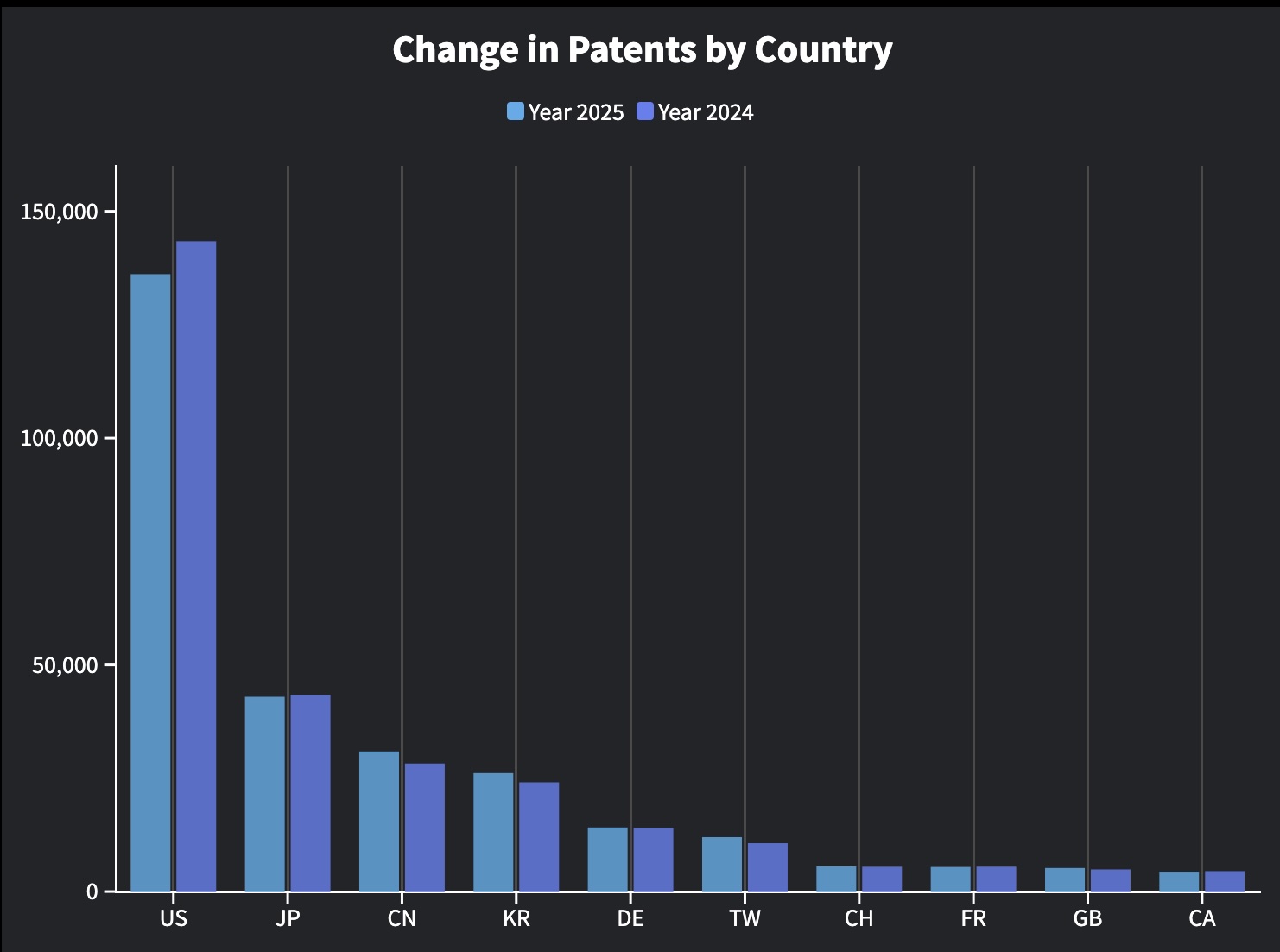
IFI CLAIMS 2025 Trends Show Lowest Level of Patent Application Filings Since 2019 – On Tuesday, January 13, patent data analytics firm IFI CLAIMS issued its 2025 U.S. Trends & Insights report showing that while U.S. patent grants last year stayed stable, only dropping by 1% over 2024’s totals, total U.S. patent applications dropped by 9% down to 393,344 filings in 2025, the lowest level of patent application filings since 2019 and off from last year’s record of more than 430,000 patent application filings in 2024. South Korean tech conglomerate Samsung Electronics remained in the top spot among U.S. patent applicants for the fourth straight year while IFI CLAIMS’ assessment of the top 10 fastest growing technology areas shows that half of the patent areas included in this year’s top 10 are related to battery technologies.
Fifth Circuit Finds No Territoriality Issue With Global Grant of “Double Shot” Copyright – On Monday, January 12, the U.S. Court of Appeals for the Fifth Circuit issued an opinion in Vetter v. Resnick affirming the Middle District of Louisiana’s grant of summary judgment declaring that Cyril Vetter, co-author of the 1966 Swingin’ Medallions single “Double Shot (Of My Baby’s Love),” and Vetter’s affiliated companies are the sole owners of the copyright to “Double Shot” throughout the world. The Fifth Circuit found no error with the district court’s declaration based on Vetter’s own recaptured interest in the song, as the termination rights exercised by Vetter arose under U.S. law and does not violate the Berne Convention or other international treaties, and found that Vetter’s acquisition of renewal rights from the heirs of “Double Shot” co-author Donald Smith entitled Vetter to a renewal copyright including all rights originally granted by Smith without any limit to the geographical scope of those renewal rights.
Barks
Cengage, Hachette File Class Action Complaint Against Google’s Gemini – On Thursday, January 15, American book publishers Cengage Learning and Hachette Book Group filed a class action complaint in the Northern District of California alleging copyright infringement claims against Google, the latest complaint faced by the Internet services giant over the training of its Gemini generative artificial intelligence platform on copyrighted works.
Canadian Solar Invalidates Maxeon TOPCon Solar Panel Patents at PTAB – On Thursday, January 15, renewable energy company Canadian Solar announced that the Patent Trial and Appeal Board (PTAB) had entered final written decisions invalidating all claims of Maxeon Solar patents directed to tunnel oxide passivated contact solar photovoltaic module (TOPCon) technology, which were asserted by Maxeon in patent infringement allegations filed in U.S. district court against Canadian Solar.
Summons Issued in X’s Antitrust Campaign Against Music Takedown Requests – On Thursday, January 15, the District of Northern Texas issued summons to a couple dozen music publishing companies, including several members of the National Music Publishers Association, who were named as defendants by social media giant X in a lawsuit alleging violations of U.S. antitrust law stemming from the allegedly abusive nature of copyright takedown requests designed to extract supracompetitive licensing rates.
EUIPO Announces Record Number of Trademark Filings During 2025 – On Wednesday, January 14, the European Union Intellectual Property Office (EUIPO) announced that the agency received a total of 327,735 new applications for EU trademarks in 2025, the largest single-year total for trademark applications since the EUIPO started receiving such filings in 1996.
USPTO’s SPARK Pilot Program to Offer Acceleration Certificates to Standards Developers – On Tuesday, January 13, the U.S. Patent and Trademark Office announced that that it would be establishing a Standards Participation and Representation Kudos (SPARK) pilot program to incentivize American participation in standards development by offering a limited number of certificates to accelerate patent examination or appeals to the Patent Trial and Appeal Board (PTAB) to companies making technical contributions to standards or otherwise participating with standards development organizations.
USC Loses Motion to Dismiss SDNY Copyright Suit Over Social Media Ads – On Tuesday, January 13, U.S. District Judge Gregory Woods of the Southern District of New York granted the University of Southern California’s motion to dismiss vicarious and contributory copyright infringement claims filed by Sony against the University of Southern California (USC), but denied USC’s motion to dismiss the case for lack of personal jurisdiction and improper venue in a lawsuit filed over USC’s use of copyrighted music in social media ads.
This Week on Wall Street
U.S.-Taiwan Trade Agreement to Lead to $250B Investment in U.S. Semiconductor Capacity – On Thursday, January 15, the U.S. Department of Commerce announced that the governments of the United States and Taiwan had reached a trade agreement under which Taiwanese semiconductor companies will invest a total of $250 billion into American computer chip production in exchange for the United States lowering reciprocal tariffs with Taiwan down to 15% from 20% and dropping certain tariffs on generic pharmaceuticals and aircraft components down to 0%.
Quarterly Earnings – The following firms identified among the IPO’s Top 300 Patent Recipients for 2024 are announcing quarterly earnings next week (2023 rank in parentheses):
- Monday: None
- Tuesday: 3M Co. (117th)
- Wednesday: Halliburton Co. (63rd); Hyundai Motor Co. (17th); Johnson & Johnson (21st); LG Electronics (2nd); Nidec Corp. (171st); TE Connectivity Ltd. (t-185th)
- Thursday: Abbott Laboratories (119th); Intel Corp. (13th)
- Friday: Samsung Electro-Mechanics Co., Ltd. (111th); Telefonaktiebolaget LM Ericsson (22nd)
![[Advertisement]](https://ipwatchdog.com/wp-content/uploads/2026/01/IP-Author-Jan-22-2026-sidebar-700x500-1.jpg)
![[Advertisement]](https://ipwatchdog.com/wp-content/uploads/2025/12/ClearstoneIP-Jan-27-2026-sidebar-700x500-1.jpg)
![[Advertisement]](https://ipwatchdog.com/wp-content/uploads/2025/11/PTAB-Masters-2026-sidebar-regular-price-700x500-1.jpg)
![[Advertisement]](https://ipwatchdog.com/wp-content/uploads/2025/12/LIVE-2026-sidebar-early-bird-new-700x500-1.jpg)







![[Advertisement]](https://ipwatchdog.com/wp-content/uploads/2021/12/WEBINAR-336-x-280-px.png)
![[Advertisement]](https://ipwatchdog.com/wp-content/uploads/2021/12/Ad-4-The-Invent-Patent-System™.png)


Join the Discussion
No comments yet. Add my comment.
Add Comment