
![[IPWatchdog Logo]](https://ipwatchdog.com/wp-content/themes/IPWatchdog%20-%202023/assets/images/temp/logo-small@2x.png)
 9
9 There’s a lot going on at the Patent Trial and Appeal Board (PTAB) right now, and it’s not just the usual noise about discretionary denial. The United States Patent and Trademark Office (USPTO) has published a one-and-done rules package that, if it survives, would fundamentally change how inter partes review (IPR) challenge works, who can challenge patents, and when.
The comment window on the proposed one-and-done rule has now closed. With more than 10,000 comments received by the USPTO and over 700 individual commenters weighing in, the proposed rules package has become a flashpoint for questions that go way beyond discretionary denial and AIA trials, with many asking whether the USPTO is functionally trying to engage in de facto legislation to neuter the PTAB.
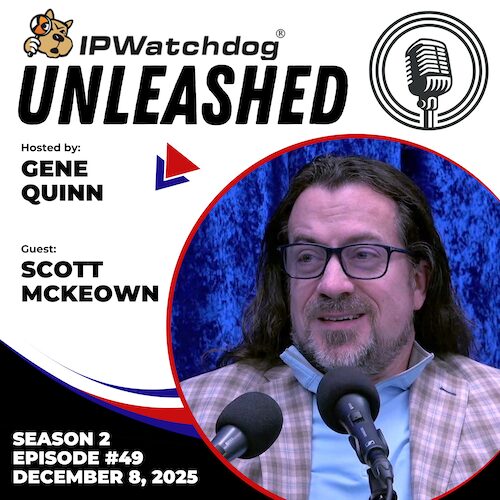
This week for IPWatchdog Unleashed,, I sat down with PTAB veteran Scott McKeown to cut through the spin and talk bluntly about what’s really at stake. We drill down on what USPTO Director John Squires is actually trying to accomplish, why the Office is describing what are aggressive policy changes using “fairness” rhetoric, why some view this proposed rules package as an effort to neuter the PTAB, and why some former Members of Congress who authored the AIA are now publicly objecting to this rules package, saying it goes too far and well beyond what Congress intended when the AIA was enacted. We also address the real-world impact on small and mid-size companies, the growing risk that the PREVAIL Act and PERA will now be dead on arrival, and what this latest PTAB fight tells us about a broken Congress, an overactive administrative state, and a patent system that simply can’t deliver quiet title.
What the Office Says vs. What the Rule Actually Does
If Director Squires were sitting at the table describing the one-and-done rules package, his pitch would be simple and appealing. If a patent has been upheld in district court or in a USPTO reexamination, that should be it. The next defendant down the line should not get another chance to challenge the same patent at the PTAB. One and done and is just basic fairness, prevents patent owners from fighting never ending challenges, but gives the government the opportunity to engage in a single review to make sure the patent was properly granted.
At a 10,000-foot level, what Director Squires wants to do resonates. Most people instinctively recoil from endless, serial attacks on the same patent. And whether we want to admit it or not the USPTO and PTAB have finite resources and repeatedly reviewing the same patent over and over again—even when subsequent challenges are from different entities—just feels like a waste of public resources. But as Scott points out, that framing is oversimplified.
In practice, the one-and-done rule is not about preventing abusive copy-cat challenges inside a single litigation. This is about something much bigger. First, it converts one win in litigation or reexamination into permanent, system-wide protection—effectively “gold-plating” the patent for all future defendants. Second, it tries to resurrect and lock in estoppel concepts that Congress deliberately removed when it replaced inter partes reexamination with IPR. Third, it achieves its goal by agency rule, while claiming to implement congressional intent in the face of statutory language and legislative history that say exactly the opposite. In short, Scott argues, the USPTO is trying to rewrite a failed estoppel regime by regulation.
Discretion, Non-Appealability, and the Administrative State Problem
 You cannot talk about this rule package without talking about discretion and non-appealable institution decisions. I point out during our conversation that Congress hard-wired a major flaw into the AIA: institution decisions are final and non-appealable. If you tell an agency its decisions on a critical gate-keeping function can never be reviewed, you are effectively telling them they can do whatever they want.
The Federal Circuit has chipped away slightly at the edges—allowing review of constitutional issues—while repeatedly saying it will not second-guess the decision to institute or deny on the merits. That has created a void that has been filled with where Director-level policy and discretion, which the U.S. Supreme Court has acknowledged the Director possesses under the AIA. Unfortunately, this has led to a ping-pong approach, with Director’s governing by memo and each new Director putting their own views into action. That is no doubt why Director Squires has moved early to put his views into the rules, which would be harder for the next Director to undo.
None of this is happening in a vacuum. It’s happening because Congress is fundamentally dysfunctional. As Scott explained, Congress can barely keep the doors open, much less tackle complex structural problems in the patent system. As a result, the administrative state steps in. When the votes aren’t there, policy is made through executive orders, memos, and now aggressive rulemaking. This is not unique to the USPTO; we’ve seen it with other agencies, and in both Republican and Democrat administrations.
Still, the political reality may prove to be brutal. If the USPTO guts the PTAB and IPR through rulemaking, the PREVAIL Act may—and probably will—be viewed as moot. In other words: the more aggressively the USPTO “fixes” the PTAB by rule, the less oxygen there is for real legislative reform that would be virtually impossible to undo.
The System Needs a Reset, Not a Quiet Administrative Coup
Philosophically, I’ve always liked the idea of a true one-and-done IPR regime. You cannot have a meaningful property right if your patent can be attacked from scratch, by new parties, over and over for the full 20-year term. That is not quiet title; it’s nothing more than perpetual probation. But what we really need is a full, honest reset of how error-correction works at the USPTO—starting from first principles, not from the accumulated debris of more than a decade of ping-pong, whiplash policy.
A serious discussion of notice, quiet title, and timing, including whether “come one, come all” bankruptcy-style notice and challenge mechanisms make sense for certain classes of patents. And the system needs some hard guardrails around what agencies can and cannot do when Congress is too paralyzed or too distracted to legislate. Unfortunately, Congress is broken. And while all of the issues and problems could be addressed there is very little chance that Congress would start fresh leveraging the lessons learned since AIA trials became real in 2012. That means we are left with attempting to tweak here, tweak there, and for every change no matter how small there will be at least three different constituencies: those that believe it doesn’t go far enough, those who think it goes too far, and those who think it is just right. Sadly, it is easy to predict that those who think any proposed tweak is just right will be the smallest subset.
Scott believes we’re getting rushed by the calendar and political reality that if rules aren’t pursued quickly no Director would have time to see a rules package through to completion. He thinks this rules package is overreaching and tries to back-door what should be legislative changes into the rules. This will invite years of litigation and further destabilizes a system that is already hanging together with duct tape.
Where This Leaves Stakeholders
While I personally do philosophically like a one-and-done approach to challenging patents, it is hard to argue with Scott when he says litigation over these rules is virtually guaranteed, and that will only continue to interject instability into the system and perhaps even provoke Congress to hold hearings and give oxygen to unfavorable legislation from the perspective of patent owners.
Scott also makes a compelling point about being careful what you wish for. Patent owners may be tempted to cheer anything that makes life harder for petitioners. But the same administrative state that can dismantle IPR by rule can turn around and dismantle you the moment the political winds shift.
Regardless, if you’re a technology or life-sciences company, the message is simple: budget for more litigation, more uncertainty, and more whiplash. The PTAB isn’t going away, but it is being steadily weakened—at least for now—and politicized.
More IPWatchdog Unleashed
You can listen to the entire podcast episode by downloading it wherever you normally access podcasts or by visiting IPWatchdog Unleashed on Buzzsprout. You can also watch IPWatchdog Unleashed conversations on the IPWatchdog YouTube channel. For more IPWatchdog Unleashed, see below for our growing archive of previous episodes.
![[Advertisement]](https://ipwatchdog.com/wp-content/uploads/2026/01/IP-Author-Jan-22-2026-sidebar-700x500-1.jpg)
![[Advertisement]](https://ipwatchdog.com/wp-content/uploads/2025/12/ClearstoneIP-Jan-27-2026-sidebar-700x500-1.jpg)
![[Advertisement]](https://ipwatchdog.com/wp-content/uploads/2025/11/PTAB-Masters-2026-sidebar-regular-price-700x500-1.jpg)
![[Advertisement]](https://ipwatchdog.com/wp-content/uploads/2025/12/LIVE-2026-sidebar-early-bird-new-700x500-1.jpg)





![[Advertisement]](https://ipwatchdog.com/wp-content/uploads/2021/12/WEBINAR-336-x-280-px.png)
![[Advertisement]](https://ipwatchdog.com/wp-content/uploads/2021/12/Ad-4-The-Invent-Patent-System™.png)


Join the Discussion
9 comments so far. Add my comment.
Anon
December 15, 2025 02:18 pmA small detour to Ron’s point of, “The AIA contains no statutory right for petitioners to have an AIA trial instituted, nor does it provide for any sufficient conditions that, if met, would have mandated institution.“:
This has been discussed previously, albeit in a different context of standing in an Article III Court.
Congress had purposefully considered and choose not to include standing (of the typical Article III variety) for actions begun at the Executive Branch administrative agency.
It is (or should be) well recognized that no bootstrapping of standing is permissible for petitioners into an Article III Court by way of the process of petitioning in post grant proceedings.
Some have attempted (implied and otherwise) to suggest that Article III standing was created by Congress in the AIA.
Such is just not the case.
Ron Katznelson
December 13, 2025 07:22 pmThis proposed IPR rulemaking is not “a quiet administrative coup.” Congress vested plenary rulemaking authority with the PTO Director to deny institution of AIA trials. Congress clearly intended that AIA trials be second in priority for the PTAB compared to ex parte appeals, given that it created many other avenues to challenge patents (Article III courts, reexamination, third party protest submissions under § 122(e)) but only one avenue to appeal an examiner’s erroneous rejection. Steve Schreiner was right to observe below that the proposed rule is not “a true one-and-done.”
I also disagree that the proposed rules “resurrect and lock in estoppel concepts that Congress deliberately removed when it replaced inter partes reexamination with IPR” and that it does so “while claiming to implement congressional intent in the face of statutory language and legislative history that say exactly the opposite.”
I explain in detail why this argument is wrong in my public comments. The AIA contains no statutory right for petitioners to have an AIA trial instituted, nor does it provide for any sufficient conditions that, if met, would have mandated institution. In contrast, Congress mandated that in establishing the IPR regulations, “the Director shall consider the effect of any such regulation on the economy, the integrity of the patent system, the efficient administration of the Office, and the ability of the Office to timely complete proceedings instituted under this chapter.” 35 U.S.C. § 316(b). These mandatory statutory factors subordinate any right of IPR petitioner meeting all institution requirements to the discretion, indeed the duty, of the Director to control the workload of the PTAB, including to prioritize ex parte appeals.
That Congress intended such plenary power to deny institution based on PTAB staff constraints is clear from § 6(c)(2)(B) of the AIA that permitted the Director at some point to deny institution of all IPR petitions in a given year beyond 344 instituted petitions in the year.
See more details in my public comments on the proposed IPR institution rules at https://downloads.regulations.gov/PTO-P-2025-0025-2415/attachment_1.pdf
Paul Morgan
December 13, 2025 04:50 pmThis is not a “slow death” of IPRs, most recent IPR requests are alread denied. This big IPR killing effort seems to be based on two other easily factually refuted myths: Namely, (1) that plural IPRs are attacking the same patent, and (2) that IPRs are duplicative of the patent infringement suits that triggered them.
1. The PTOs own statistics show that only a small minority of patents have more than one IPRs requested from more than one party. [And, that is almost entirely due to the patent owner suing more than one party, each of which is legally entitled to its own defense.]
2. IPR’s have rarely been duplicative in any way with the patent suit that triggered them. Claim validity is NOT tried or decided in most patent suits, because more than 90% are settled before any trial!! The majority of the few actually tried patent suits will also NOT have final prior art validity determinations, since far more suits are decided on non-infringement, 101 unpatentable subject matter, or other issues!
This elimination of most IPRs has already increased patent suits and will increase pre-trial settlement amounts. That will benefit patent litigation attorneys and increase financial investing in patent purchasing for lawsuits by patent assertion entitites.
Paul Morgan
December 11, 2025 01:34 pmQuiry the assumption that reexamination is always available as an alternative to the unavailablity of IPRs? Reexaminations also have a similar statutory unappealable provision, in 35 USC 303:“(c) A determination by the Director pursuant to subsection (a) of this section that no substantial new question of patentability has been raised will be final and nonappealable. Upon such a determination, the Director may refund a portion of the reexamination fee required under section 302.”
Does this also provide immunity from any judicial appeal or control for any rationale for killing off the longstanding statutory reexamination system? Is this Director already now personally killing off reexamination requests, like he has IPR requests, with than immunity, or not? Has there been any news or commentary about this?
Jonathan Stroud
December 10, 2025 08:22 pmThere’s nothing slow about it
Don Stout
December 10, 2025 03:28 pmAs Stephen said, it’s not truly “one and done”, except with respect to IPR’s. IPR’s are killing the patent system — swinging things so far in favor of the infringers that patentees are giving up. If Congress doesn’t like this effort at rebalancing, it is free to act. Don’t count on that though.
Stephen Schreiner
December 10, 2025 11:11 amA lot of this is about framing. Petitioners believe they are losing their right to challenge patents. Not really. A patent can always be challenged again in district court and/or by filing for ex parte reexam (EPR).
For that reason, it’s not a true one-and-done. Maybe it is one-and-done-for-IPRs. Some (like the current Director) would argue that brings some fairness back to the process. It also arguably realigns the implementation of the AIA with its intent. Most people did not envision that the AIA regime would allow the same patent to be subjected to multiple IPRs, and over many years.
There is a need for a mechanism for error correction, and it exists with EPR.
Totally agree that this could be destabilizing if later administrations flip 180 degrees on these policies. That’s a big problem. But that does not mean that the “adjustments” now being implemented are invalid or unwarranted.
Doug Pittman
December 10, 2025 08:40 amScott being Scott.
Nothing new here.
As to what’s happening at the USPTO …it’s just as I expected and why I hired him as my lawyer – AND now USPTO Director.
I said when my thief filed PTAB IPR hearings that if I lost in PTAB All Hell would break loose, and it’s has and is going to get even worse.
Hang on Scott and all you infringement lovers. You haven’t seen nothing yet.
I know this man very well. He’s what I voted for.
Pro Say
December 9, 2025 05:05 pmWith China and others breathing down our neck, America can wait no longer to reshape the PTAB, IPRs, and PGRs into what Congress intended.
Which is exactly what the new, forward-thinking, know-what’s-at-stake PTO leadership is quickly doing.
That Scott and the infringer lobby don’t like the rule package surprises . . . absolutely no one.
Add Comment