


 0
0 “[T]he Trump-Vance FTC remains committed to rooting out unfair and uncompetitive conduct in all appropriate cases where Congress has authorized the agency to act.” – Federal Trade Commission RFI
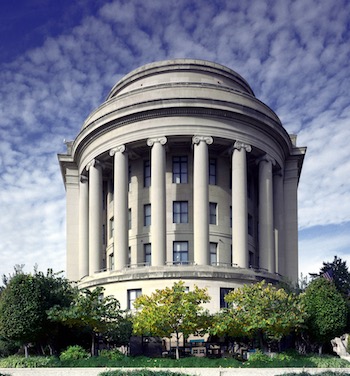
The Federal Trade Commission Building, originally known as the Apex Building, located at 600 Pennsylvania Avenue, NW in the Federal Triangle area of Washington, D.C. Public Domain.
Late last week, the Federal Trade Commission (FTC) announced that the agency was acceding to decisions by U.S. regional circuit courts vacating the agency’s Biden Administration-era rule banning noncompete clauses from U.S. employment contracts and preventing their enforcement. While some lawmakers have decried the decision to end this rule, the FTC also issued a request for information (RFI) as the Trump Administration seeks to develop a case-by-case enforcement approach for cracking down on noncompete abuses.
Biden’s Broad Noncompete Ban Violates ‘Overwhelming Tradition’ of Case-by-Case Decisions
In April 2023, the FTC approved by a 3-2 vote its rule banning new noncompete clauses and preventing enforcement of such clauses against any employees except for senior executives. Although FTC Commissioners voting in favor of the ban publicly argued that noncompete agreements prevent labor mobility and are inherently unfair, business advocates like the U.S. Chamber of Commerce opposed the rule, pointing out such agreements protect vital procompetitive interests in R&D investments and workforce training. Last August, the Northern District of Texas granted a preliminary injunction setting aside the rule nationwide because the rule was promulgated outside of the FTC’s substantive rulemaking authority. The Middle District of Florida also issued injunctive relief in August 2024 prohibiting application of the noncompete ban against the plaintiff in that case.
The FTC’s decision to dismiss appeals pending in both the Fifth Circuit and Eleventh Circuit has been met with disappointment from some lawmakers. U.S. Representative Primala Jayapal (D-WA), an early proponent of the FTC’s noncompete ban, called the Trump Administration’s decision a major setback for American workers and adding that the previous ban would have increased earnings by $488 billion over the next decade for the approximately 30 million Americans encumbered by noncompete clauses. Bipartisan support for limits on noncompete provisions has been growing in recent months, notably through introduction of the Workforce Mobility Act this June by U.S. Senators Todd Young (R-IA) and Chris Murphy (D-CN).
However, as the FTC’s RFI on noncompete agreements notes, Commissioners at the agency disagreed themselves on whether statutory authority for the ban existed at the time that the rule was promulgated. Then-Commissioner Andrew Ferguson, who now serves as FTC Chairman, was one of two dissenting votes on the noncompete ban pointing out that the broad categorical ban against all noncompete clauses ran counter to “the overwhelming tradition of assessing noncompete agreements on a case-by-case basis.”
Still, as the FTC’s RFI itself states, “the Trump-Vance FTC remains committed to rooting out unfair and uncompetitive conduct in all appropriate cases where Congress has authorized the agency to act.” The agency’s call for public comment notes that noncompete clauses are often inserted into contracts without due consideration as to whether such provisions are appropriate. The FTC adds that its staff has reviewed significant evidence showing that noncompetes prevent labor from shifting to under-served markets, creating harms that are particularly acute in rural areas that can access healthcare or other professionals.
Complaint Against Pet Cremation Company Shows FTC Enforcement Will Continue
Members of the public are invited to submit comments to the FTC either publicly through Regulations.gov or via email marked “confidential” sent to noncompete@ftc.gov. Although any information relevant to noncompetes is welcome, the FTC’s RFI includes a series of questions requesting information on the scope of such agreements, the job positions and salary ranges typically subject to such agreements, and whether such agreements contribute to a loss of innovation. The RFI also seeks input on whether noncompete provisions cause workers to turn down job opportunities, prevent them from starting new businesses, or if they affect hiring practices or job mobility in the healthcare sector.
The FTC appears to already be shifting toward a case-by-case approach toward addressing noncompete abuses. On the same day the agency issued its RFI, it also announced a complaint alleging that pet cremation company Pet Services’ noncompete provisions against 1,800 employees constitutes unfair methods of competition unlawful under Section 5 of the FTC Act, codified at 15 U.S.C. § 145. The agency also entered a proposed consent order that would prevent Pet Services from enforcing each of those noncompete agreements. The complaint and proposed consent order were approved in a 3-1 vote by the FTC with Commissioner Rebecca Kelly Slaughter providing the lone dissenting vote.
Until the FTC establishes a new final rule, efforts to curtail the use of noncompetes by American employers could result in a patchwork regime. John Chun, Partner at Herrick, Feinstein LLP, said that “with the demise of the FTC’s ban, states will continue to play the leading role in setting rules-of-the-road for noncompetes,” with the trend toward preventing such agreements likely to continue. The FTC’s action against Gateway Services indicates that the Trump Administration will continue taking action against noncompetes, especially those restricting low-wage workers, Chun added.
Responses to the FTC’s RFI on noncompetes are due to the agency by no later than 11:59 PM Eastern on November 3, 2025.
![[Advertisement]](https://ipwatchdog.com/wp-content/uploads/2026/10/Junior-Oct-15-2026-sidebar-700x500-1.jpg)
![[Advertisement]](https://ipwatchdog.com/wp-content/uploads/2026/10/BlackBox-IP-Oct-20-2026-sidebar-700x500-1.jpg)
![[Advertisement]](https://ipwatchdog.com/wp-content/uploads/2026/10/Questel-Oct-22-2026-sidebar-700x500-1.jpg)
![[Advertisement]](https://ipwatchdog.com/wp-content/uploads/2026/09/WE-BUY-PATENTS-SIM-IP-Ad-1-revised-on-Sep-28-2026-700x500-1.jpg)
![[Advertisement]](https://ipwatchdog.com/wp-content/uploads/2026/09/Life-Sciences-2026-sidebar-early-bird-date-corrected-700x500-1.jpg)
![[Advertisement]](https://ipwatchdog.com/wp-content/uploads/2024/09/Patent-Prosecution-Training-sidebar-700x500-2025-03-27.jpg)





![[Advertisement]](https://ipwatchdog.com/wp-content/uploads/2021/12/WEBINAR-336-x-280-px.png)
![[Advertisement]](https://ipwatchdog.com/wp-content/uploads/2021/12/Ad-4-The-Invent-Patent-System™.png)







Join the Discussion
No comments yet.