
![[IPWatchdog Logo]](https://ipwatchdog.com/wp-content/themes/IPWatchdog%20-%202023/assets/images/temp/logo-small@2x.png)

 0
0 “Foster argues that the Federal Circuit’s decision emboldens viewpoint-based discrimination and post hoc censorship of commercial identity.”
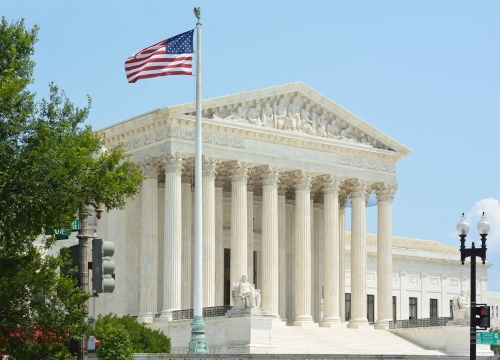 In a petition for certiorari docketed August 6, trademark applicant Thomas Foster filed a petition for writ of certiorari with the U.S. Supreme Court asking to overturn a May ruling by the U.S. Court of Appeals for the Federal Circuit affirming a trademark examiner’s refusal to register the standard character mark “US SPACE FORCE.” Along with raising constitutional challenges, Foster also contends that the Federal Circuit’s ruling undermines Lanham Act statutory provisions affording applicants the right to a constructive use date.
US SPACE FORCE Mark Sought for Entertainment Concept, Not Government Impersonation
Foster filed his trademark application for US SPACE FORCE in March 2018, days after President Donald Trump gave a speech announcing his intent to create a sixth military branch known as the U.S. Space Force but months before Trump ordered the Pentagon in June 2018 to begin organizing the new military branch. Following several rejections from the trademark examiner for false suggestion of a connection under 15 U.S.C. § 1052(a), findings affirmed by the Trademark Trial and Appeal Board (TTAB), the Federal Circuit agreed that Foster’s applied-for mark was “the same or a close approximation of a name or identity of the United States.” The appellate court ruled that the false suggestion of connection analysis was properly open through the TTAB’s December 2022 reconsideration decision, and not as of the date of Foster’s intent-to-use application filing.
Foster’s petition for writ includes three questions presented to the U.S. Supreme Court: Whether the Federal Circuit improperly considered government developments post-dating an intent-to-use application to support a Section 1052(a) refusal; Whether the Federal Circuit’s deference to the agency’s statutory interpretation of Section 1052(a) violated the Court’s 2024 ruling in Loper Bright Enterprises v. Raimondo; and, Whether Section 1052(a) is unconstitutionally vague as applied to an intent-to-use application referencing a fictionalized entity that did not exist at the time of filing.
Foster notes that, although his trademark application was filed in the wake of “a speech in which President Trump speculated, perhaps jokingly, about creating a new military branch,” his application arose from the development of an entertainment concept surrounding a fictionalized law agency. “The idea was–and remains–to tell stories, not to impersonate the government,” Foster’s petition reads.
Federal Circuit Continues ‘Troubling Pattern’ of Sidestepping Constitutional Issues
The Federal Circuit’s decision to avoid constitutional challenges raised by Foster fits what he calls the appellate court’s “troubling pattern” of sidestepping such issues in cases like In re: Elster (2022). Although Foster raised constitutional challenges before the TTAB and preserved them on appeal, the Federal Circuit’s ruling ignored those issues without explanation.
The lower ruling destabilizes the integrity of intent-to-use trademark applications, Foster argues, by rejecting his trademark application based on political developments following his filing date. Further, the Federal Circuit’s reliance on the TTAB’s interpretation of false suggestion of a connection under Section 1052(a) arguably violates the Court’s holding in Loper Bright, which acknowledges the judiciary’s responsibility under the Administrative Procedures Act (APA) to interpret ambiguous statutory provisions, which is codified at 5 U.S.C. § 706.
Finally, by basing its refusal on the speculative formation of government entities, Foster continued his argument that the Federal Circuit’s application of Section 1052(a)’s false suggestion of a connection is unconstitutionally vague as applied. Not only has there been a long understanding that fictional entities and characters do not fall within the scope of the analysis for a false suggestion of a connection, but the Federal Circuit’s determination that President Trump’s passing political remarks carry source-identifying weight is a distortion of trademark law warranting the Court’s correction, Foster’s petition reads. By supporting the government’s unbounded discretion to deny trademark registrations based on evolving political narratives, Foster argues that the Federal Circuit’s decision emboldens viewpoint-based discrimination and post hoc censorship of commercial identity.
Image Source: Deposit Photos
Author: etienjones
Image ID: 52674523
![[Advertisement]](https://ipwatchdog.com/wp-content/uploads/2026/09/Lighthouse-IP-Sep-15-2026-sidebar-700x500-1.jpg)
![[Advertisement]](https://ipwatchdog.com/wp-content/uploads/2026/09/Clerq-RPX-Sep-16-2026-sidebar-700x500-1.jpg)
![[Advertisement]](https://ipwatchdog.com/wp-content/uploads/2026/09/Patently-Sep-17-2026-sidebar-700x500-1.jpg)
![[Advertisement]](https://ipwatchdog.com/wp-content/uploads/2026/06/Womens-IP-Forum-2026-sidebar-regular-price-700x500-rev1.jpg)
![[Advertisement]](https://ipwatchdog.com/wp-content/uploads/2026/08/OneTransform_700x500_v1-REVISED.jpg)
![[Advertisement]](https://ipwatchdog.com/wp-content/uploads/2024/09/Patent-Prosecution-Training-sidebar-700x500-2025-03-27.jpg)





![[Advertisement]](https://ipwatchdog.com/wp-content/uploads/2021/12/WEBINAR-336-x-280-px.png)
![[Advertisement]](https://ipwatchdog.com/wp-content/uploads/2021/12/Ad-4-The-Invent-Patent-System™.png)





Join the Discussion
No comments yet.