
![[IPWatchdog Logo]](https://ipwatchdog.com/wp-content/themes/IPWatchdog%20-%202023/assets/images/temp/logo-small@2x.png)

 1
1 This week on IPWatchdog Unleashed we take a dive into the world of university technology transfer and university innovation with Laura Peter, who is the Executive Director of the University of North Carolina Charlotte Office of Research Commercialization and Partnerships and is a former Deputy Under Secretary of Commerce for Intellectual Property and Deputy Director of the United States Patent and Trademark Office (USPTO) during President Trump’s first term. Listen here.
We begin our conversation discussing how Peter found herself at the Patent Office when Andrei Iancu was Director. Peter tells us that years ago when she was general counsel for a publicly traded company, she hired Iancu’s firm to represent the company. Fast forward 15 years and Iancu has become Director, and he reached out to Peter to see if she was interested in helping him at the Patent Office. “Of course, I jumped at the opportunity because it brought together my policy background, and also coming to the PTO to me was, going to the Emerald City and the Wizard of Oz,” Peter explained. “It was this great, glorious place, and it still is, where patents are protected and intellectual property is protected.”
We pivot to discuss how Peter found herself in her current role as the head of the technology transfer program at UNC Charlotte.
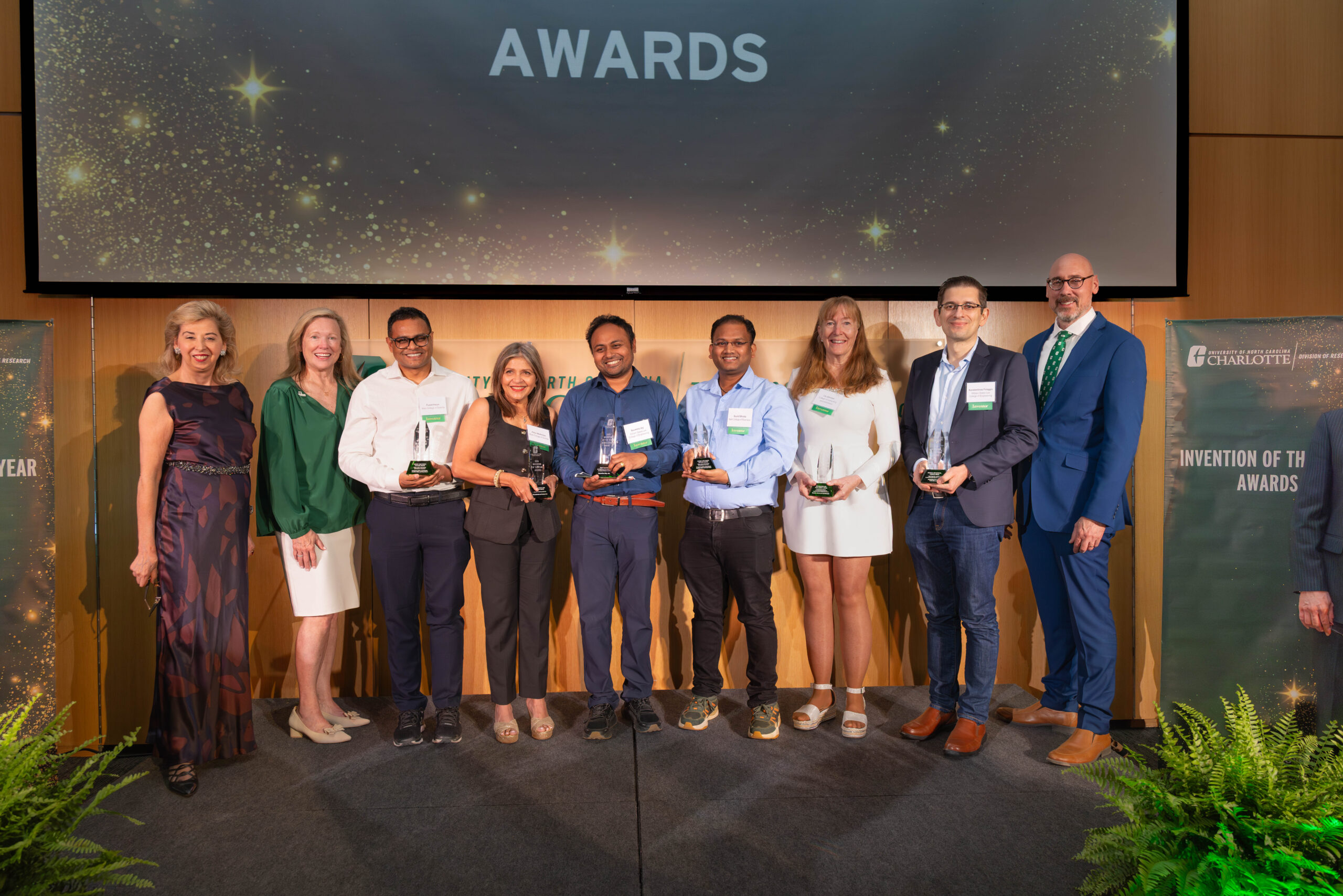
“I had thought about going back to industry, but I didn’t want to do something so narrow,” Peter said. “I think when you’re in the PTO, it changes you, or changed me anyway, I can say that. I wanted to do something bigger. I wanted to have an impact, and so I started looking around at universities, and I found this opportunity at UNC Charlotte, where they’re up and coming, they’re moving to R1 status, they are moving up in the U.S. News World and Report ranks… and they’re really powering up in their research, so I thought well this would be a great opportunity, and I hit it off very well with the Vice Chancellor, Vice Chancellor John Daniels, and I said look here’s what I can do, I can come and keep the wheels on the bus turning for technology transfer, that’s the heart of the job, you know making sure the patents get licensed out to industry and so on, but I can bring two more things, one is bringing an innovation and entrepreneurial mindset to the faculty on campus, bringing in speakers, educating faculty and researchers about what intellectual property is, why it’s important, where it comes from, and what it can do for them, and then the other thing I can do is elevate UNC Charlotte on the national and international stage as far as an intellectual property player,” Peter said before going into a list of awards, recognitions and accomplishments UNC Charlotte has already had since she joined the university.
 We then pivot into discussing core patent issues surrounding law, policy and the business of innovation. To jump start the conversation I commented that it strikes a lot of people who aren’t familiar with the industry as counterintuitive, but if you don’t have a patent and you can’t own the innovation, then getting it to market becomes extremely difficult, maybe even impossible, because the discovery to innovation to market commercialization lifecycle costs a lot of money. And, if no one owns the patent you can’t possibly invest, which is a key piece of the puzzle that’s often missed.
“I absolutely agree,” Peter enthusiastically emphasized. “When you file a patent, you’re actually creating an asset that can be monetized, and that means a venture capitalist will see that you have an asset and can actually give you money because they see you own something.”
“[S]hifting gears a little bit to the whole march-in rights issue—that’s why that became such a giant threat, if you get a patent and the government is allowed to take it, basically for any reason that they wish because they don’t like how much you’re charging, that undermines the whole value, and can you get a venture capitalist to take the risk of investment when they know it can be just taken away on a whim?”
This leads us into a conversation about what is known in the technology transfer world as the “valley of death,” where so many of these great inventions and great ideas just go to die. And for those unfamiliar with the term, the “valley of death” that sink-or-swim period in time where initial seed funding from the federal government has been expended to fund the basic research and translational research but the technology is not yet at a mature enough place to bring in revenues from the marketplace. This means additional funding for commercialization research is needed, and must be provided by the private sector, before the innovation goes to market. And although the graph below shows the public and private funding in percentages, in real terms the amount of money expended by the private sector dwarfs the amount spend through public sources. Regardless, navigating the valley of death is critical for every university-based innovation or technology, and often the more groundbreaking and consequential the innovation the more commercialization research is needed and the wider the valley of death becomes.
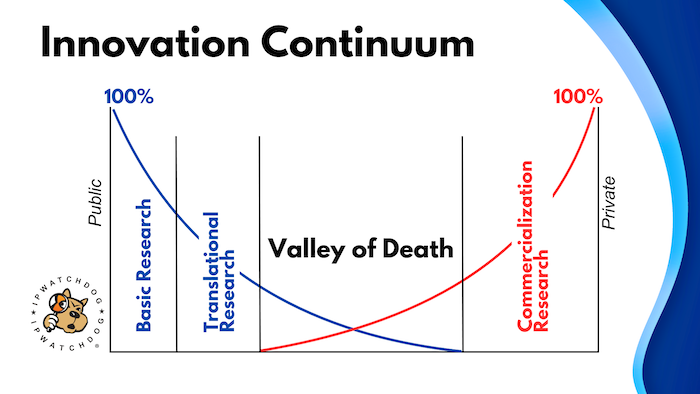
“It’s not only getting the venture capitalists to invest in it to help build a bridge over the valley of death, but it’s also the expertise of the researchers in the university—they are not equipped and not trained,” Peter explained as she drew the distinction between university researchers being very good at basic research but less good—or not good—at commercialization research. “If you don’t have people who are willing to invest their time and resources as well as their money to cross that bridge, it’s going to die anyway, and then if you threaten the potential payoff with capricious taking of IP 10 years down the line, why in the world would you ever invest in university research if it’s going to be so easily taken?”
“I think that patents are a little bit mysterious. They have a lot of mystique around them. The rules get very complicated,” Peter explained as she answered my question about whether the constant assault on Bayh-Dole and misuse of march-in-rights surprises her. “We have a drug pricing crisis in our country, and everyone’s trying to look for a solution. The point is, though, that attacking the patent system using Bayh-Dole and attacking Bayh-Dole is the wrong tool for a noble cause.”
Our wide-ranging conversation goes on to discuss how other countries engage price control tactics on drugs, which means the United States is subsidizing drugs for the entire world, which is a trade problem and not a patent problem. We proceed to discuss startups, patent eligibility reform, the Patent Trial and Appeal Board and much more.
So, without further ado, we invite you to listen to full conversation. You can listen to our full discussion wherever you get your podcasts (links here) or you can visit IPWatchdog Unleashed on IPWatchdog.com. You can also watch the video below, on the IPWatchdog YouTube channel.
More IPWatchdog Unleashed
For more IPWatchdog Unleashed, see below for our growing archive of previous episodes.
![[Advertisement]](https://ipwatchdog.com/wp-content/uploads/2026/04/IPWatchdog-May-7-2026-sidebar-700x500-1.jpg)
![[Advertisement]](https://ipwatchdog.com/wp-content/uploads/2026/04/Virtual-AI-2026-May-18-19-2026-sidebar-700x500-1.jpg)
![[Advertisement]](https://ipwatchdog.com/wp-content/uploads/2026/04/ClearstoneIP-May-14-2026-sidebar-700x500-1.jpg)



![[Advertisement]](https://ipwatchdog.com/wp-content/uploads/2021/12/WEBINAR-336-x-280-px.png)
![[Advertisement]](https://ipwatchdog.com/wp-content/uploads/2021/12/Ad-4-The-Invent-Patent-System™.png)



Join the Discussion
One comment so far.
Paul Morgan
February 25, 2025 09:37 amI assume you wrote this before Musk stopped so much university research funding? Lawsuits have already been filed.