
![[IPWatchdog Logo]](https://ipwatchdog.com/wp-content/themes/IPWatchdog%20-%202023/assets/images/temp/logo-small@2x.png)

 3
3 “[The data] suggests the patent system may be imposing a double hurdle on AI claims: harder to keep alive, and harder to enforce once alive.” – Professor Amy Semet
 As the full Senate Judiciary Committee prepares to hold a major hearing on the state of U.S. patent eligibility law tomorrow, Amy Semet, Associate Professor of Law at the University at Buffalo School of Law, through her affiliation with the IP Policy Institute, has published a research paper providing the first empirical data on subject matter eligibility issues for artificial intelligence (AI) patents asserted in U.S. district court litigation. The research paper finds that not only are AI inventions invalidated at a higher rate than non-AI inventions, but also, unexpectedly, that obviousness invalidations for AI patents are low due to an incredibly high rate of subject matter eligibility invalidations in the sector.
Wide Gap in Invalidity Grounds Shows Obviousness Doing Comparatively Little Work
As Semet acknowledges, the definition of an AI invention has been a moving target for at least the U.S. Patent and Trademark Office (USPTO) and the Organization for Economic Co-operation and Development (OECD), which have both revised their official definition of AI invention in recent years. Relying principally on the USPTO’s Artificial Intelligence Patent Dataset, Semet’s analysis addresses this definitional concern by analyzing AI inventions along several probability thresholds from 50% probability, which sweeps in borderline cases, to 93%, which captures AI patents with near certainty. As Semet notes, the 50% cutoff includes 1.3 million patents while the 93% cutoff contains 860,000 patents.
Restricting the analysis’ attention to 14,000 patents covering AI technology that were litigated in U.S. district court between 2000 and 2025, Semet notes that such litigation tends to be dominated by non-practicing entities and individual-inventor startups. These patents are also more exposed to repeat challenges at the USPTO, where 23.6% of AI patents asserted in U.S. district court are challenged in Patent Trial and Appeal Board (PTAB) validity proceedings versus 11.9% of all asserted non-AI patents. The study finds that AI patents are far more often than non-AI patents procedurally disposed of early in cases through motions to dismiss or judgments on the pleadings. As Semet notes, this means that infringement cases involving AI patents are not trial-intensive as such disputes that do not settle are likely to be screened out early by district courts.
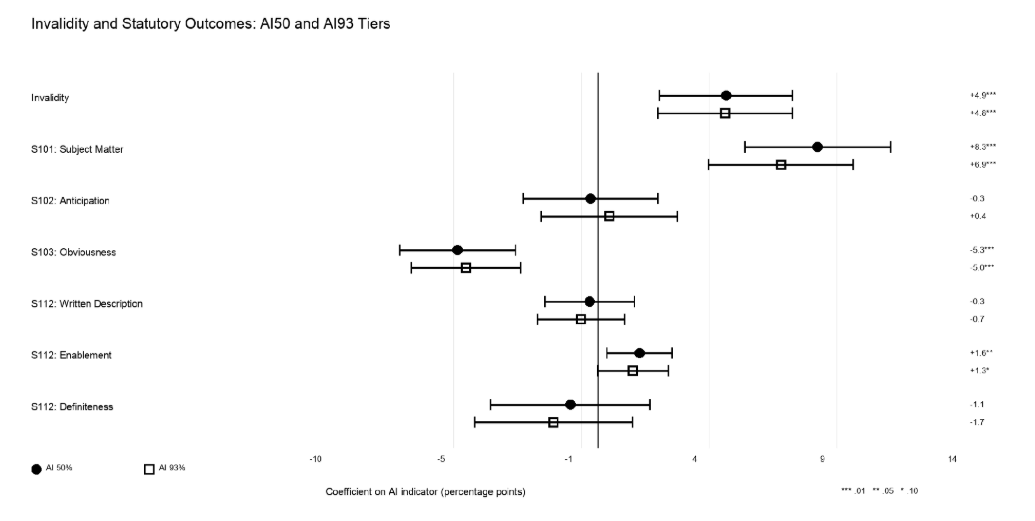 Focusing on district court cases reaching an outcome on the merits, Semet notes that AI patents are far more likely to be invalidated than non-AI patents under 35 U.S.C. § 101 for subject matter eligibility. Conversely, non-AI patents are also invalidated under 35 U.S.C. § 103 for obviousness at significantly higher rates than AI patents, an unexpected result as AI and software patents more generally are often criticized for combining known techniques. As a result, “the prior-art doctrine that is doctrinally best suited to police routine recombination is doing comparatively little of the invalidating in this space,” Semet highlights. While this is efficient from a case disposition standpoint, she adds that this result is inefficient in the sense that matters for innovation because patents are invalidated on a legal basis rather than technical questions of whether the advance was actually non-obvious.
Other than subject matter eligibility, the only other statutory ground found “statistically significant in some specifications” in invalidating AI patents was lack of enablement, but Semet notes that enablement loses significance when removing a small number of multi-patent case clusters featuring vision AI patents. As a result, the finding is a suggestive, secondary, weak finding, Semet reports.
Section 101 Rates Higher for AI Patents Even When Controlling for Alice
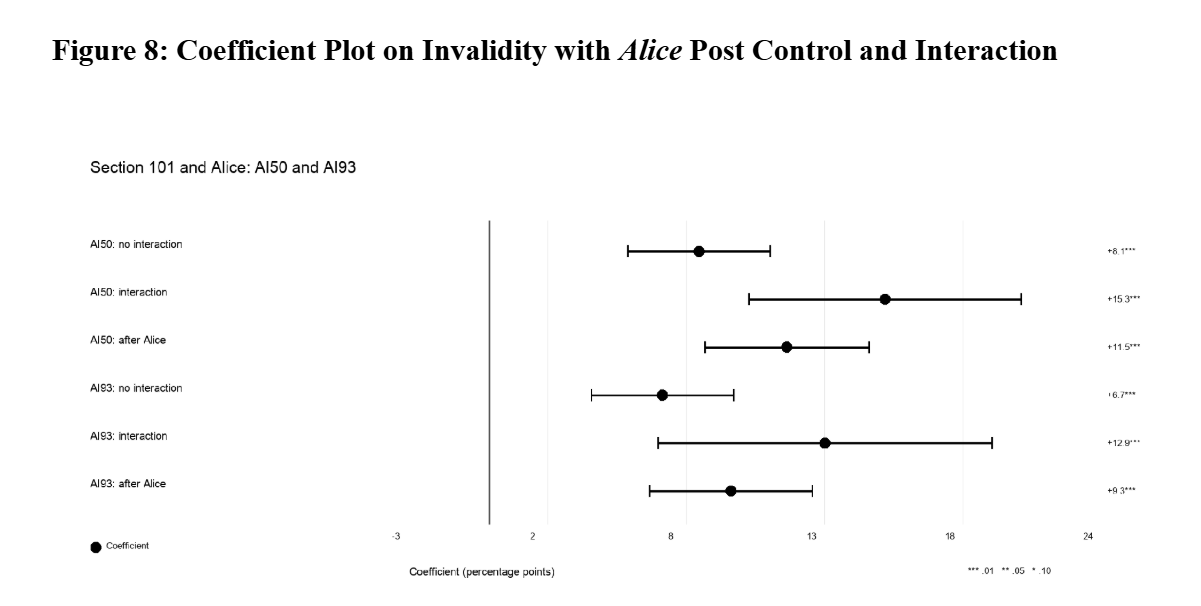
The U.S. Supreme Court’s 2014 ruling in Alice v. CLS Bank has had an outsized impact on AI patents, which are more likely to be invalidated under Section 101 since Alice even when accounting for the general post-Alice increase in subject matter eligibility invalidations. One interaction model revealing predicted probability shows that, while AI patents were not especially likely to be invalidated under Section 101 before Alice, they were significantly more likely to face eligibility invalidations following the Court’s ruling than non-AI patents. To a lesser degree, Semet’s analysis also finds that AI patents are less likely to result in an infringement ruling than non-AI patent counterparts.
 Performing multiple robustness checks, Semet’s data shows that the significant Section 101 and Section 103 findings remain for AI patents even when excluding software and telecommunications patents to control for the impacts of changing validity doctrine in those sectors.
The combination of higher validity risk with lower infringement success creates an asymmetry that “suggests the patent system may be imposing a double hurdle on AI claims: harder to keep alive, and harder to enforce once alive.” These patterns create a mismatch with legacy patent doctrine that did not contemplate how patent law would apply to the unique features that make AI or any technology distinctive. Under the current state of patent eligibility doctrine, Semet concludes the data shows that current doctrine is falling hardest on upstream, foundational technologies, posing a calibration problem for U.S. patent law.
Noting the coordinated response that federal lawmakers have called for regarding AI innovation, Semet’s paper advances several reforms that address this calibration problem without privileging AI patents. Granular guidance on the application of Section 101 to data-driven learning systems should be supplied by the Federal Circuit, while courts and Congress should work in concert to rebalance Section 101 and Section 112 invalidity grounds so that the underlying concern of overbroad AI patents can actually be reached during infringement cases. Semet acknowledges that the elimination of all judicial exceptions under Section 101 is the “most ambitious” reform suggested, but the empirical data of the study shows that subject matter eligibility has supplanted novelty and obviousness in ways that have been anecdotally suggested by splintered Federal Circuit rulings in American Axle and Athena Diagnostics.
Ultimately, “as AI technologies become increasingly central to the economy, the current legal landscape may be systematically disadvantaging this key class of emerging inventions,” Semet said in a statement sent to IPWatchdog.
This article was updated on 7/13 to reflect a correction to the study’s findings on enablement and to clarify attribution.
![[Advertisement]](https://ipwatchdog.com/wp-content/uploads/2026/08/Solve-Intelligence-Aug-27-2026-sidebar-700x500-rev1.jpg)
![[Advertisement]](https://ipwatchdog.com/wp-content/uploads/2026/08/Tradespace-Sep-1-2026-sidebar-700x500-1.jpg)
![[Advertisement]](https://ipwatchdog.com/wp-content/uploads/2026/07/Womens-IP-Forum-2026-sidebar-register-early-bird-now-700x500-1.jpg)
![[Advertisement]](https://ipwatchdog.com/wp-content/uploads/2026/08/OneTransform_700x500_v1-REVISED.jpg)
![[Advertisement]](https://ipwatchdog.com/wp-content/uploads/2026/07/Juristat-Varsity-Ad-2026-IPW-ad-FreeTrial_2-UPDATED-on-Jul-15-2026.png)
![[Advertisement]](https://ipwatchdog.com/wp-content/uploads/2024/09/Patent-Prosecution-Training-sidebar-700x500-2025-03-27.jpg)




![[Advertisement]](https://ipwatchdog.com/wp-content/uploads/2021/12/WEBINAR-336-x-280-px.png)
![[Advertisement]](https://ipwatchdog.com/wp-content/uploads/2021/12/Ad-4-The-Invent-Patent-System™.png)





Join the Discussion
3 comments so far. Add my comment.
Peter
July 15, 2026 03:17 pm…and what if I told you that you could dispose of a case and get even more credit by allowing the case, which then would you take?
John, do you also take issue with the USPTO giving examiners greater credit for allowances than rejections? If you do not trust examiners honestly apply 101 rejections and 103 rejections, then why would you trust them to grant applications? Or do you only care about perverse incentives when they work against you?
John Gross
July 14, 2026 02:23 pmIf you had a quote of cases per quarter, and I told you that you could dispose of a case and get credit by doing 10 hours of work, or 2 hours of work, which would you take?
Examiners are human, and take the easy path
a 101 rejection can be written by AI in about 3 minutes just by looking at the claim language and boiling it down to nothing
a 103 rejection requires prior art queries, review, mapping and analysis to fit a very precise test
its the old expression, when your only tool is a hammer, everything looks like a nail
Third M
July 14, 2026 12:02 pmFrom IBM’s 2014 Amicus Brief to the Supreme Court on Alice:
The rapid evolution of computer technology illustrates this concern. Incentives provided by the patent system have helped turn computers from room- sized behemoths used only by scientists to ubiquitous hand-held devices that can be used for all manner of complex activities. This astonishing progression, however, has led courts to ignore the fact that scores of enormously innovative and highly valuable inventions were necessary to accomplish this transformation and erode the barrier between man and machine. In allowing this more intuitive interface to obscure the presence of the machine in patent eligibility analysis, courts are effectively declaring the erosion of the interface complete. That declaration threatens the development of further interface- eroding innovations that promise a new era where computers will be able to think more like humans. “Cognitive computing” systems will closely emulate human thought processes and be able to learn and deliver insight based on their accumulated knowledge. See, e.g., Cognitive Computing, http://ibm.co/1l5Ud9e. Adopting an abstract idea test that ascribes no weight to the presence of a computer at this critical time endangers this technology before it even leaves the starting gate.
Add Comment