
![[IPWatchdog Logo]](https://ipwatchdog.com/wp-content/themes/IPWatchdog%20-%202023/assets/images/temp/logo-small@2x.png)

 0
0 “[7-Eleven v. Nike] reflects the continued movement of trademark law away from discrete symbols and toward broader commercial identities.”
 Trademark law has traditionally protected the most recognizable aspects of a brand: names, logos, and slogans. Increasingly, however, companies are asking courts to protect something far less tangible, the overall identity consumers associate with a brand. Colors, product aesthetics, marketing campaigns, and even the timing of a product launch have become valuable commercial assets in their own right. The recently filed lawsuit between 7-Eleven and Nike illustrates how modern trademark disputes are moving beyond conventional source identifiers and into the realm of brand identity itself.
The question these cases raise, in one form or another, is deceptively simple: can trademark law protect a brand’s identity even when no trademark has technically been copied?
When a Color Scheme Becomes a Trademark
7-Eleven filed suit against Nike in the U.S. District Court for the Northern District of Texas on July 1, 2026, alleging that Nike’s upcoming Air Max 95 “Big Bubble” sneaker infringes the convenience retailer’s federally registered Tri-Color Mark, a combination of orange, green, and red that 7-Eleven has used since 1987. The complaint doesn’t stop at color. It also points to the shoe’s scheduled release date of July 11, which 7-Eleven has long promoted as “7-Eleven Day” and celebrates with its Free Slurpee Day promotion, and to product details that reinforce the association, including a store-shelf graphic on the insole and a product description referencing “strolling down to the corner store.” 7-Eleven says it approached Nike privately before filing suit, and that Nike indicated it intended to proceed with the launch regardless. Nike has not publicly responded to the allegations, though the shoe was pulled from its SNKRS app shortly after the complaint became public.
What makes the case notable is what it doesn’t allege. Nike never put the words “7-Eleven” on the shoe, and the complaint doesn’t claim it did. Instead, 7-Eleven is asking a court to find that a color combination, paired with a calculated release date and suggestive marketing language, is enough on its own to suggest sponsorship or affiliation. That is a meaningfully different question from the ones trademark litigation has traditionally answered, and it sits at the leading edge of a broader trend: courts being asked to protect not a mark, but an impression.
Four Kinds of Identity, One Doctrinal Thread
The 7-Eleven complaint doesn’t exist in isolation. It’s the newest entry in a line of cases that, taken together, trace the expansion of trademark protection from words and symbols toward something closer to a brand’s overall commercial impression. Each case tests a different type of identity, color, product reputation, silhouette, and pattern, but they share a common doctrinal foundation.
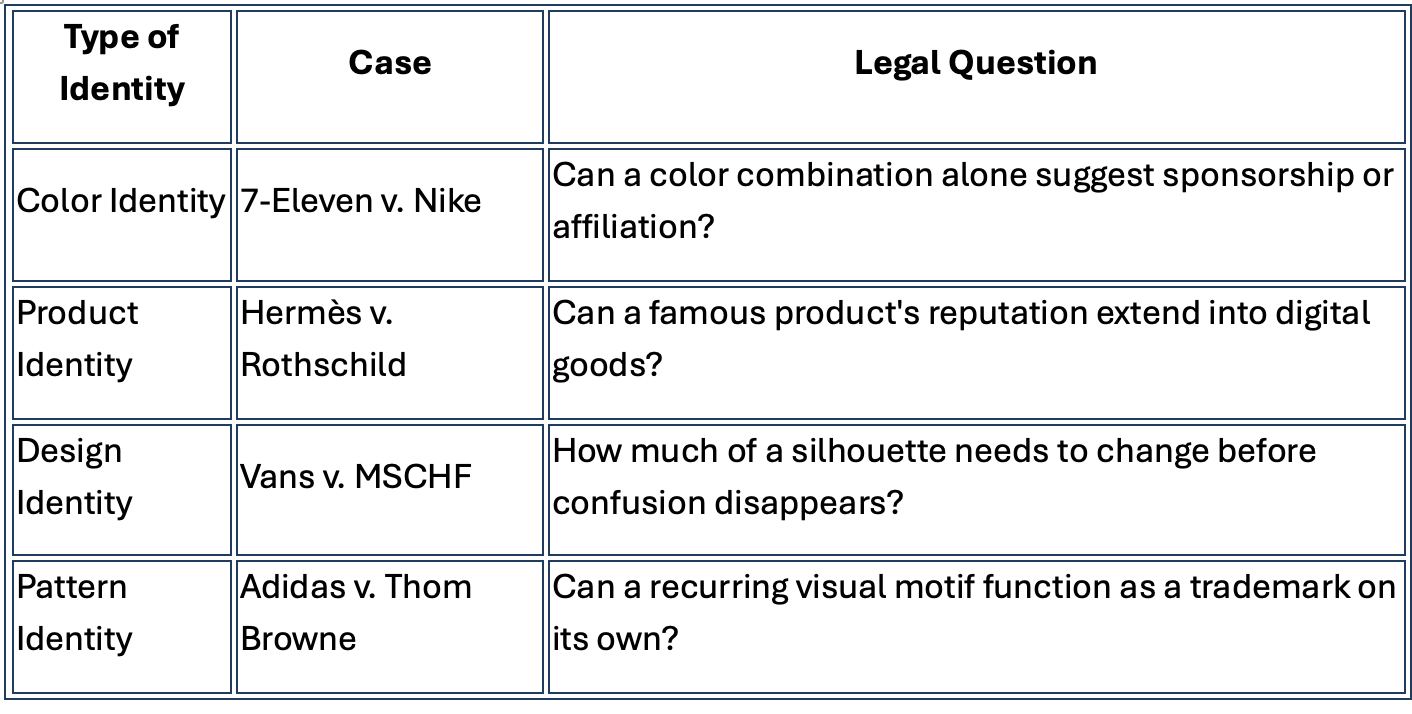
Color Identity. The doctrinal foundation for 7-Eleven’s claim traces back to Qualitex Co. v. Jacobson Products Co., in which the Supreme Court held that a single color, standing alone, can serve as a trademark so long as it has acquired distinctiveness and doesn’t serve a functional purpose. That 1995 decision is what makes 7-Eleven’s Tri-Color Mark registrable in the first place, and it’s the reason the current lawsuit isn’t dismissed out of hand as an attempt to monopolize orange, green, and red as such. The question for the court will be whether that specific combination, in that specific arrangement, has become so associated with 7-Eleven that consumers read it as a source identifier rather than a generic aesthetic choice.
Product Identity. Hermès International v. Rothschild tested whether a product’s reputation could extend beyond the product itself. A federal jury found that Rothschild’s “MetaBirkin” NFTs infringed Hermès’ trademark rights, rejecting his argument that the digital images were protected artistic expression under the Rogers test, and the court later granted Hermès a permanent injunction after finding Rothschild continued profiting from the NFTs post-verdict. The case matters here because it confirmed that source confusion doesn’t require a competing physical product; reputation itself can be the asset at stake, wherever it turns up.
Design Identity. Vans, Inc. v. MSCHF Product Studio addressed how much a product can be altered before it stops evoking its source. MSCHF’s “Wavy Baby” sneaker distorted the Old Skool silhouette into a warped, cartoonish version of itself, and never reproduced any Vans logo or wordmark. A federal court granted Vans a preliminary injunction anyway, finding a likelihood of confusion based on the overall shape and impression of the shoe, and the U.S. Court of Appeals for the Second Circuit affirmed. The ruling underscored that trade dress protection can reach a product’s silhouette even through a parody or commentary defense.
Pattern Identity. Adidas America, Inc. v. Thom Browne Inc. pushed the same theory further and came out the other way. Adidas argued that Thom Browne’s four-bar stripe designs infringed its famous Three-Stripe mark, but a jury sided with Thom Browne, apparently persuaded that the stripes appeared in a different context, tailored menswear rather than athletic wear, and served a different market. The verdict didn’t reject the underlying theory that a recurring visual motif can function as a trademark; it simply found the facts didn’t support confusion in that instance. The Second Circuit later affirmed. Even in defeat, the case shows how far brand owners are now willing to litigate over motifs.
One more foundational case belongs alongside these: Christian Louboutin S.A. v. Yves Saint Laurent America Inc., in which the Second Circuit confirmed that Louboutin’s red-soled shoe qualified for trademark protection, at least when the red sole contrasted with a different-colored upper. Between Qualitex and Louboutin, courts had already accepted that a single color, applied in a specific way, could carry the same source-identifying weight as a word or logo. 7-Eleven v. Nike is best understood as the latest application of that principle to a new set of facts, rather than a doctrinal leap.
Why These Cases Matter
What ties these disputes together is a shift in what plaintiffs are asking courts to protect. It’s no longer just whether a competitor copied a logo, but whether it borrowed enough of a brand’s overall identity to create a false impression of association. That shift tracks how brands actually build recognition today. Companies invest heavily in cohesive visual identities that span product design, advertising, retail environments, and social media, and consumers frequently recognize a brand before they ever see its name. A color palette or a distinctive silhouette can do the same work a logo used to do.
Social media has sharpened this dynamic. Platforms built around visual recognition reward brands with consistent, quotable aesthetics, which gives companies even more incentive to treat their overall look as an asset worth defending, and gives competitors more incentive to gesture at that look without crossing a line they may not be able to define in advance.
The Next Frontier of Trademark Law
How 7-Eleven v. Nike is ultimately resolved will turn on the specific facts and evidence at trial. But the lawsuit’s significance doesn’t depend on which side wins. It reflects the continued movement of trademark law away from discrete symbols and toward broader commercial identities, a movement Qualitex and Louboutin began decades ago and that Hermès, Vans, and Adidas have each tested against a different fact pattern since.
That movement puts real pressure on courts. Robust trademark protection rewards investment in branding and helps prevent consumer deception, but protection stretched too far risks handing companies something close to a monopoly over colors, silhouettes, and design ideas that competitors ought to be free to use. Drawing that line will only get harder as branding continues to move away from logos and toward immersive, unmistakable visual identities.
If that’s the direction trademark law is heading, 7-Eleven v. Nike may end up being remembered as one of the cases that defined how far it went.
![[Advertisement]](https://ipwatchdog.com/wp-content/uploads/2026/09/Patently-Sep-22-2026-sidebar-700x500-1.jpg)
![[Advertisement]](https://ipwatchdog.com/wp-content/uploads/2026/06/Womens-IP-Forum-2026-sidebar-regular-price-700x500-rev1.jpg)
![[Advertisement]](https://ipwatchdog.com/wp-content/uploads/2026/09/WE-BUY-PATENTS-SIM-IP-Ad-1-700x500-1.jpeg)
![[Advertisement]](https://ipwatchdog.com/wp-content/uploads/2026/08/OneTransform_700x500_v1-REVISED.jpg)
![[Advertisement]](https://ipwatchdog.com/wp-content/uploads/2024/09/Patent-Prosecution-Training-sidebar-700x500-2025-03-27.jpg)






![[Advertisement]](https://ipwatchdog.com/wp-content/uploads/2021/12/WEBINAR-336-x-280-px.png)
![[Advertisement]](https://ipwatchdog.com/wp-content/uploads/2021/12/Ad-4-The-Invent-Patent-System™.png)






Join the Discussion
No comments yet. Add my comment.
Add Comment