
![[IPWatchdog Logo]](https://ipwatchdog.com/wp-content/themes/IPWatchdog%20-%202023/assets/images/temp/logo-small@2x.png)

 1
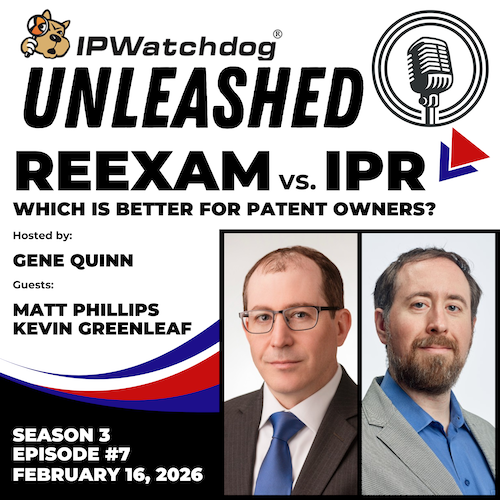
1 This week on IPWatchdog Unleashed we discuss whether patent owners are better off facing post-grant challenges at the Patent Trial and Appeal Board (PTAB) or the Central Reexamination Unit (CRU) at the United States Patent and Trademark Office (USPTO). PTAB practitioners Matt Phillips and Kevin Greenleaf joined me for about how patent owners and challengers should be strategically thinking about the shifting post-grant environment at the USPTO.
Our conversation highlights the growing reality that post-grant practice is no longer defined solely by inter partes review (IPR), but that ex parte reexamination has seen a resurgence in popularity, which requires careful evaluating timing, procedural dynamics, cost, and institutional realities. During our conversation we attempt to answer the question of whether patent owners are better off in reexamination, or whether they are better off with IPR at the PTAB.
The Return of Reexamination
For many years following enactment of the America Invents Act (AIA), IPR proceedings at the PTAB dominated post-grant patent challenges. Inter partes reexamination faded into history, being replaced by IPR proceedings. And ex parte reexamination was often viewed as a secondary tool used primarily when IPR was unavailable. That dynamic is changing.
Both Phillips and Greenleaf noted that reexamination is again becoming part of mainstream post-grant strategy, driven in part by discretionary-denial concerns and evolving PTAB policies under new USPTO Director John Squires. The result is a renewed debate over the comparative advantages of PTAB trials versus the examination-style proceedings conducted by the CRU.
This shift away from IPR and toward ex parte reexamination is not merely procedural— it reflects a deeper strategic recalibration by petitioners thanks to an environment where administrative patent review remains in flux.
Threshold Standards and Practical Reality
One key distinction discussed was the difference between institution standards in IPR proceedings and the “substantial new question of patentability” (SNQ) threshold for reexamination.
In practice the “substantial new question of patentability” threshold for institution of a reexamination is quite low, which means initiating a reexamination proceeding is much easier than winning institution of an IPR, particularly today. However, the critical inflection point in reexamination is the first Office action, not the decision to order reexamination. Statistics show that most reexamination requests are granted, but focusing on that statistic alone can be misleading. The real question is whether the examiner ultimately issues a rejection or a notice of intent to issue a reexamination certificate. This is because it is entirely possible that the CRU may determine that there is a substantial new question of patentability that justifies starting a reexamination, but then very quickly determine that on closer review there really is nothing there significant enough to warrant even the rejection of the claims in a first action in reexamination.
Meanwhile, the “reasonable likelihood of prevailing” standard for IPR institution is a meaningfully higher standard legally speaking. When this higher standard is layered on top of a substantial increase in the number of discretionary denials it is easy to understand why petitioners are beginning to look past IPR challenges and instead requesting reexamination of patents they wish to contest. And while many petitioners would still much rather prefer IPR to reexamination, one of the real benefits for patent owners in IPR is that non-institution decisions at the PTAB can end a challenge quickly, sometimes in six months, while reexamination can involve longer and more iterative prosecution-style engagement.
PTAB Advantages
While many will not likely see the PTAB as providing advantages for patent owners, Phillips did identify a variety of things he likes about the PTAB and why he thinks the PTAB can be a more favorable forum for patent owners. The advantages he sees for patent owners at the PTAB include:
- Strict evaluation of petitions as written
- Limited ability to “repair” defective challenges
- Structured discovery, including expert depositions
- Application of the Phillipsclaim-construction standard
- Predictable timelines and procedural discipline
Phillips also observed that petitioners must draft near-perfect IPR petitions, because the Board will not fill gaps in the challenger’s case. Subtle drafting errors can be outcome-determinative.
By contrast, reexamination reflects a collaborative examination framework, where examiners can reformulate rejections or combine prior art differently than originally presented. This flexibility can be advantageous or risky, depending on perspective.
The Interview Advantage in Reexamination
As the PTAB wanes in popularity due to the increase in discretionary denials, many patent owners are worried—and have expressed concern—that with the IPR door closing at the PTAB challenges will simply shift to the CRU. Greenleaf does not see that as a problem though, saying that many patent owners will fare much better at the CRU than they will at the PTAB. The reexamination advantages he identified in the discussion included:
- Direct engagement with examiners
- Iterative argument development
- Multiple opportunities to refine claim scope
- A prosecution-style path to allowance
Greenleaf also specifically identified examiner interviews as one of the most compelling advantages of reexamination for patent owners. This dynamic can produce faster claim resolution in some cases and allows patent owners to actively shape outcomes through examiner interaction. In short, reexamination can feel more like prosecution than litigation, which should appeal to certain patent owners and counsel.
Duty of Disclosure and Supplemental Examination
Another important distinction between IPR and reexamination that was discussed during our conversation involves the duty of disclosure. In reexamination proceedings, the traditional examination-style disclosure obligation applies. In PTAB proceedings, that duty generally does not arise unless a motion to amend is filed. This creates a strategic tradeoff:
- Reexamination provides “inoculation” value by allowing patent owners to disclose large bodies of prior art.
- PTAB proceedings avoid the cost and burden of large IDS submissions across related litigations.
The panel also discussed supplemental examination, which remains a seldom utilized mechanism for addressing potential inequitable-conduct risks. Once completed, supplemental examination can eliminate inequitable-conduct defenses tied to disclosed information regardless of whether the Office decides to initiate a reexamination.
Strategic Uncertainty, Policy Whiplash and the Future
Perhaps the most important takeaway from the discussion was the recognition that post-grant practice remains highly sensitive to USPTO preference. Everyone acknowledged that PTAB policies have shifted repeatedly across administrations, and that rulemaking offers the most durable path to stability given how unlikely it seems that Congress will step in and make changes.
Ultimately, the discussion underscored that administrative patent review remains in a period of uncertainty. Changes in PTAB discretionary-denial practice, operational shifts within the CRU, and the absence of stable rulemaking create ongoing unpredictability for both patent owners and challengers. As post-grant challenges increasingly shift between forums, practitioners must focus on rigorous diligence, careful drafting, and adaptable strategy. The conclusion is that in today’s environment, success in post-grant proceedings depends less on forum preference and more on preparation, technical strength, and the ability to navigate a system still searching for long-term equilibrium.
More IPWatchdog Unleashed
You can listen to the entire podcast episode by downloading it wherever you normally access podcasts or by visiting IPWatchdog Unleashed on Buzzsprout. You can also listen to IPWatchdog Unleashed conversations on the IPWatchdog YouTube channel. For more IPWatchdog Unleashed, see below for our growing archive of previous episodes.
![[Advertisement]](https://ipwatchdog.com/wp-content/uploads/2026/02/LIVE-2026-sidebar-regular-price-new-700x500-1.jpg)





![[Advertisement]](https://ipwatchdog.com/wp-content/uploads/2021/12/WEBINAR-336-x-280-px.png)
![[Advertisement]](https://ipwatchdog.com/wp-content/uploads/2021/12/Ad-4-The-Invent-Patent-System™.png)





Join the Discussion
One comment so far. Add my comment.
Pro Say
February 17, 2026 05:41 pmThanks — great info. Two questions:
1. What’s the cost difference to patent owners between IPRs and Reexams?
2. Which, if either, do litigation finance firms prefer?
Add Comment