
![[IPWatchdog Logo]](https://ipwatchdog.com/wp-content/themes/IPWatchdog%20-%202023/assets/images/temp/logo-small@2x.png)

 0
0 “Countries cited as origins of counterfeits tended to show higher reported instances of hazardous child labor, forced labor victims and workplace fatalities.”
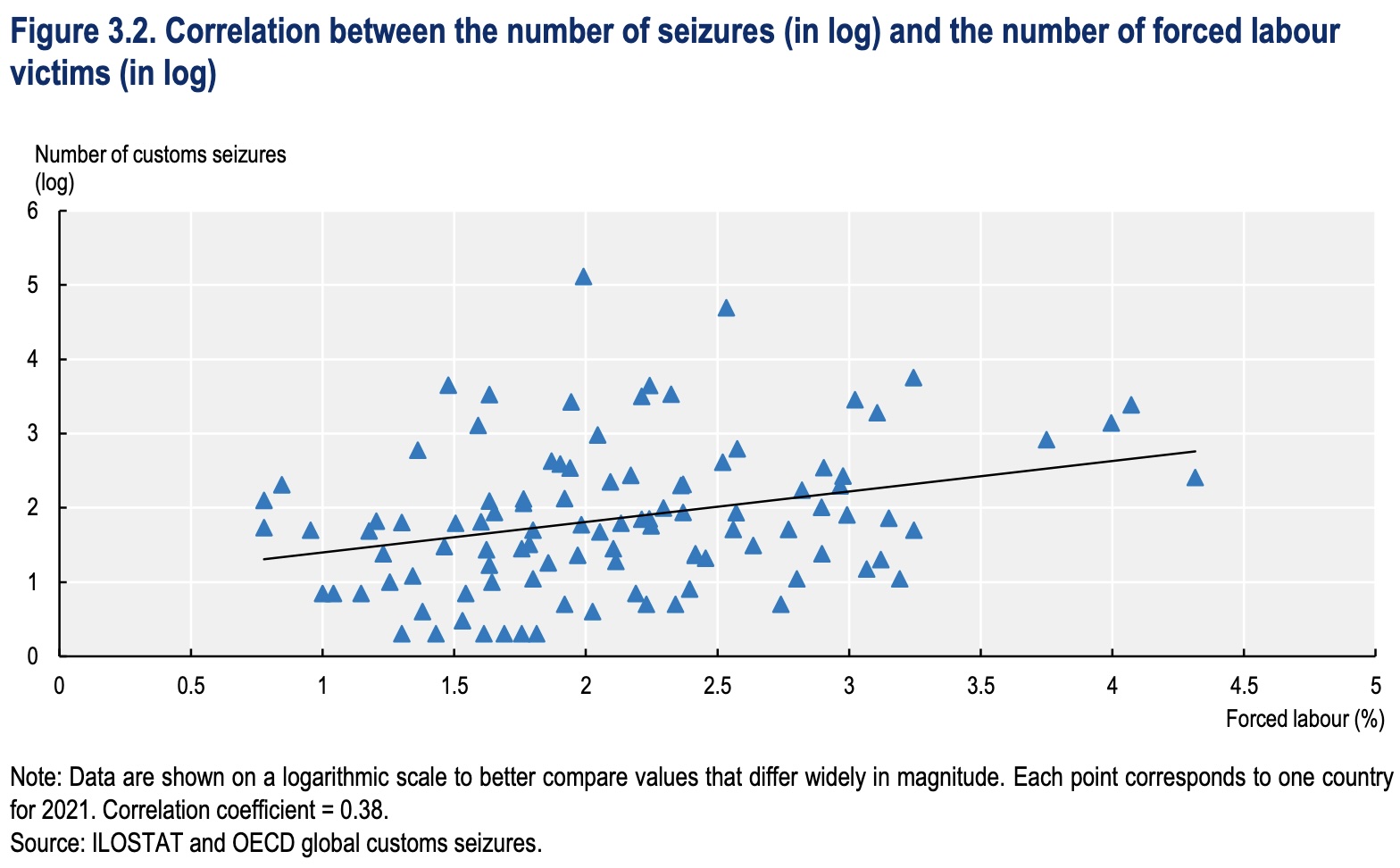
Source: EUIPO-OECD report
Yesterday, the European Union Intellectual Property Office (EUIPO) and the Organisation for Economic Co-operation and Development (OECD) published the results of a joint study detailing the close connection between illicit trade in counterfeits and labor exploitation. The joint study shows clear, repeated associations between the intensity of counterfeit trade and abusive labor conditions, strongly suggesting that such conditions structurally enable the production and distribution of counterfeits.
Clear Link Shown Between Exploitative Labor Practices and Counterfeit Supply Chains
The EUIPO-OECD joint report on fakes and forced labor derives findings from global customs data and available labor statistics. Using econometric modeling that controls for income levels, trade openness and institutional quality, the study finds that a one-percentage-point increase in the prevalence of forced labor correlates with a 0.0076% increase in the value of counterfeit trade, which globally reaches an average value of $467 billion USD each year. The EUIPO-OECD report states that these findings confirm that labor exploitation is not simply a by-product of counterfeit trade but is instead a mutually reinforcing partner to the global trade in fakes.
There are several forms of labor exploitation that enable the production and distribution of counterfeit goods chronicled by the EUIPO-OECD joint report. Surveying several studies on illicit trade impacting intellectual property rights, the report details factories making fake branded clothing, cigarettes and footwear that heavily leveraged children and undocumented migrants to provide labor. In many cases, these individuals worked in unsafe conditions under constant surveillance preventing them from leaving the factory.
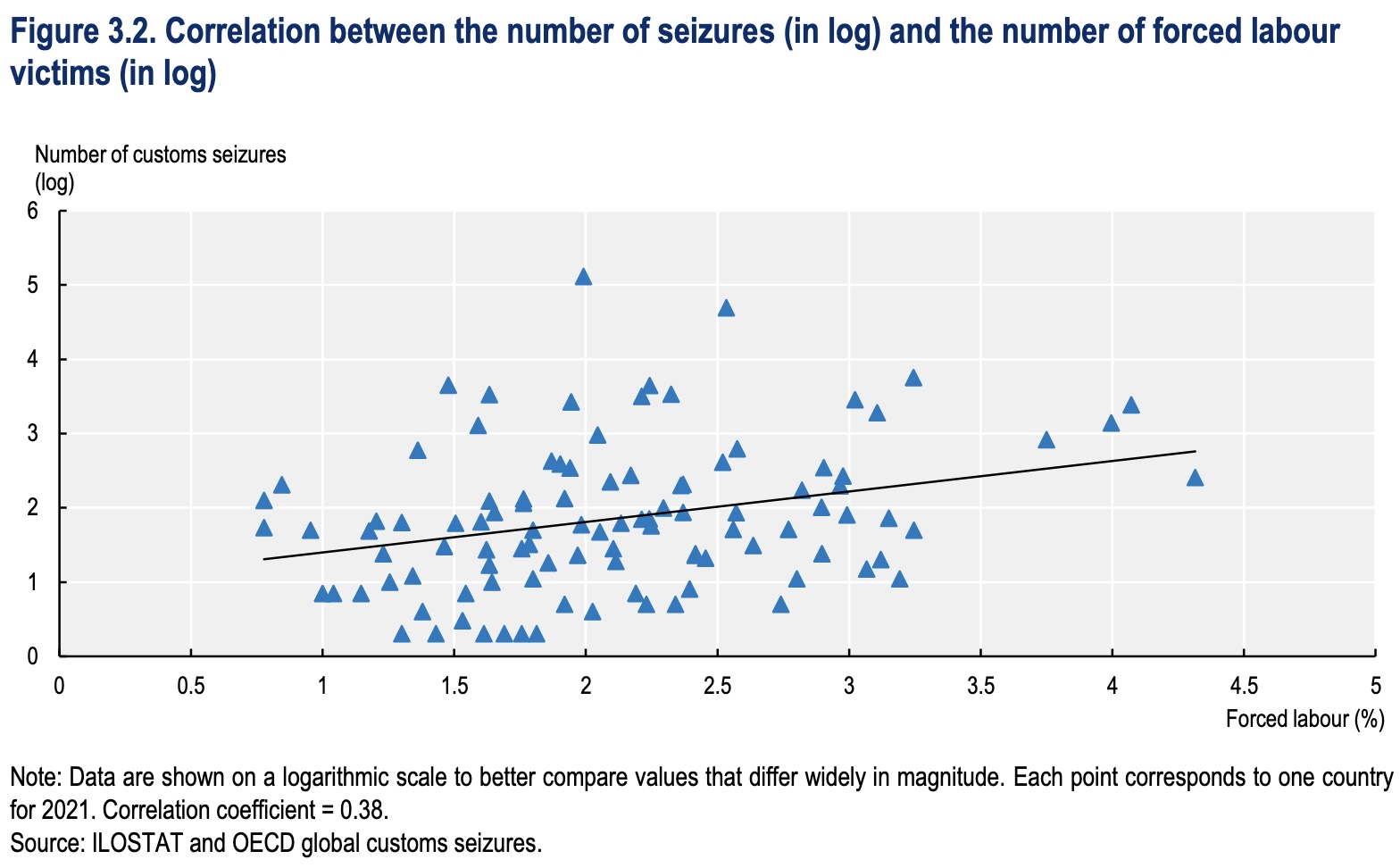
Source: EUIPO-OECD report
Counterfeit trade also plays a big role in human trafficking operations, with studies detailing several instances of migrants selling counterfeit handbags and DVDs to repay traffickers. Organized crime groups often use the same smuggling routes for both human trafficking and the distribution of counterfeit pharmaceuticals, luxury goods and cigarettes, among other fake goods. While the EUIPO-OECD joint report acknowledges that most current evidence linking counterfeit trade to labor exploitation is anecdotal, it consistently shows that exploitative labor practices are employed to reduce the costs of producing counterfeits.
Data analysis in the EUIPO-OECD joint report showed clear positive correlations between illicit trade in counterfeits and labor abuses. Countries cited as origins of counterfeits tended to show higher reported instances of hazardous child labor, forced labor victims and workplace fatalities. Further, those countries also tended to report higher rates of workers in unregulated or undocumented jobs as well as lower levels of trade union representation and collective bargaining. While cautioning that these correlations do not reflect causal mechanisms, the report notes that environments where worker protections are weak could be facilitating the development of illicit trade networks.
Report Urges Better Labor Enforcement Mechanisms, More Clean Trade Zones
Weak governance, limited rule-of-law and social vulnerability are prominent characteristics of the environments in which counterfeit trade thrives on exploitative labor practices. Growing awareness of the link between those illicit activities is resulting in regulatory and enforcement measures being implemented to address forced labor, including the Uyghur Forced Labor Prevention Act in the U.S. and EU’s Forced Labor Regulation. However, these measures do not create enforcement mechanisms preventing the use of abusive labor practices by organized crime groups, but rather are designed to prevent counterfeits produced by forced labor from entering the market.
By showing that counterfeiting is a labor market issue and not simply a matter of better IP enforcement in international trade, the report makes clear that anti-counterfeiting efforts need to better address underlying social dynamics that support the profitability of counterfeiting, according to EUIPO and OECD. Stronger enforcement mechanisms against modern slavery would remove a key cost advantage supporting counterfeit trade while also increasing global gross domestic product by more than $600 billion USD. Further, better data sharing between officials investigating labor practices and counterfeit goods would help better identification of illicit activities in either field.
The EUIPO-OECD report concludes with several policy directions that emerge as effective measures for addressing counterfeit trade. Along with stronger labor governance and inspections and better data sharing among investigatory agencies, the report advises better adherence to OECD guidelines for due diligence and multinational companies so companies can better identify and remove forced labor risks from their supply chains. The report also urges expanding the number of clean trade zones certified under the OECD’s Free Trade Zone Certification Scheme to embed decent work principles further into global logistics networks.
![[Advertisement]](https://ipwatchdog.com/wp-content/uploads/2026/01/IP-Author-Jan-22-2026-sidebar-700x500-1.jpg)
![[Advertisement]](https://ipwatchdog.com/wp-content/uploads/2025/12/ClearstoneIP-Jan-27-2026-sidebar-700x500-1.jpg)
![[Advertisement]](https://ipwatchdog.com/wp-content/uploads/2025/11/PTAB-Masters-2026-sidebar-regular-price-700x500-1.jpg)
![[Advertisement]](https://ipwatchdog.com/wp-content/uploads/2025/12/LIVE-2026-sidebar-early-bird-new-700x500-1.jpg)








![[Advertisement]](https://ipwatchdog.com/wp-content/uploads/2021/12/WEBINAR-336-x-280-px.png)
![[Advertisement]](https://ipwatchdog.com/wp-content/uploads/2021/12/Ad-4-The-Invent-Patent-System™.png)





Join the Discussion
No comments yet. Add my comment.
Add Comment