
![[IPWatchdog Logo]](https://ipwatchdog.com/wp-content/themes/IPWatchdog%20-%202023/assets/images/temp/logo-small@2x.png)

 1
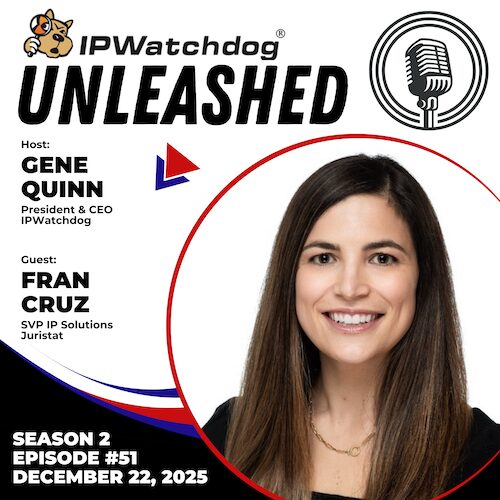
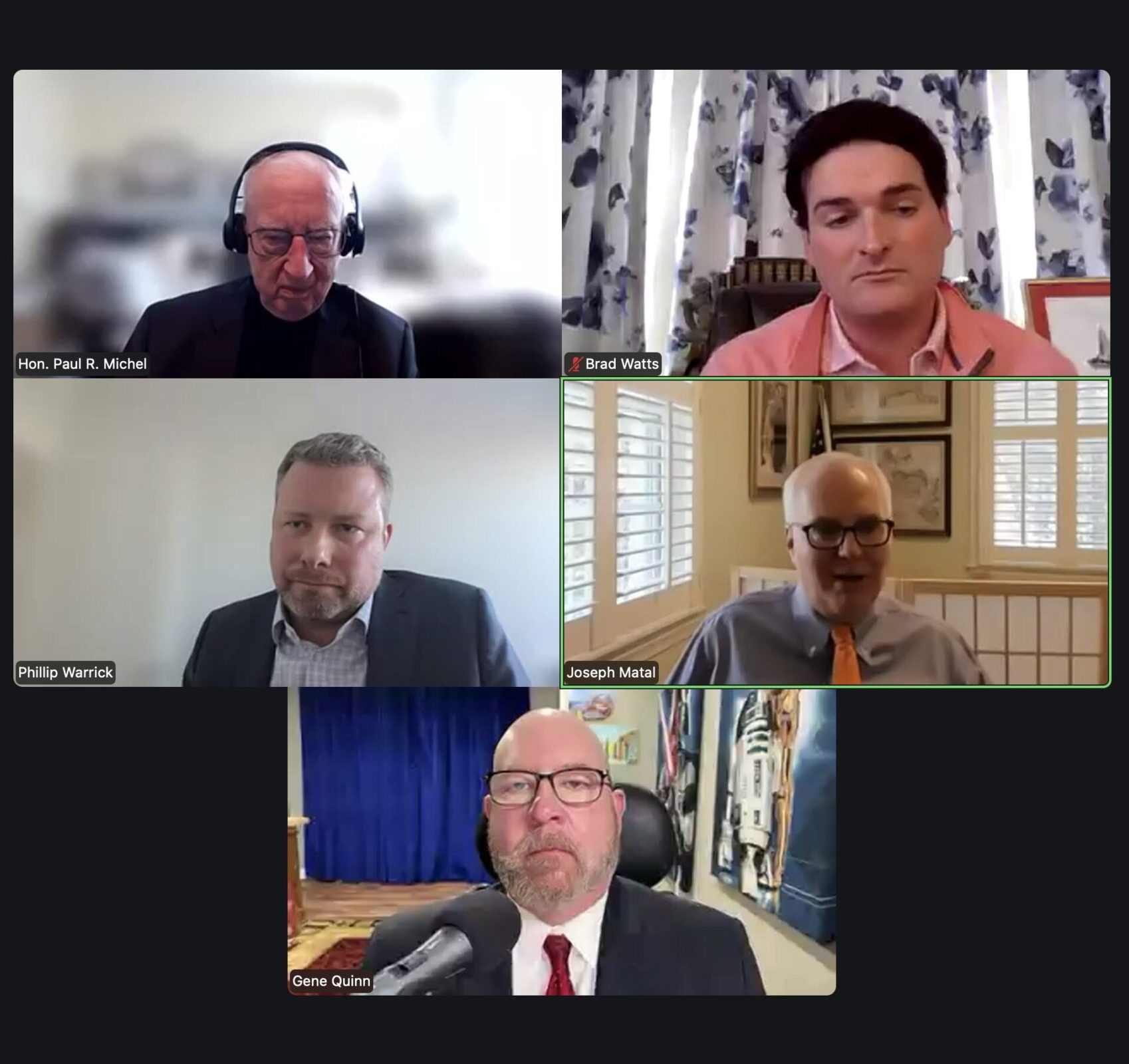
1 As we wind down 2025 it is time to reflect on the year that was, and what the future will bring. This year was punctuated by a structural reset for the U.S. patent system. What unfolded was not just incremental reform, but a coordinated shift driven by leadership change, policy realignment, economic pressure, and accelerating adoption of AI—all converging to reshape how patents are examined, challenged, monetized, and managed. This week on IPWatchdog Unleashed I am joined by Fran Cruz, Senior Vice President of IP Solutions at Juristat, who will be joining us periodically as a co-host as we move into 2026. In this episode Frank and I explore the monumental changes and the biggest trends that impacted the patent and innovation industry during 2025, and which will play an important role in defining 2026.
At the center of this reset was new leadership in the White House, with President Donald J. Trump returning to the Oval Office. And while no President truly involves themselves with day-to-day patent and innovation policy, the people President Trump has placed in positions of authority within our industry are having a tremendous impact. Administrative patent reform started early with the nomination and confirmation of Howard Lutnick as the Secretary of Commerce, and right out of the gate hiring Coke Stewart as Deputy Director of the United States Patent and Trademark Office (USPTO), which put her in position to become Acting Director for the first 8 months of the Trump Administration. Secretary Lutnick clearly gave then Acting Director Stewart marching orders to reform the agency in ways generally only seen after a confirmed Director takes the helm, which put the agency on a new trajectory even as the industry waited for the confirmation of John Squires as Director, which came on September 18, 2025.
 The new Commerce and USPTO leadership has acted as the catalyst for most of the downstream change that we witnessed during 2025. With a renewed mandate to reduce backlog, improve patent quality, and modernize operations, the agency moved decisively—putting speed, accountability, and strategic coherence front and center. And since being confirmed Director Squires has only put his foot on the accelerator, wasting no time as he has put his stamp on patent eligibility policy at the Office, proposed new rules that would significantly curtail the PTAB, and continues to champion innovation and innovators by demanding strong patents that have good and quiet title.
Of course, one of the most consequential outcomes was the aggressive recalibration of post-grant proceedings at the PTAB. Tighter discretionary denial standards, reclamation of institution decisions in the Office of the Director, and stricter real-party-in-interest requirements have created a measurable shift away from IPRs. Patent owners gained leverage as challengers faced friction for the first time in years.
At the same time, 2025 delivered the strongest pro-eligibility signals in over a decade. Through guidance updates, precedential decisions, examiner reminders, and MPEP revisions, the USPTO laid the groundwork for a more predictable and innovation-aligned approach to §101—particularly for software and AI-enabled inventions. While courts ultimately control the doctrine, the agency made clear it intends to examine inventions with an eye toward real-world utility.
Economic realities also forced behavioral change. Significant USPTO fee increases—combined with corporate cost-cutting—pushed in-house teams to rethink portfolio strategy. The year saw sharper filing discipline, aggressive maintenance-fee pruning, fewer RCEs, and closer scrutiny of outside counsel spend. In-house teams became more data-driven, more prescriptive, and more strategic—reshaping firm-client dynamics in the process.
Overlaying all of this was the rapid normalization of AI. The USPTO accelerated internal AI pilots to improve prior-art searching and examination efficiency, while practitioners increasingly adopted AI tools for drafting, searching, and analysis. What was experimental at the start of 2025 became table stakes by year-end. Firms and teams that failed to adapt are falling behind—and quickly.
The year also surfaced tension points that will define the next phase: workforce and examiner culture shifts, changes to interview incentives, uncertainty around patent legislation, the potential of a patent tax, and renewed pressure on university patents and the Bayh-Dole Act framework (See here, here and here). These unresolved issues signal that while the reset has begun, the system is still in motion.
So, join us for a wide-ranging conversation about the biggest moments of 2025 and what this likely means for the future.
More IPWatchdog Unleashed
You can listen to the entire podcast episode by downloading it wherever you normally access podcasts or by visiting IPWatchdog Unleashed on Buzzsprout. You can also listen to IPWatchdog Unleashed conversations on the IPWatchdog YouTube channel. For more IPWatchdog Unleashed, see below for our growing archive of previous episodes.
![[Advertisement]](https://ipwatchdog.com/wp-content/uploads/2026/02/Solve-Intelligence-Feb-5-2026-sidebar-700x500-1.jpg)
![[Advertisement]](https://ipwatchdog.com/wp-content/uploads/2025/12/LIVE-2026-sidebar-regular-price-700x500-1.jpg)



![[Advertisement]](https://ipwatchdog.com/wp-content/uploads/2021/12/WEBINAR-336-x-280-px.png)
![[Advertisement]](https://ipwatchdog.com/wp-content/uploads/2021/12/Ad-4-The-Invent-Patent-System™.png)
Join the Discussion
One comment so far. Add my comment.
Anon
December 23, 2025 12:51 pmGreat context here – looking forward to the IPWatchdog coverage as 2026 unfolds.
Add Comment