
![[IPWatchdog Logo]](https://ipwatchdog.com/wp-content/themes/IPWatchdog%20-%202023/assets/images/temp/logo-small@2x.png)
 0
0 In our latest IPWatchdog Unleashed podcast, I spoke with Rob Sahr, shareholder at Wolf Greenfield and co-chair of our 2025 Life Sciences Masters™ program. Our conversation zeroed in on a hard truth the public rarely sees: moving a molecule from early discovery to an FDA-approved therapy requires a chain of scientific and economic miracles—and every one of them leans on a reliable patent system.
In this conversation, we discuss the extraordinary journey from molecule to medicine. Together, we explore how scientific breakthroughs depend not only on research and capital, but also on a stable and predictable patent system. From double patenting and government funding to judicial uncertainty and policy headwinds, our conversation dives into the fragile balance between innovation and patent policy—and the many scientific miracles required to bring new drugs to life.
A Life Sciences Journey
Rob’s journey from neuroscience PhD to law student to patent attorney is a testament to the deep interplay between science and law in the biopharmaceutical industry. Inspired by a course titled “Brain the Final Frontier” during his time at SUNY Albany, Rob’s passion for neuroscience ignited, fueling his future transition into the pharmaceutical realm and eventually into patent law. Rob’s path through the life sciences industry underscores the myriad challenges and triumphs involved, and what he refers to as the miracles necessary to move from discover to drug candidate to FDA approved drug that will hopefully change lives. As Rob highlights, understanding the science is just the beginning; it’s about navigating those early stages of research and the rigorous process of drug development, which requires capital—with the patent system providing the incentive for those with funds to invest in future treatments and therapies.
The Long Road From Idea to Drug Candidate
A significant focus of our conversation was demystifying the often-misunderstood drug development process, especially regarding government involvement. All too often the public—and media and politicians alike—mistakenly claim the government is responsible for drug discovery and bringing drugs to market. You’ve probably heard the refrain—we’ve paid for those drugs already, so why is big pharma allowed to charge us for what we’ve already paid for?
Rob candidly challenges the narrative that the government completely funds and enables drug discovery, illuminating the critical, albeit supplementary, role it plays. “Government funding is vital,” Rob acknowledges, “but it only sets the foundation—private sector innovation advances potential therapeutics to actual, viable treatments.” Indeed, Rob is exactly right. There is a significant misconception that the miracles of drug development are a direct output of government-backed research, but as Rob points out, such breakthroughs require consecutive miracles and massive investments from the private sector. In fact, it is better to think of government funding—which is much less than 1% of the overall cost to bring a drug through FDA approval and to market—as seed funding. The government funds basic science too speculative for any private sector company to fund. So, while government funding is very important it is simply false to say or suggest that government seed funding pays for the development, clinical trials and eventual marketplace entry.
Patent Law is Critical in Making Miracles Possible
Not surprisingly, recurring theme of our conversation is the indispensable role patent law plays in encouraging innovation within the life sciences sector. As Rob noted, strong patent protections are essential for attracting the necessary investments to bring pioneering drugs to market. Here Rob raises concerns about recent judicial decisions that have introduced complexities into patenting processes, with double patenting and eligibility issues, casting shadows over the ability to obtain any protection, or at least the full protection the Patent Act envisions. This legal uncertainty has been a drag on investment and innovation, and has forced innovators to abandon certain pursuits, including innovation relating to diagnostics.
Challenges and Hope for the Future
Our dialogue concluded with reflections on the future of life sciences and patent law. Although there are concerns about diminished research opportunities, especially in diagnostics due to patent ineligibility issues, Rob remains optimistic. Despite the policy headwinds, Rob remains confident that the life sciences sector will continue to deliver breakthroughs. The industry hasn’t shut down; it’s adapting. Companies still want to solve impossible problems. Scientists still want to fix disease.
But the pace and diversity of innovation will depend heavily on whether the U.S. restores predictability in patent law. Eligibility reform, double-patenting clarity, and a return to statutory grounding would go a long way toward stabilizing the innovation ecosystem.
More IPWatchdog Unleashed
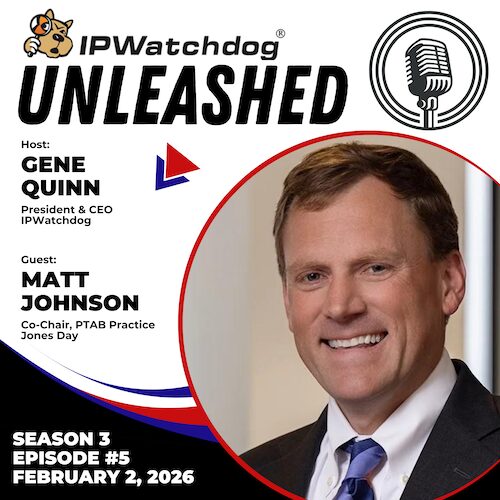
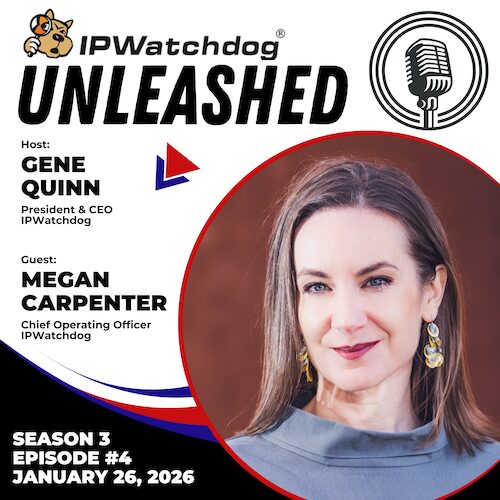
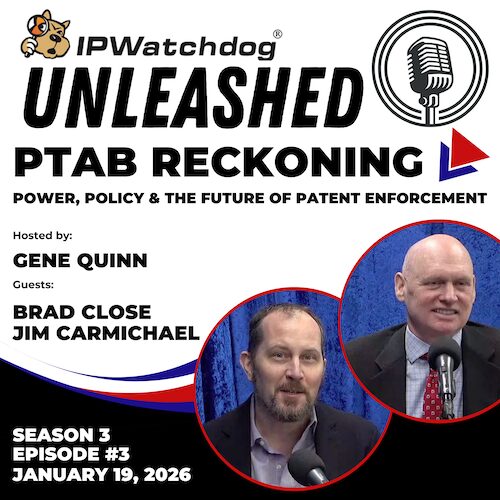
You can listen to the entire podcast episode by downloading it wherever you normally access podcasts or by visiting IPWatchdog Unleashed on Buzzsprout. You can also watch IPWatchdog Unleashed conversations on the IPWatchdog YouTube channel. For more IPWatchdog Unleashed, see below for our growing archive of previous episodes.
![[Advertisement]](https://ipwatchdog.com/wp-content/uploads/2026/02/Junior-AI-Feb-10-2026-sidebar-CLE-700x500-1.jpg)
![[Advertisement]](https://ipwatchdog.com/wp-content/uploads/2026/02/Anaqua-Feb-12-2026-sidebar-700x500-1.jpg)
![[Advertisement]](https://ipwatchdog.com/wp-content/uploads/2026/02/Ankar-AI-Feb-17-2025-sidebar-700x500-1.jpg)
![[Advertisement]](https://ipwatchdog.com/wp-content/uploads/2025/12/LIVE-2026-sidebar-regular-price-700x500-1.jpg)



![[Advertisement]](https://ipwatchdog.com/wp-content/uploads/2021/12/WEBINAR-336-x-280-px.png)
![[Advertisement]](https://ipwatchdog.com/wp-content/uploads/2021/12/Ad-4-The-Invent-Patent-System™.png)





Join the Discussion
No comments yet. Add my comment.
Add Comment