


 0
0 “There are ‘growing concerns among small business owners that navigating a patchwork of state AI and privacy laws could hinder their ability to grow and compete.’” – U.S. Chamber of Commerce
 The U.S. Chamber of Commerce Technology Engagement Center (C_TEC) today released its fourth annual report, titled “Empowering Small Business: The Impact of Technology on U.S. Small Business,” analyzing the important role of technology in small business operations, the unprecedented adoption rates of artificial intelligence (AI), and growing concerns about regulatory compliance. The report surveyed 3,870 U.S. small businesses with fewer than 250 employees between June 6 and June 26, 2025, highlighting how emerging technologies are reshaping America’s entrepreneurial sector.
Widespread Adoption of Technology Among Small Businesses
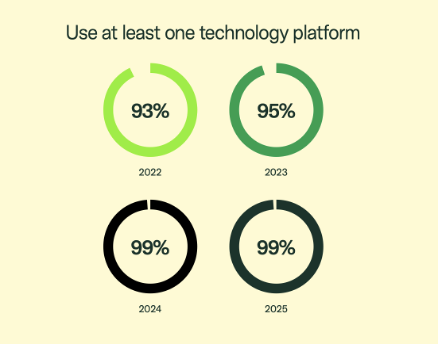
In 2025, nearly all small businesses had adopted technology within their company, with 99% of companies now using at least one technology platform, up from 93% in 2022. The shift in businesses implementing technology platforms signifies a transformation in how small businesses operate in the digital workforce.
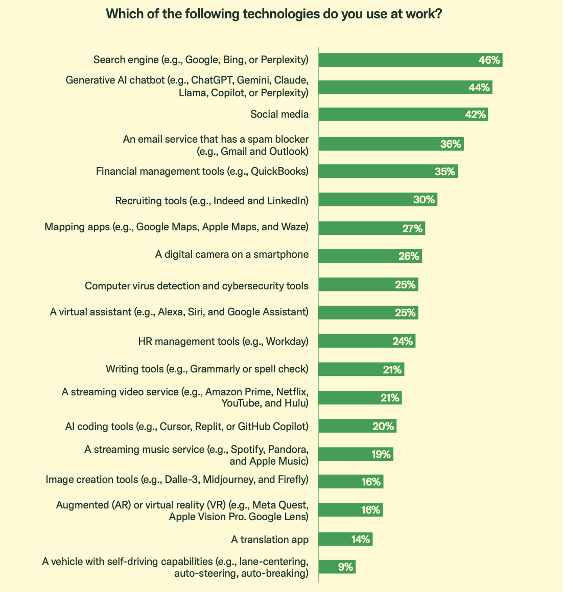
C_TEC’s data underscored that generative AI has emerged as the second most popular technology tool, used by 44% of small businesses, exceeding search engines at 46% and social media at 42%.
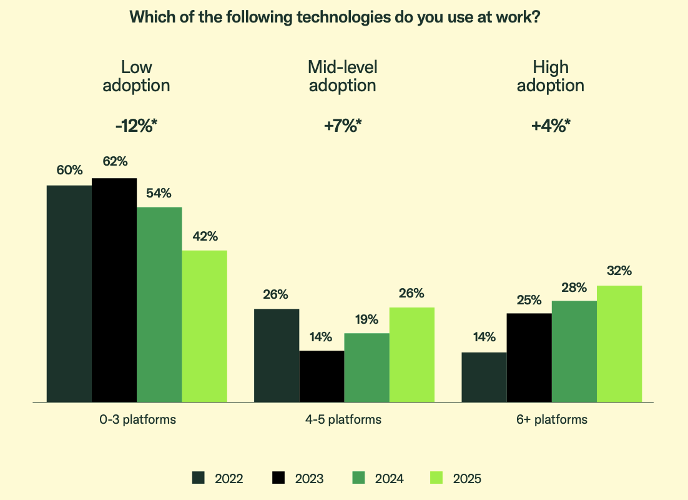
The distribution of technology adoption indicated that “high adopters” that utilized six or more platforms to sustain their business operations comprised nearly one-third of small businesses. The high adoption of technology represented a 4% increase from the previous year, while low adoption businesses, which use 0-3 platforms, decreased by 12%. The report’s findings suggest that small companies are developing a comprehensive approach to technology, rather than relying on any one technological solution.
AI Adoption Increases Across All Business Sectors
In 2025, businesses have doubled their adoption of AI, increasing from 23% in 2023 to 58%. From 2024, the 18% increase defines one of the fastest growing technology adoption rates documented in the C_TEC’s research.
The technology sector leads in AI adoption at 77%, followed by financial services (74%), and entertainment/media (65%). AI usage is widespread across all industries, including traditionally conservative sectors, such as construction (47%) and manufacturing 46%), which show significant adoption rates. Most small businesses (63%) rely predominantly on externally developed AI tools rather than building their own internal solutions, with only 8% taking a completely in-house AI development approach.
80% of small businesses increased their AI implementation plans after learning about their competitors’ usage, as it “helps businesses to remain competitive and thrive despite inflationary, workforce, and supply chain challenges.”
Technology Drives Business Growth
The correlation between technology adoption and business performance continues to strengthen, as high-technology adopters significantly outperform their counterparts across key metrics. Small business owners using AI report remarkable growth rates, including 85% increased sales, 84% profit growth, and 82% increased their workforce. These figures contrast with the 77% sales growth rate of low technology adopters.
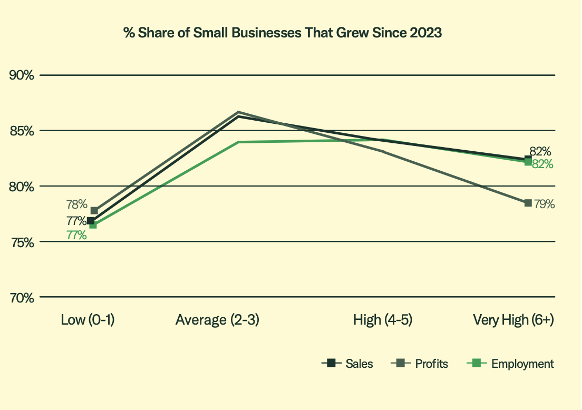
The “% Share of Small Businesses That Grew Since 2023” chart illustrates that the technology performance correlation between very high adopters, who use six or more platforms, achieved 82% sales growth, compared to 77% for low adopters. This pattern holds consistently across sales, profits, and employment metrics, reinforcing the business case for investing in technology.
Small businesses are leveraging technology across operational areas, with marketing and promotions leading at 46%, followed by payroll management at 44%, and customer relationship management at 42%. The variety of applications, from accounting and inventory management to cybersecurity and supply chain optimization, demonstrates how technology has become essential to nearly every area of small business operations.
Cryptocurrency and Emerging Technologies
The report revealed that 96% of small businesses plan to adopt emerging technologies, 77% specifically plan to utilize AI, and 49% considering the adoption of cryptocurrency. Small businesses are demonstrating a strong interest in emerging technologies beyond AI. Businesses that are familiar with cryptocurrency (33%) expect the usage to increase significantly over the next two years.
The telecommunications sector leads cryptocurrency adoption at 61%, followed by technology companies at 48%, and education at 48%. Small business owners express a high interest in stablecoins, with 84% indicating that they would consider using cryptocurrency or stablecoins as part of their business if the implementation were streamlined.
Increasing Concerns About Rules and Compliance
While there is high interest in technology adoption, small businesses expressed concerns about the regulatory landscape. The percentage of companies concerned that changing technology regulations would harm their operations increased by 11 percentage points to 65% in 2025. Likewise, concerns about compliance with various state laws increased by 14 percentage points to 65%. There are “growing concerns among small business owners that navigating a patchwork of state AI and privacy laws could hinder their ability to grow and compete,” said a press release issued by the Chamber.
Only 31% of small businesses feel well-prepared to comply with the proposed AI laws that would require disclosure of AI use, risk assessments, and human oversight of consequential decisions. 95% of businesses expect difficulties in complying with regulations, with the main concerns being staying updated on new requirements (35%) and uncertainty regarding the regulations’ applicability (26%).
Among businesses currently using AI, 77% report that restrictions on the technology would have a negative impact on their growth, operations, and profitability. The potential effects of regulations extend beyond just compliance costs: 33% of respondents say that AI regulations would increase their expenses related to AI, 29% would utilize fewer AI platforms, and 28% would decrease their use of AI applications if new regulations were implemented.
Data Access Competitiveness
The report emphasized the crucial role of data access in enhancing the competitiveness of small businesses. About 75% of respondents believe that limiting their access to data would negatively impact their profits, while 76% regard such restrictions as slowing their ability to grow. Concerns also extended to targeted advertising, with 73% of businesses indicating that losing targeted advertising would harm their business operations.
The ability to collect, analyze, and utilize customer data has become a crucial factor in competing with larger companies, making restrictions on data access a challenge to advance. With regulation uncertainty regarding AI and data privacy, it is identified as a potential challenge for ongoing technology innovation.
The report concluded with policy recommendations such as eliminating the patchwork of state AI regulations; “modernizing and digitizing government”; and “enacting smart national data privacy legislation” to promote innovation while mitigating risks.
Image Source: Deposit Photos
Image ID: 21279887
Author: tashatuvango
![[Advertisement]](https://ipwatchdog.com/wp-content/uploads/2026/10/Questel-Oct-22-2026-sidebar-700x500-1.jpg)
![[Advertisement]](https://ipwatchdog.com/wp-content/uploads/2026/10/ClaimHit-Oct-28-2026-sidebar-700x500-1.jpg)
![[Advertisement]](https://ipwatchdog.com/wp-content/uploads/2026/09/Life-Sciences-2026-sidebar-early-bird-ends-Oct-25-700x500-1.jpg)
![[Advertisement]](https://ipwatchdog.com/wp-content/uploads/2026/09/WE-BUY-PATENTS-SIM-IP-Ad-1-revised-on-Sep-28-2026-700x500-1.jpg)
![[Advertisement]](https://ipwatchdog.com/wp-content/uploads/2024/09/Patent-Prosecution-Training-sidebar-700x500-2025-03-27.jpg)







![[Advertisement]](https://ipwatchdog.com/wp-content/uploads/2021/12/WEBINAR-336-x-280-px.png)
![[Advertisement]](https://ipwatchdog.com/wp-content/uploads/2021/12/Ad-4-The-Invent-Patent-System™.png)






Join the Discussion
No comments yet.