![[IPWatchdog Logo]](https://ipwatchdog.com/wp-content/themes/IPWatchdog%20-%202023/assets/images/temp/logo-small@2x.png)
Other Barks & Bites for Friday, February 6: Counterfeit Study Shows 41% Fail Product Safety Standards; USPTO De-Designates PTAB Precedentials on RPI Amendments
This week in Other Barks & Bites: Senator Ted Cruz (R-TX) calls for a federal framework for deploying self-driving cars to replace the state patchwork negatively impacting U.S. dominance in the field; a major apparel industry organization releases a study showing that nearly half of counterfeit products test positively for high levels of hazardous chemicals; Novartis issues guidance calling for its first annual operating profit loss in a decade due to patent expirations to blockbusters Entresto and Xolair; and more.
Steve Brachmann
February 6, 2026, 01:43 PM
 0
0
![[Advertisement]](https://ipwatchdog.com/wp-content/uploads/2026/02/Junior-AI-Feb-10-2026-banner-with-speakers-1500x500-1.jpg)
CAFC Agrees Content Sharing Patents are Ineligible in Win for Walmart
he U.S. Court of Appeals for the Federal Circuit (CAFC) on Thursday affirmed a Western District of Texas decision granting Walmart, Inc. summary judgment that Q Technologies’ content sharing patents are invalid as patent ineligible. The opinion was authored by Judge Lourie. Q Technologies owns U.S. Patent 9,635,108, 10,567,473 and 10,594,774, all of which are titled “Systems and Methods for Content Sharing Using Uniquely Generated Identifiers” and share a common specification.
Eileen McDermott
February 5, 2026, 01:32 PM
1
Federal Circuit Affirms Noninfringement Finding in Ladder Patent Dispute
The U.S. Court of Appeals for the Federal Circuit (CAFC) on Thursday affirmed a district court’s grant of summary judgment of noninfringement in favor of Tricam Industries, Inc. in a patent infringement suit brought by Little Giant Ladder Systems, LLC. The decision held that Tricam’s ladders did not infringe Little Giant’s patent, either literally or under the doctrine of equivalents, and that the district court correctly construed the key claim term “cavity.”
Rose Esfandiari
February 5, 2026, 12:15 PM
0
CAFC Affirms Summary Judgment Ruling in Patent Suit Against NASA Mars Helicopter Subcontractor
The U.S. Court of Appeals for the Federal Circuit (CAFC) on Wednesday affirmed a district court’s grant of summary judgment in favor of AeroVironment, Inc. in a patent infringement suit brought by inventors Paul and David Arlton. The decision held that AeroVironment’s affirmative defense under 28 U.S.C. § 1498 covered all of its alleged infringing activities related to the Ingenuity Mars helicopter. AeroVironment cross-appealed the district court’s denial of its motion for attorneys’ fees.
Rose Esfandiari
February 4, 2026, 03:15 PM
0
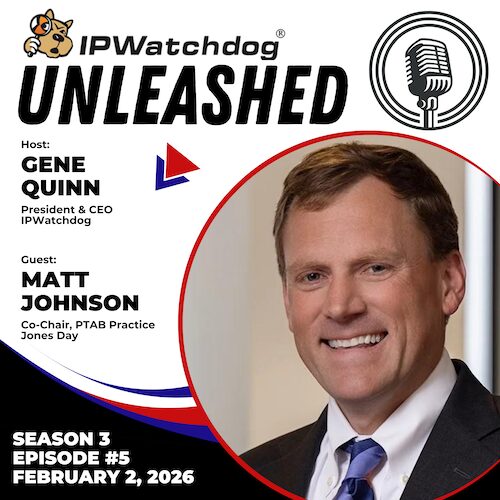
Inside the PTAB Reset: Practical Fixes for a Reengineered PTAB | IPWatchdog Unleashed
In this episode of IPWatchdog Unleashed, I speak with Matt Johnson, Co-Chair of the PTAB Practice at Jones Day, and we take an in-depth look at the Patent Trial and Appeal Board (PTAB) nearly a decade and a half after its launch. Johnson and I discuss the ongoing PTAB reset at the United States Patent and Trademark Office (USPTO) and suggest practical fixes for a better, reengineered PTAB. The majority of the conversation is devoted to concrete, targeted reform suggestions that would lead to a better functioning PTAB and more streamlined IPR review system. Instead of abstract complaints, Johnson proposes narrowing PGR estoppel to encourage early challenges, moving IPR estoppel to the point of institution to eliminate gamesmanship, separating institution decisions from full merits adjudication to reduce confirmation bias, and rethinking quiet-title concepts to better align notice to implementers with settled expectations of patent owners.
Gene Quinn
February 3, 2026, 03:29 PM
1
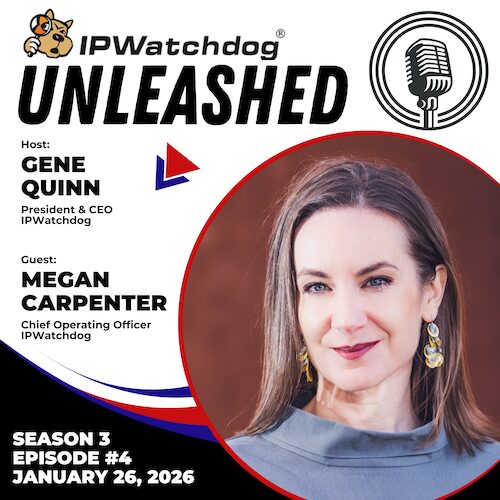
Strengthening IP Enables Human Creativity and Economic Mobility | IPWatchdog Unleashed
In this week’s episode of IPWatchdog Unleashed, I speak with Megan Carpenter, who just recently stepped down as Dean of UNH Franklin Pierce School of Law after more than eight years. Our conversation was part personal journey and business philosophy together with a candid assessment of the IP ecosystem. We tackle emerging issues, including AI’s impact on legal practice and education. And we discuss the role of IP as essential to sustaining innovation in a rapidly evolving global economy, and fostering human creativity, innovation, and economic mobility.
Gene Quinn
January 27, 2026, 11:56 AM
1
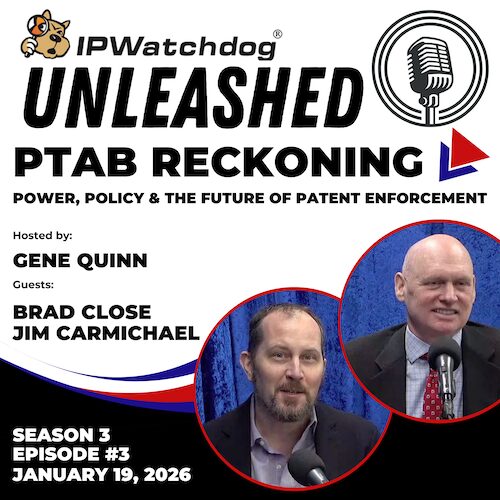
Why PTAB Reform Alone Won’t Save the U.S. Patent System | IPWatchdog Unleashed
In the latest episode of IPWatchdog Unleashed, I sat down with my good friends Brad Close, who is the Executive Vice President of Transpacific IP, and Jim Carmichael, a former judge on the Board of Patent Appeals and Interferences and founder of Carmichael IP. Brad, Jim and I engaged in a candid conversation that provides our unvarnished assessment of the Patent Trial and Appeal Board (PTAB), where it started historically, where it is today, and where it may finally be headed. Bottom line: the PTAB is no longer the automatic execution squad it once was, but durable patent rights will require reform well beyond the agency level.
Gene Quinn
January 20, 2026, 09:58 AM
1
![[Advertisement]](https://ipwatchdog.com/wp-content/uploads/2026/02/Anaqua-Feb-12-2026-banner-1500x500-1.jpg)
Judge Wolson Issues Key Summary Judgment Ruling on Eve of Trial in Arbutus v. Moderna
On February 2, 2026, U.S. District Court for the Eastern District of Pennsylvania Judge Joshua D. Wolson, sitting by designation in the U.S. District Court for the District of Delaware, made several key summary judgment rulings in advance of trial in Arbutus Biopharma Corporation and Genevant Sciences GmbH (collectively “Arbutus”) v. Moderna, Inc. and ModernaTx, Inc.
Dan Shores
February 4, 2026, 01:15 PM
0
USPTO De-Designates Two PTAB Decisions on RPIs in Light of Corning Optical
The U.S. Patent and Trademark Office (USPTO) de-designated two decisions having to do with real-parties-in interest from precedential status on Tuesday. The Office de-designated Proppant Express Invests., LLC v. Oren Techs., LLC, IPR2017-01917, Paper 86 (PTAB Feb. 13, 2019); and Adello Biologics LLC v. Amgen Inc., PGR2019-00001, Paper 11 (PTAB Feb. 14, 2019). According to a USPTO email sent Tuesday, both decisions conflict with the decision in Corning Optical Communications RF, LLC v. PPC Broadband Inc., IPR2014-00440, Paper 68 (PTAB Aug. 18, 2015) (precedential).
Eileen McDermott
February 4, 2026, 08:15 AM
0
Inside the PTAB Reset: Practical Fixes for a Reengineered PTAB | IPWatchdog Unleashed
In this episode of IPWatchdog Unleashed, I speak with Matt Johnson, Co-Chair of the PTAB Practice at Jones Day, and we take an in-depth look at the Patent Trial and Appeal Board (PTAB) nearly a decade and a half after its launch. Johnson and I discuss the ongoing PTAB reset at the United States Patent and Trademark Office (USPTO) and suggest practical fixes for a better, reengineered PTAB. The majority of the conversation is devoted to concrete, targeted reform suggestions that would lead to a better functioning PTAB and more streamlined IPR review system. Instead of abstract complaints, Johnson proposes narrowing PGR estoppel to encourage early challenges, moving IPR estoppel to the point of institution to eliminate gamesmanship, separating institution decisions from full merits adjudication to reduce confirmation bias, and rethinking quiet-title concepts to better align notice to implementers with settled expectations of patent owners.
Gene Quinn
February 3, 2026, 03:29 PM
1
Patent Reset: 2025’s Pivotal Moments and What Comes Next
As we wind down 2025 it is time to reflect on the year that was, and what the future will bring. This year was punctuated by a structural reset for the U.S. patent system. What unfolded was not just incremental reform, but a coordinated shift driven by leadership change, policy realignment, economic pressure, and accelerating adoption of AI—all converging to reshape how patents are examined, challenged, monetized, and managed. This week on IPWatchdog Unleashed we explore the monumental changes and the biggest trends that impacted the patent and innovation industry during 2025, and which will play an important role in defining 2026.
Gene Quinn
December 22, 2025, 04:05 PM
1
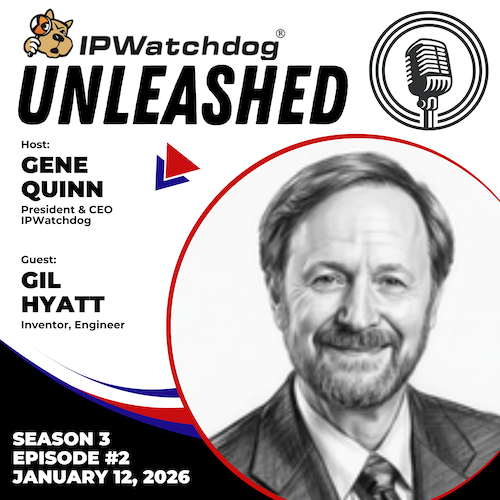
Pioneering AI Innovations and Legacy: A Conversation with Inventor Gil Hyatt / IPWatchdog Unleashed
This week on IPWatchdog Unleashed, I sat down with prolific inventor Gil Hyatt, exploring his innovative journey and aspirations to leave a lasting legacy. One of the key highlights of the conversation was Gil’s creation of a non-profit Pioneering AI Foundation, which is aimed at advancing AI technology and bolstering U.S. economic interests. This non-profit organization is set to hold Gil’s substantial portfolio of AI patent applications, which cover his pioneering work dating back to the 1980s, and includes groundbreaking claims in artificial intelligence that could revolutionize sectors like education, manufacturing, and trade.
Gene Quinn
January 13, 2026, 02:15 PM
4
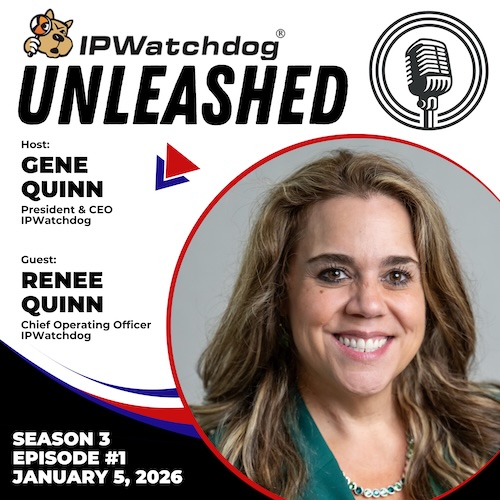
Entrepreneurship, Innovation and Becoming a Patented Inventor: Behind the Scenes with Renee Quinn
This week on IPWatchdog Unleashed, I sat down with my business and life partner, Renee Quinn. In addition to telling Renee’s story about how she found her way into the intellectual property world, and through our sometimes-comical banter, we together explore what it really takes to build, sustain, and continuously reinvent an entrepreneurial company like IPWatchdog. What emerged was a practical roadmap for entrepreneurship, invention, navigating platform risk, and focused on the necessity of constantly being ready to pivot as old business models start to show signs of age and ultimately falter. From Renee’s journey from IP outsider to patented inventor, to firsthand lessons learned navigating Amazon’s reseller ecosystem, the discussion highlights how intellectual property operates in the real world, not the classroom.
Gene Quinn
January 6, 2026, 02:15 PM
1
Varsity Sponsors
![[Advertisement]](https://ipwatchdog.com/wp-content/uploads/2026/02/Anaqua-Feb-12-2026-sidebar-700x500-1.jpg)
![[Advertisement]](https://ipwatchdog.com/wp-content/uploads/2025/12/LIVE-2026-sidebar-regular-price-700x500-1.jpg)

Latest Podcasts


IPWatchdog Events
CLE Webinar: How to Prompt AI – A Hands-On Workshop for Patent Prep and Pros
February 10 @ 12:00 pm - 1:00 pm ESTWebinar: IP at Risk – Avoiding Costly Compliance Mistakes in Export Controls
February 12 @ 12:00 pm - 1:00 pm ESTWebinar: Optimizing the Chemistry Drafting Process – Where AI Actually Helps
February 17 @ 12:00 pm - 1:00 pm ESTWebinar: Resurrecting Antibody Genus Protection – Allowed Claims Through CDR-Scanning
March 5 @ 12:00 pm - 1:00 pm ESTIPWatchdog LIVE 2026 at the Renaissance Arlington Capital View
March 22 @ 1:00 pm - March 24 @ 7:00 pm EDT
Industry Events

Subscribe to IPWatchdog
This is the best way to stay informed. We send a daily roundup of our latest news, press releases, and events.
Get Email Updates
Sponsored Content





Recent Podcasts
![[Advertisement]](https://ipwatchdog.com/wp-content/uploads/2021/12/WEBINAR-336-x-280-px.png)

Press Releases