
![[IPWatchdog Logo]](https://ipwatchdog.com/wp-content/themes/IPWatchdog%20-%202023/assets/images/temp/logo-small@2x.png)
Transcript: Brian Hinman on IPWatchdog Unleashed, Season 1, Episode 26
TRANSCRIPT: Brian Hinman
IPWatchdog Unleashed, Episode 26, December 2, 2024
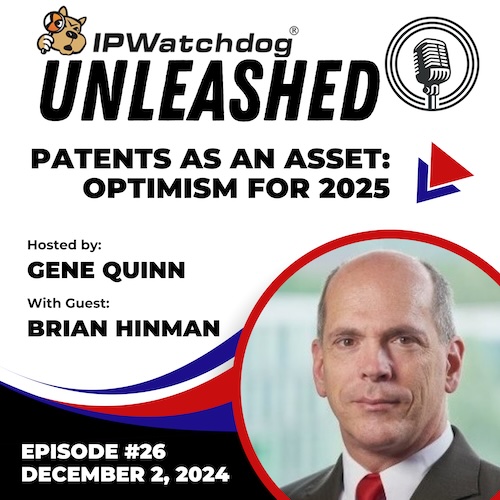 RENEE QUINN: Hello everyone, welcome to IPWatchdog Unleashed, where each week we journey into the world of intellectual property to discuss the laws, news, policy and politics of innovation, technology and creativity. With analysis and commentary from industry thought leaders and newsmakers from around the world, IPWatchdog Unleashed is hosted by world renowned patent attorney and the founder of IPWatchdog.com, Gene Quinn, who has twice been named one of the most influential people in the intellectual property community and recognized numerous times as one of the top IP strategists in the world. Take it away, Gene.
GENE QUINN: Thanks, Renee. And thank you for joining us again this week for another episode of IP Watchdog Unleashed. This week, my conversation is with Brian Hinman, who is one of the leading IP executives and investors in the world.
Brian has held senior executive positions at leading technology companies, including IBM, Philips and Verizon. After spending more than six years as Chief Innovation Officer for Aon, today he is the Chief IP Officer for Coat Capital, which works to find, fund and scale the next generation of technology companies with breakthrough innovations that can deliver greener, more sustainable, more efficient and effective manufacturing, which can lay the foundation for bringing advanced manufacturing back to America.
During our conversation, Hinman explains how Coat provides capital for scaling manufacturing and operations with IP assets-backed investment and with those assets including designs, patents, trade secrets, know-how, copyrights, proprietary equipment, customer contracts and even data. The way Hinman describes this IP asset-backed investment strategy sounds a lot more owner-friendly and startup-friendly than a typical venture capital round of investment. Which is not to say anything bad about venture capital or the venture capital business, but when VCs come in, they often want quite a lot of the company, frequently more than half of the company, in order to make an investment.
In exchange for an investment in the company, Hinman says they receive a percentage of the company’s revenue in the forms of an IP royalty that is paid quarterly. And if there is an exit at some point, the investors get a percentage of that exit, but ownership of the company stays in the hands of the founders. During our conversation, we also discussed pending legislation, particularly the Restore Act, which would effectively overrule eBay and create a presumption that a permanent injunction is the proper remedy.
With Hinman explaining that the legislation places the burden on the infringer to demonstrate that a permanent injunction is not warranted, which according to him is the way it should be. And we discussed Hinman’s belief that the next director of the patent office in the United States should not come from the world of big tech, and that it is important for President-elect Trump to nominate somebody who brings the innovator’s perspective. Someone who has not only advised patent owners, but who has real familiarity with innovation and advising innovators.
In other words, someone who will promote the virtues of innovation. Without further ado, here’s my conversation with Brian Hinman.
Hi Brian, thanks for joining me here today. It’s good to talk to you.
BRIAN HINMAN: Yeah, great seeing you again Gene.
GENE QUINN: Yeah, we kind of fell out of touch a little bit there. I’m glad to be back in touch with you. It’s always good to hear from you. Before we get going too far into the conversation, why don’t you just tell people what you’re doing now, currently.
BRIAN HINMAN: Yeah, so I left Aon, I think it was back in June, really to look at different ways, really a new way to conduct IP-based lending. So Aon, if you recall, Aon IP Solution moved its IP insurance brokers and the quality of IP evaluators for mergers and acquisitions that they were doing into Aon’s main business entity. And Louis Lee, who was the CEO, formed a new entity, Moat Metrics, that does real evaluations and IP analytics.
I think Aon revolutionized the IP-based lending because they coupled it with the insurance offering to create a backstop to protect the loans against default. And unfortunately, the insurance industry got a little spooked or skittish for a variety of reasons. And the industry’s really trying to rebound from that, trying to get smarter about it.
And the insurance will eventually come back, but IP-based lending in and of itself is not going away. It’s such an important asset class. As you know, the intangible assets generally are extraordinarily valuable and critical to companies.
And being able to offer such IP-based lending to growth companies seeking capital is really such a huge solution. So, what I’ve done in June, actually it was back in March, I joined Cody Capital. And really, we’ve got a mission of finding funding and scaling a new generation of technology companies that have these kind of breakthrough innovations or IP.
So, we use IP-focused investment model that’s really structured to be less dilutive of the ownership of these companies and their founders and produce uncorrelated returns for investors. So whereas Aon was focused on debt lending, providing debt capital, we’re providing a form of equity capital. We’re looking for companies that have IP that directly correlates to the company’s revenue stream, just like we did at Aon, and can lay a foundation for really what we’re focused on, bringing advanced manufacturing back to the U.S. And the growth companies already have an established revenue stream, a strong portfolio of IP, and really an existence of having secured capital. So we’ve got three real prongs to the go-to-market strategy. We’ve got an asset-backed focus, an income-producing focus, and a scaling services focus. So first, we provide capital for scaling the company’s manufacturing and operations, really to help customers meet their demand for the IP advantages in their products as they enter markets.
This is all backed by their IP assets, which might include designs, patents, trade secrets, know-how, copyright, proprietary equipment, customer contracts, even data. We call that asset-backed. And secondly, we receive a percentage of the company’s revenue, really in the form of an IP royalty or revenue share, really, to provide our investors with an annual cash yield along the way that’s paid quarterly.
And then we get a percentage of the future company exit. So whether they do an IPO or sell the company or whatever, that serves to buy out the royalty and leaves the equity ownership and control in the hands of the entrepreneurs that are really building it. We call that income-producing.
And then we provide IP managements. So we have folks to do IP management. We have technologists to help them operationally support the business to protect and optimize and scale the company’s assets for future growth.
We call that scaling services. So really, we’re targeting technology companies. That’s our focus generally. And we’re looking for high-growth areas like sustainability, sustainable manufacturing, things like that.
GENE QUINN: Okay. So, I have so many questions now. I mean, because it sounds like it’s very interesting what you’re doing, and it sounds like it is a lot more owner-friendly, like startup-friendly.
And not to say anything bad or wrong about our friends in the venture capital business, but when they come in, they’re often given quite a lot of money, you know, based on where the company is. And they want quite a lot of the company, oftentimes more than half, or at least half the company. So, if I’m hearing what you’re saying is this is maybe an alternative to that as long as there is the ability to service the royalty payments along the way, and then they can buy you guys out before they go to the next round.
BRIAN HINMAN: Absolutely. So, it provides them the opportunity to grow when they need to grow versus bleeding them dry, so that way there’s more of a chance of a default on that loan. We want to help enable them, and that’s where the services come in, so we can actually sit beside them as advisors and help them along the way to make sure that they’re really doing the right things.
GENE QUINN: That’s an interesting model. I think, I mean, there should be an awful lot of interest in the startup and owner community for something like that, I would think. So let me ask you this, and this may be for somebody like you who’s been in this industry for so long, not to date you or anything, but you really know this.
You’ve seen it, the good, the bad, and the ugly across the spectrum here. How do you describe to somebody the difference between the IP-backed lending and the insurance? Because I know, and I think I know what you were just talking about is how Aon got involved in both of those, but it was the insurance market that kind of scared people, not the asset-backed lending part of the market.
Is that right?
BRIAN HINMAN: Yeah. I think the insurance was good for a lot of different reasons, mainly for the lender, right? So, the lender comes in, a private equity firm, say, comes in and they want to, you know, they can agree to provide access to the loans, but they are relying heavily, heavily on the insurance backstop, and the insurers are looking at the valuation, right?
The insurers are saying, okay, we want to make sure that we’re comfortable that the company is going to survive, that their business plan is checked off, and that the value of the IP is sustainable, right? That it really is a direct correlation to that revenue stream, because that’s what we’re insuring. We’re insuring that company, and we’re insuring that value.
So they look at it from both a going concern and a liquidation value, and that’s where I think the disconnect happened, because you’ve got a going concern value, so the company submits a business plan, and over a three- or four- or five-year loan period, they’re saying, I’m going to produce these number of widgets, I’m going to make this amount of revenue, and then I’ll move on, and that’s the term of the loan, and so the investor comes in, okay, I’ve got $100 million I can throw into there, but I’m insuring, in a lot of cases, 100% of that, right? So the insurer’s looking at, from an underwriting perspective, looking at that risk, and the risk is really super important, but they also look at it in a default scenario. So if the company does default, for whatever reason, on that loan, then the insurance kicks in, and then the investor’s saying, okay, pay me, right?
Because I want to be made whole, I know that the company has defaulted, but I don’t care because I got the insurance, right? So that’s why, and the disconnect happened is, it’s really difficult to predict what that value’s going to be at the end of the day. What we’re doing at Cody Capital is saying, okay, we’re going to look in this lens, and we’re going to look at the value and use components.
In other words, if there’s a company that we are providing a loan to that’s got patents relating to semiconductors, but there are use cases beyond that, if there’s companies already practicing that, that’s great, or if they’re, well, I mean, it’s not great, but it provides value because it shows who might be a potential acquirer for this. Or maybe it’s an extension of existing technology that this company’s doing that’s new and different, but we provide the research looking at who might acquire these things at the end of the day. So if there is a default, there’s got to be value in use, otherwise the value is zero.
If nobody’s doing it, nobody’s investing in R&D in that technology space, then the value is really de minimis, and you really don’t have a way to recoup your investment. And that’s where the insurers really got skittish because the value was a lot less than what we had anticipated because there was no value in use. And what we’re doing at Cody Capital is saying, okay, we want that value and use proven upfront, so that way we don’t have that issue.
GENE QUINN: Okay. So, I guess this is totally different than what some of the insurers were out there doing for a while. I don’t know whether they’re still doing it, but they were insuring judgments, for example, which struck me as just, given, and maybe we could talk about this if you want to, but given where the federal circuit is right now, and there’s a spot that they’ll let you have that much, but they won’t let you have probably $500 million or more, and you get, I think, 0% chance of keeping that verdict.
And I think I saw some, Brian, that were insuring billion-dollar verdicts, and I thought, this is going to go really ugly at some point here. But that’s a different part, right, of the sector?
BRIAN HINMAN: That’s totally different. We actually provide a judgment preservation insurance, or at least we brokered that at Aon, and I think they’re still doing that. You scratch your head because it’s a Russian roulette kind of a thing, right?
I mean, you really don’t know what a jury’s going to decide, but in this case, the judgment’s already been there, right? So the jury has said, okay, they’re infringing this, and here’s the award, say it’s $1 billion. But to your point, being able to preserve that judgment, because the insurance doesn’t pay out until the last adjudicated decision is there.
So, all the appeals have been exhausted, $1 billion is the number, and then it’ll pay out. That takes, first of all, a long time. Anything can happen between now and then, a ton of risk, and it’s really, really super hard to preserve a judgment like that, like you said.
GENE QUINN: Yeah, I thought that that was, I mean, maybe we’ll get to a place where, I mean, it shouldn’t be hard, right? In an ideal world, it should be able to figure these out. There will be some that get overturned, there will be some that stand, there’ll be some big, valued numbers that stand, some that go away.
And we’re just not seeing, I think, a healthy, functioning marketplace for patent litigation because of the real restriction on damages at the federal circuit, among other things.
BRIAN HINMAN: Well, and you’ve got, I mean, there are some good things happening legislatively, right? I love the Restore Patent Rights Act of 2024, which is really aiming to remedy the weakening of what I call a weakening of the patent rights following eBay. And it’s really providing a legal right of a patent owner to a rebuttable presumption of injunctive relief upon finding of infringement of the exclusive right that’s been granted by a patent.
I mean, the Constitution really tried to enable that, or at least thought, this is what we want to do for the country, is allow this exclusive right granted by a patent. And that’s what I think the rights act is designed to do. So I think that may help, from a damages perspective, come a long way, right?
GENE QUINN: Yeah, I mean, I agree with that. I think it’s hilarious that you can get an exclusive right granted by the government, and you don’t have the right to exclude once you prove that the person has taken it from you. Once there’s all their defenses have fallen away, once the patent has been confirmed valid, and suddenly this exclusive right becomes non-exclusive.
And it’s just, it’s bizarre on so many different levels. And I think the RESTORE Act is going to be, I think, a hard lift, because I had been hearing that the people who didn’t like it were saying, oh, well, this is just going to codify eBay. And it’s like, no, it’s not what it’s supposed to do.
But then I will tell you, and I went and I looked at it, I kind of saw their perspective. So, what they’re trying to do is get back to where we were before eBay, which was not that you would get an automatic injunction, but that you had this strong presumption of an injunction. And then the other side…
BRIAN HINMAN: It places the burden on the infringer to demonstrate that a permanent injunction is not warranted. That’s where it belongs.
GENE QUINN: Right. No, I agree with that. But do you think that that’s going to change the way judges analyze this stuff?
And because that’s really the question. So, what I was thinking is, is if there’s a concern that they’re still going to apply the equity standards, which I think is in the act, which makes some sense so that you’re not doing stupid stuff. Right.
Like if there’s a global pandemic, maybe we want people to infringe to save the planet as we just coming off of one. Right. You know.
But I think that harm should be irrebuttably presumed. You know, I mean, this is not a situation where if you’re going to allow infringement for a decade, which often happens while you’re waiting for these cases, that that comes with no consequence. That’s a great consequence that you can’t compensate the owner for.
BRIAN HINMAN: Yeah, exactly. And I think that’s why I think this act is really going to, I hope, restore the viability of the patent system as an as an instrument to protect this innovation and hopefully facilitate the financing and monetization of the transfer of technology. So, I mean, there’s a lot of benefits to this.
But to your point, I’m just not sure. I hope it gets the legs that it needs, but we need somebody strong in the patent office. I mean, that’s another question: who’s going to take over. But I think it really has to happen.
GENE QUINN: Do you have any thoughts about that, the patent office?
BRIAN HINMAN: I have a lot of maybe. I think one guy that—or a person profile should not be somebody from big tech because I think it’s a mistake. The FCC Commissioner Carr, he’s publicly stated that big tech is going to be investigated during a second Trump term.
He’s already said that. So, it’s going to be really stupid to have the FCC go after big tech at the same time the USPTO is turning it over to a big tech guy. So, selecting somebody from them, I think, really means status quo and is not going to allow America to really rise to the challenge of competing against China in areas like AI.
And they’ve also been big, you know, big tech’s been supporters of both Biden and Obama administration. So, it’s really hard to imagine that Trump’s going to favor big tech for this kind of job. 18 out of the top 20 petitioners challenging patents at the P-TEB are from big tech.
So again, Apple, Samsung and Google and Microsoft, Intel and Cisco, they’re among the top 10 most active challengers. So, it seems anyone who’s closely associated with with AIA that really created the P-TEB is not going to be the right choice. So I think what we do need is somebody that we need a patent attorney that’s intimately familiar with at least some aspects of the patent system, whether that be through experience representing patent owners in trying to litigate the patents or patent challenges at the P-TEB or somebody that really knows the patent acquisition system.
We need somebody that really has advised patent owners and real innovators and is really going to encourage more innovation in areas like artificial intelligence should be a mandatory prerequisite.
GENE QUINN: Yeah, I couldn’t agree with you any more. I just don’t see this being a big tech. You know, you look at all of President Trump’s, President-elect Trump’s now appointments, and these people do not, whether you like them or you don’t like them, they do not scream status quo.
These are people that are going to change things up, shake things up. And big tech, I mean, particularly if you pick one of the, you know, the Apple, Google, Intel, Microsoft, Cisco crowd that is such heavy users of the PTAB, I mean, I suppose they might change things up and then even put their foot down on the PTAB accelerator even more. But that can’t be the right answer.
I mean, you know, I get into some arguments with people about what the P-TEB stats show. If you really look at what they show is they show that if you get a final decision, you have almost no chance of winning. That’s what they show.
And that was never the case in district court. When you had federal judges hearing these, you had about 30 percent of patents that were challenged that would go down. And now it’s 85 percent of the patents that get all the way to a decision have at least one claim.
They’re defective, you know, and 70 percent of them lose all the claims. I mean, this is just the shooting gallery.
BRIAN HINMAN: Yeah, I mean, a patent was always said to be presumed valid by law, but the act, you know, the AIA for, you know, that created the P-TEB is basically looking at, OK, now we’re going to review it for a second time, the validity of a patent before usually before the proceeding with any infringement case in a lot of cases. So, I mean, it’s just it’s just really it goes against what we’ve really are all about in this in the U.S. Yeah.
GENE QUINN: Do you have any thought, I mean, Prevail moved in the Senate, at least is out of the committee now, and it’s now at the full Senate level. It won’t there’s not enough time for it to get enacted. And even if it did get passed, the House doesn’t have a companion that’s anywhere near close.
So, we’re really continuing to set this up for the next Congress. But do you have a thought on that or on PERA, which still didn’t even quite make it that far? There’s still a lot of resistance there against the eligibility reform.
BRIAN HINMAN: Yeah, I think I mean, once again, you’ve said it, I really don’t know what what’s going to happen in this next administration. It’s it’s going to be difficult, I think, to to get anything done, at least initially. But, you know, the appointees that that Trump makes and, you know, maybe that will help to gather momentum because I really don’t think it’s going to be a status quo type of administration.
We’ve already seen that with the dialogue that’s come across and some of the choices that he’s made. But with respect to patents, I think a lot of it’s going to revolve around, you know, the secretary of commerce and the USPTO director and in being able to help to, I guess, create the right momentum, which hopefully will trickle over to Congress and trickle over to the other administrators to make the right decisions.
GENE QUINN: Yeah, it’s going to be interesting to watch, right, because the candidate, the nominee for secretary of commerce, what I’ve heard about him is he is he’s a patent owner himself, from what I understand. Yes. And that he a firm believer in the patent system and like most patent owners, not particularly fond of the PTAB.
As a matter of fact, I’ve heard he doesn’t like the PTAB at all. But then on the other side, you have Elon Musk, who has said some things against patents, you know, and frankly, I think Elon is right. Elon has said patents are for the weak.
Yes, they are. When you’re when you’re the biggest company in the world like Apple or Google, you don’t need patents. What you need patents for is to get an opportunity to compete against the big players, to get investment.
Exactly.
BRIAN HINMAN: Yeah, because he’s I mean, you might say what you like about Elon Musk. I think his stance on patents, as you said, is very clear. But on the other hand, I think he’s also saying, as you said as well, that, you know, the small companies is what he’s all about.
He’s made it on some of the podcasts on Joe Rogan and some of these others that, you know, he stated, you know, that he’s backing these smaller companies to try and protect their innovation. So, it’s you know, there’s, you know, a lot going on that the commerce director, I do like the pick that he chose, you know, the former CEO of Cantor Fitzgerald. I think he’s a great he’s a great choice.
And I think, you know, he’s a patent owner, like you said, and he is pro innovation.
GENE QUINN: Yeah, that’s what that’s what we need, I think, if you look at just the last 20 years at the patent office, so much of that time has been spent with somebody from big tech involved. And I don’t some people say, oh, well, they’re on the take or they’re and you’re not on the take. I mean, if you spend your career in big tech, working for Microsoft or working for Google, you start that’s the way you see the world.
You know, you don’t have to say that these people are on the take to say that, well, they’re kind of been siloed for so long. They maybe are, you know, drinking the Kool-Aid, you know, and don’t see the forest for the trees.
BRIAN HINMAN: I think, yeah, and I think maybe Dave Kappos might be an exception. Dave is a very dear friend of mine, and we work closely together at IBM. I think it was a very effective USPTO director, Andre Iancu, as well.
I thought he was very, very effective. But, you know, some of the others, I think you’re absolutely correct. It’s there’s a, you know, they’re thinking in their right ear on behalf of big tech.
And as you know, there’s a ton of lobbyists and a ton of money being directed by the contingent in Washington because they have the money to do it, to push their agenda. And the USPTO director, in some cases, you know, will listen to that and perhaps have an influence over those decisions.
GENE QUINN: Yeah, and policy starts with people, so we probably won’t have a really great idea until we know who the nominee is for the patent office. And then they’ll give us a lot of clues, I think. Yes, so as as an investor, I guess you probably you call yourself an investor, right?
You’re investing in companies, whether it’s through insurance or otherwise. I mean, you’re trying to give them financial solutions that allow them to continue to do what they want to do. So, from your money man perspective, what do you think is the right resume or CV for the next director?
We’ve talked about not big tech, but who, and if not a particular person, you know, like what qualities or experiences? You talked about somebody who’s advised a patent owner. But what else do you think is going to make an effective leader?
BRIAN HINMAN: I think it would be great to have somebody that’s actually been through it. So maybe it’s somebody that’s an innovator himself. So, he’s a patent attorney that’s very experienced in seeing all different aspects of the law.
Right. So maybe they’ve got a lot of different, they’re intimately familiar with a lot of the aspects of the patent system. Perhaps they’ve been through representing patent owners in patent litigation or they’ve experienced patent challenges at the PTAB, somebody that really knows the system.
But they’re also an innovator themselves. Maybe they’ve got patents, and they know how, first of all, how challenging it is to get a patent and keep the patent. Perhaps maybe they’ve experienced the PTAB in a negative way or at least seeing the difficulties that that might provide.
You know, they’re a real innovator and they actually have that perspective coming in. So, they know both ends of the spectrum. They know that the big tech has a certain way of thinking, and they can appreciate that.
Maybe they’ve been in big tech at some point, and they can also appreciate, more importantly, the innovators perspective. And that’s really what we’re trying to get somebody in there to really that they’ve not only advised patent owners, but they really have looked at innovation and they’ve advised on innovation, or they’ve been an innovator themselves. I think that’s really somebody to promote the virtues of innovation.
That’s really what we need. Yeah.
GENE QUINN: And you have mentioned a couple of times now that what we need is a patent attorney. And I always just like to point out people will sometimes people will say, oh, that’s the last thing we need. We don’t need an attorney.
We don’t need a patent attorney. We need. Well, the statute actually sort of requires it.
You don’t necessarily maybe have to be a patent attorney with a registration number. But the statute requires that particular job to go to somebody within the industry who understands the substance of the industry.
BRIAN HINMAN: Yes.
GENE QUINN: And that’s different than a lot of other appointments.
BRIAN HINMAN: Patents are a unique animal, and you have to have the experience in having looked and being able to evaluate patent claims, right, the broadness or the narrowness of claims and looking at a lot of the rules around that and what gets patented, what should be patented, what should not be patented. I mean, all that because you’re having an army of people, including patent examiners that are going to report to you and being able to have the experience to direct them or guide them on certain ways of doing business is essential, I think.
GENE QUINN: So, what do you think if you had to look into your crystal ball and make a prediction, what do you think the future is for, say, asset backed financing? Is that really a function of who is the director or the litigation climate or what do you what is it a function of?
Number one. And number two, what do you think moving into 2025? Are you bullish or bearish?
BRIAN HINMAN: I’m very bullish. I’m not sure that it’s as much of a result of of who’s in office or who’s in the USP. I don’t think it has anything to do with that.
I think it has to do with the whole lending environment and innovators out there that in the sources and the uses of capital. Right. So, I mean, there’s lots and lots of great innovators out there, growth companies, right.
Really good technology growth companies that have a lot of innovation that they’ve already invested in. And as you know, with a startup, it’s hard to invest because it costs money to patent. And so, you’ve got important areas like trade secrets that are equally as valuable, but you have to determine that value.
So, it’s going to I think the reason I’m bullish is because I think there’s a broad spectrum of opportunity for firms like ours, for instance, to go in, you know, and find these these growth companies being able to identify the capital, the right capital, because there are investors out there that can appreciate this. And you’re looking for specialty lenders, ones that are beyond the traditional VCs or even the P.E. environment that that go out and they fund because they’re looking to fund companies that, you know, they’re they’re more focused on the revenue portion and looking at the business plan. We’re focused on looking and making that direct connection between IP and the revenue stream.
And that’s where the specialty arms or the specialty legs of these different investors, that’s the ones we’re attracting to because they can appreciate what that brings, because we can determine what that value of the IP is. And that can be used as a real source of, you know, of a reason to provide that capital. Right.
You can provide that as collateral to obtain these loans. And so I think there’s lots of opportunity to do that. I think the insurance will come back.
And, you know, so I’m very bullish on that. We can wait. Right.
I mean, we’re not the kind of loans that we’re providing are going to be without insurance. But at some point, in the future, sure, I’d like to entertain that again. And I think we can educate the insurers again that there’s a different you know, there’s some different folks in town that think about it a different way, the way Aon did and others.
And I think that there’s lots of opportunities to provide this where you’re not raping and pillaging these small startups that are trying to to make money and you’re coming in and taking, you know, providing a huge portion that you’re demanding as a return on that investment. We don’t want that. And I think there are other investors out there that don’t want that either.
You know, we don’t want to provide the traditional debt capital and or even the equity, the straight equity capital that’ll, you know, you sell yourself to the devil for 40 percent of your company. You’re giving up to get this capital. You don’t want to do that to these companies.
It’s just going to cause them a lot of angst and they won’t allow them to grow that the way that they need to grow. Right.
GENE QUINN: How do you even start to value this, though? I mean, a couple of thoughts pop into my head is one. It strikes me as really odd how intangible assets are carried or accounted for, not accounted at all.
Sometimes seems on the books of a company. It’s almost like they don’t exist unless and until you go to sell them. And we know that that’s not true.
I mean, and then they get treated sometimes like they’re a negative value, whether a positive value, because you have to pay to keep maintaining them. And then I have in my head the other thing, too, is what impact does this never-ending battle to fight in the form of your choice have on deciding what the value is? You know, I mean, if you get to fight in the eastern district of Texas, for example, you as a patent owner have a chance.
Most people think, oh, it’s a patent owner friendly jurisdiction. No, if you look at the numbers, it’s slightly defendant oriented, but very slight. I mean, it’s pretty close to 50-50.
But you go to some courts like Northern California, for example, and the patent owner really has almost no chance and not no chance. It’s like no chance to even get started because you’re going to lose a lot of these cases on a motion to dismiss. So how does that factor in the difficulty in figuring out what these things really are on a spreadsheet in an accounting way?
And then the reality of forum shopping. I mean, how does that factor into what you do?
BRIAN HINMAN: Yes. So, the first part of it, even what we tried to do at Aon, because, you know, IP, we tried to establish as a separate asset class, which is an increasingly hard thing to do. And so, we went to one of the things we did was go to the credit agencies, because as you can imagine, the S&P and the, you know, when they do a credit rating of a company, you know, they consider a lot of different factors, and we try to instill in them.
One of the main things we tried to instill in was try and add the IP component to that. So you’re looking at when they’re doing the credit rating of a company, you want to provide the value of the intellectual property as an input to that. So as the analysts, the credit analysts are going out and looking at the credit worthiness of a company, you can consider what that value of the IP is that’s set apart from, you know, the property plant and equipment value and some of these other aspects.
It could be a game changer. You know, we were starting with that education. Unfortunately, we didn’t get there.
But that’s something I think that should be considered. And that would go a long ways to creating this IP as a separate asset class, because if you have a public company that has to quarterly report what that changing value of that IP is over time, there’s going to be a heck of a lot more emphasis on generating that IP and also maintaining the value and making sure that that is growing over time so that, you know, if it’s becoming a requirement for these companies, then determining the value and making sure you’re sustaining it is going to be actually important. The second part of your question, which is really the forum shopping.
Yeah, it’s become that part of a system. I’m here in Texas, in Houston. You know, the Eastern District is, you know, is very close to me.
The Western District of Texas also is becoming very, very hot in El Paso and in jurisdictions like that. And you’re absolutely right. Going to California or even to New York and some of these other jurisdictions, depending on, you know, the I guess the history of the way that these cases have been, you know, adjudicated is difficult.
And so, what you’re seeing is is a whole lobbying effort of big tech and others to push for some of those jurisdictions because they do think they have a better chance. I think over time, this, you know, that will certainly be hopefully will even out such that it will be, you know, it won’t so much be forum shopping because every forum ideally should be the same. Right.
Decision should be really transparent and consistent across all of these different jurisdictions such that you won’t have that forum shopping. But a lot of it does depend on that value. And unfortunately, some of these innovators are struggling with that because they don’t have the resources to really throw these, you know, to defend these cases.
And what you’re seeing is is a lot of this, you know, I guess what they’re calling efficient infringement or predatory infringement, which is very sad, but it all relies on, you know, on an innovator’s ability to, you know, to prove his case. And it’s becoming very difficult.
GENE QUINN: It is becoming increasingly difficult. And one of the things that since, you know, you brought up efficient infringement and then the other side of that are the patent trolls, you know, the people who are just, you know, and they’re bad actors on both sides. And it shouldn’t shock anybody that that’s the case that’s throughout life.
And they’re bad patent owners, too. But I think that that narrative has just always been overblown. But the question that I have is it seems to me that people, rightly or wrongly, look at it different when it is the innovator who got the patent who’s going after somebody.
And maybe also I think if it is, you know, the company didn’t work out, but it’s the investor who the patents have fallen to, the investor who invested the money, then there’s a nexus there where I think it falls apart for a lot of people is when the original investor, the original innovator is not there. Somebody swoops in, buys patents, and then it feels a lot more like it’s a tax on innovators, not because that person’s done anything other than been in the right place at the right time and has a risk tolerance that allows them to buy these and sue. And I wonder, I mean, I know why the property has to be right, because that’s the way that investors get their money back is by selling these things.
But how does that factor into your decision on value, knowing that if you were to sell this downstream to somebody who is, quote, unquote, a patent troll, that that person’s going to have an enormous difficulty with these assets. So they must be worth less to them and worth less to everybody. And it just, it seems like every decision winds up being like dominoes pushing down, you know, like another brick on the barge, right?
It just weighs it down, weighs it down, weighs it down. How do you account for that?
BRIAN HINMAN: Well, I think you and you and I actually had this recent discussion on looking at, for instance, injunctions, right? So, looking at the whole NPE environment. So you’re looking at, you know, when I say NPE, non-price taxing entity, I think of companies that are out there just acquiring and amassing portfolios and then suing, right?
So, it was the former intellectual ventures model when they were out there buying everything, which, you know, which changed. But there are still entities out there that do this, and they use the portfolios just as ammunition to go out and attack, right? And they’re taking advantage of that.
But the innovator himself, right? So, you know, the guy that’s out there creating the innovation and he can’t, unfortunately, doesn’t have the capital to make it. Or maybe he’s tried, but he doesn’t have the capital to set up a manufacturing operation.
It’s a great innovation. It’s a tremendous breakthrough in technology that would be a game changer, but he just doesn’t have the resources to do it, can’t get the investors to buy it. And so then, lo and behold, somebody out there is going out there and says, hey, I’ll give you a million dollars for these innovations, which might be, well, it is less than what is really worth because it’s worth a lot if it was to actually be practiced in the world and actually selling widgets or services, which we’ll never see the light of day if it gets sold to these, you know, NPEs.
So, I think there is a value component there, and it does degrade that value because that value will never be realized because it’s only being used in a certain set of circumstances where a guy’s going to buy the patents, and he’s going to go out and find infringers and go out and assert those, and he will obtain a value through a, you know, a settlement value or litigation value, right, versus the operational value of going out, this could be a billion-dollar company if this guy only had the resources and the capital to make it big. And unfortunately, what you’re seeing is a lot of these companies can’t do it. So, you’re right, there is a value component that’s, it’s really sad.
GENE QUINN: And I think that that’s why the litigation funding is so critically important because it does allow for the owner of the asset to stay in the loop. You get a little bit, usually, contingency representation from the firm, or maybe they’re doing a hybrid situation, and then you get a funder. So, you essentially have three people at the table, the original innovator, the law firm, and the investor.
And the infringers don’t like that. And I, you know, I mean, I, again, understand there are bad actors on both sides. I don’t understand what IP Edge did in Delaware.
I mean, I understand what they did. I don’t understand why they did it, but they did, you know. So, they’re a bad actor, at least in that, for that decision.
They made a bad decision. But that doesn’t mean that this whole industry, and you just hear just ridiculous claims. I mean, like, these are not people that are throwing money around.
I mean, these are wise investment analysts making these decisions. They’re not backing crappy cases. That’s right. At least in my experience.
BRIAN HINMAN: Yeah, I think lit funding has definitely changed the game. I think there are a lot of, and there are a lot of really smart lit funders out there, and they’re picky, and they should be, right? They’re not going to throw money, bad money at, you know, good money at bad money.
So, I mean, it’s just, there are bad situations that they, you know, that they would ordinarily say no to, but they’re looking and filtering and finding those hidden nuggets. And the innovators, you know, it is an opportunity for that innovator to really share in those proceeds, right? So, it has changed the game.
GENE QUINN: Yes, it certainly has, and hopefully it’ll continue to change it for the better. But I, you know, I appreciate that you think next year is going to be a good year, and you’re not bearish about this. I don’t know anymore.
You know, I just don’t know. I mean, I want to be excited every year. Every year I hope that the next year is going to be better.
And maybe this time there’s a little bit of difference, because depending upon who President Trump puts in the Patent Office, we will maybe get more of a cheerleader that’s pro-innovation. And I think that that could go a long way for setting the tone. Because I do think, and maybe you could comment on this.
I do think a big piece of the problem the industry has faced is just never-ending criticism in the popular press and from our politicians about the patent system. And nobody wants to be an innovator anymore. Why would you?
Because you’re blamed for everything.
BRIAN HINMAN: Yeah, and you’re right. There’s a lot of media attention to it. A lot of misleading information and incorrect information out there.
And, you know, I don’t know what people believe. Hopefully, and I am hopeful that the right dialogue will occur if the right person is there to share that message directly. So maybe that’ll change that spectrum a bit.But yeah, I am hopeful.
GENE QUINN: Good, good. Well, I really appreciate you taking the time to chat with me here today. This has been great.
Is there anything that you want to leave the audience with? Any thoughts about whether it be the industry or about next year or predictions? I’ll give you an opportunity to wrap up.
BRIAN HINMAN: Yeah, I think it’s a different world that we live in now versus 30 years ago when I was starting into this business. And it was, to a large extent, a lot easier to do things, right? Easier to, perhaps easier to obtain a patent, certainly to maintain a patent, and also to go out and license, right?
I mean, I was making a ton of money in licensing at companies like Westinghouse and IBM and InterDigital and Verizon and other companies that I’ve led the IP organizations in. But now it’s a different world. And there’s lots of things happening like this whole predatory infringement and large companies using patented IP of innovators and their startups without permission and passing the problem off to their attorneys because it’s more efficient.
And the poor innovator doesn’t have the money to really defend himself. It’s a difficult, difficult environment. And I am hopeful.
I think the world hopefully will change. Balance will be returned. Innovation will be pro-innovation again.
And our patent system can straighten itself out. The PTAB can, I don’t know as if doing away with the PTAB is the right decision, but I think certainly aligning it with the right priorities, I think is a necessity for the new USPTO director, hopefully, to come in and really make sense of all this mess. But yeah, I am hopeful.
Thank you, Gene.
GENE QUINN: Well, good. Well said, Brian. I really appreciate it. It’s always good to see you. And let’s not be a stranger. Let’s stay in touch and hopefully we’ll get you to one of our programs in 2025.
BRIAN HINMAN: Oh, I’ll definitely be there for your main event. Absolutely.
GENE QUINN: Awesome. Well, thanks a lot, Brian. And we’ll talk soon.
RENEE QUINN: Thank you for listening to IPWatchdog Unleashed. We will be back next week, and we hope you will join us again. In the meantime, please be sure to visit IPWatchdog.com to read all the latest news and information about what is happening in the intellectual property world. And also be sure to subscribe to our free daily email newsletter.