
![[IPWatchdog Logo]](https://ipwatchdog.com/wp-content/themes/IPWatchdog%20-%202023/assets/images/temp/logo-small@2x.png)

 0
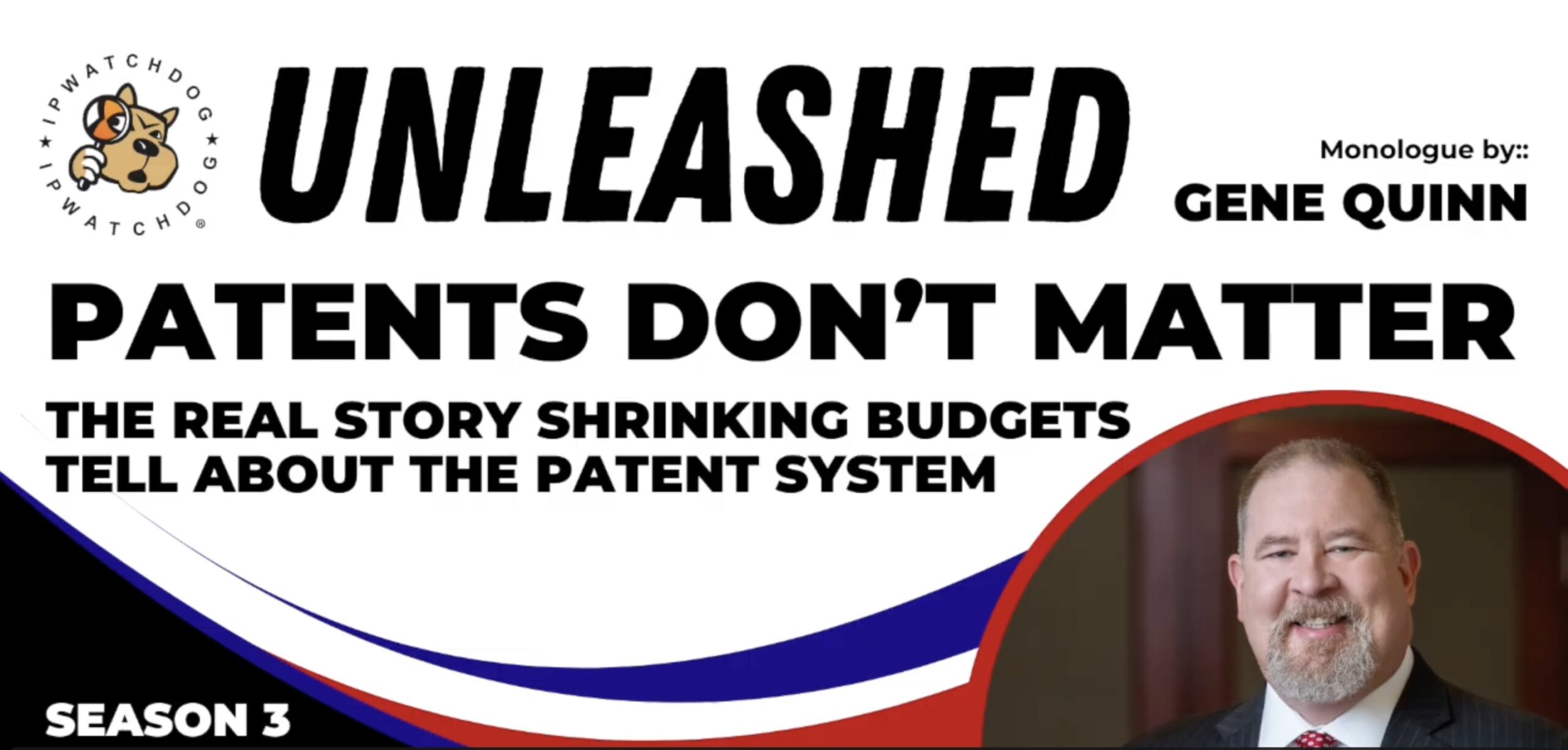
0 I keep hearing the same thing from patent professionals across the industry—inside companies, inside law firms, and even from investors. Patent budgets are shrinking, expectations are rising, and nobody seems willing to admit what that combination actually means.
Obviously, shrinking budgets and rising expectations create an unsustainable pathway. And it should hardly be shocking to anyone that when companies reduce what they’re willing to invest in identifying inventions, drafting applications, prosecuting patents, and maintaining portfolios, what they are saying with their actions is that they have lost in the patent system—because if they had more faith in the patent system, and they believed patents were valuable assets, their actions would be different.
Like searching for gold, when gold prices are high it is more economically viable to mine in difficult locations, or land that has less concentration of gold. When gold prices are low it just doesn’t make sense to mine unless it is easy and/or the concentration of gold is very high. And patents are like gold. In a climate where patents are strong and valuable it makes all the sense in the world to do whatever you can to obtain them and keep them because they create real value. Conversely, when patents are weak and worthless it makes no sense to invest in their creation.
Priorities Are Defined by Budgets
If you look at patent budgets today, it’s becoming increasingly difficult to argue that many companies still believe in the patent system, generally speaking. And it is difficult to believe many companies think patents are strong, or valuable. Sure, companies still say patents are critical to innovation strategy, but they don’t mean it. Just look at their actions. In business, priorities are defined by budgets, and budgets are shrinking year after year.
And this is where the conversation starts to become uncomfortable for everyone involved—companies, law firms, and frankly the patent system itself.
When you look past the talking points and PR rhetoric, and don’t allow your judgment to be clouded by irrational hopes and dreams about the past or what could be, and instead you focus on budgets, filing decisions, and expectations being placed on outside counsel—the story is clear. For most companies, patents simply don’t matter at all. And why should they really? For most companies the odds of using a patent to prevent anyone from doing anything is practically zero.
We kid ourselves when we say that a patent is an exclusive right. The inability to get an injunction against an adjudicated infringer means that most patents are not really property, and it means the U.S. patent system is nothing more than a compulsory licensing regime. And that means patent owners rely on infringing companies to do the right thing, which is as silly as it sounds. In corporate America, where nothing is personal and decisions are purely business, hoping for benevolence where there is no legal compulsion to do the right thing is about as productive as praying to win the lottery in order to fund your retirement. It is no plan at all.
Sure, I understand the desire to spend less, but thoughtful triage—cutting with a scalpel and not a meat cleaver—is the way to move forward with a rational strategy.
Do Clients Really Want Higher Quality Patents?
Perhaps the biggest challenge facing the industry is the growing gap between what companies say they want and what they are actually willing to invest to get. Everyone says they want higher quality patents. But higher quality patents require more work—more technical disclosure, more thoughtful claim strategy, more careful prosecution. And that simply can’t happen when the budget keeps going down.
While in this climate it probably makes sense to spend less on what are weaker, less valuable patents, there is also a bit of a self-fulfilling prophecy at work. Yes, patents are weaker—but they are not dead. Yes, patents are less valuable and worth less, but they are not completely worthless. Yes, it has gotten harder to obtain the patent protection companies want and need—but not impossible.
Patent practitioners are excellent at adapting to whatever nonsensical test or standard the Federal Circuit comes up with, but if you need to cut your budget you simply cannot get the same number of patents. So, each patent you get that you want to have any hope of keeping when challenged and enforcing when infringed must be created differently. This means more effort and energy needs to go into the harvesting of the invention, including cooperation from the inventors with the patent team, and it means spending more to write more robust and detailed patent applications, and it means far greater effort during the prosecution of the application. And not surprisingly that all means more needs to be spent, not less.
But a lot of companies are effectively asking for 2026-level high-quality patent work that will pass Federal Circuit muster to be done at 1980-level prices. That is no strategy at all. And for an asset that can last up to 20 years, all it does is ensure you collect large numbers of weak patents that realistically have little or no value because they could never be enforced, they will be lost if challenged, and worse—in order to keep those low quality patents for their full lifetime you use up precious resources paying for ever increasing maintenance fees and annuities—all to keep assets that you really weren’t serious about acquiring in the first place—because if you were serious you would have done things very differently.
The AI Productivity Illusion
While I think AI tools and platforms offer great promise, and I think everyone in the industry should be using these tools, there is a significant disconnect between what AI can do and what many believe AI actually does.
As many patent professionals already know, there is a growing belief by many clients that AI should make patent preparation dramatically cheaper. And while that is a legitimate expectation given how some have hyped AI solutions, that is not happening today. AI tools and platforms are currently capable of helping experienced patent practitioners to create a better work product—often times a much better work product—but AI is no magic button—certainly not now and perhaps never in our industry since the very nature of what we are supposed to be doing is defining and protecting something that up to now has not existed. But there is no question that AI can and does make the work product significantly better. What is unrealistic, however, is believing that AI will create a better work product while simultaneously providing enhanced efficiency that translates into projects taking less time.
Sharing in Phantom Savings
Still, some clients that aren’t even using AI internally are already insisting they should be sharing in the supposed productivity gains from AI and pay less for patent work because they claim to know that AI makes everything faster and more efficient.
Stated simply, you can’t build stronger patent portfolios by spending less money, demanding more work, and hoping AI somehow fills the gap. That won’t happen now; it may never happen. And if you as a client are demanding more, paying less, believing AI is the answer, you will continue to collect low quality assets that have little hope of doing anything other than draining your resources.
And this is where the situation becomes irrational, and entirely untenable. Instead of rethinking how patents are developed, managed, and funded, many companies are trying to solve a problem of their own creation. In fact, the industry has created a paradox: companies say they want stronger patents, but they are investing less to create them. And the real issue here is not whether law firms should charge less or whether AI does or will eventually improve efficiency. The real issue is whether companies are being honest with themselves about the economics of patents.
If organizations truly believe patents are valuable strategic assets, they must invest accordingly. And if they are unwilling to make those necessary investments, then they should stop pretending that patents remain a priority and make different decisions.
Squeezing Harder Isn’t the Answer
The patent system has always depended on a simple premise—that companies believe protecting innovation is worth the investment. But when budgets shrink and clients seem to increasingly want to put blind faith in black magic as a solution, something has to give. Companies need to start asking some hard questions about what they actually believe the patent system is worth and start acting accordingly with eyes wide open and with full understanding of the consequences—whatever they may be.
And maybe—just maybe—the real question isn’t about whether patents still matter. Maybe the real question is whether companies are willing to invest in them the way they used to. Presently, the answer to that question, based on unrealistic demands and shrinking budgets, is no, they are not willing to invest the time, money and energy necessary. And rather than come to terms with the necessary consequences of that decision they continue to try and get more out of outside counsel for less, as if by squeezing a rock hard enough it will eventually bleed.
![[Advertisement]](https://ipwatchdog.com/wp-content/uploads/2026/03/IP-Copilot-Mar-17-2026-sidebar-700x500-1.jpg)
![[Advertisement]](https://ipwatchdog.com/wp-content/uploads/2026/02/LIVE-2026-sidebar-regular-price-new-700x500-1.jpg)







![[Advertisement]](https://ipwatchdog.com/wp-content/uploads/2021/12/WEBINAR-336-x-280-px.png)
![[Advertisement]](https://ipwatchdog.com/wp-content/uploads/2021/12/Ad-4-The-Invent-Patent-System™.png)





Join the Discussion
No comments yet. Add my comment.
Add Comment