
![[IPWatchdog Logo]](https://ipwatchdog.com/wp-content/themes/IPWatchdog%20-%202023/assets/images/temp/logo-small@2x.png)

 0
0 “Of the 47,337 comments supporting the march-in guidelines, 46,681 used templates repeating the same arguments. That seems like a pretty significant finding—but the GAO buries it.”
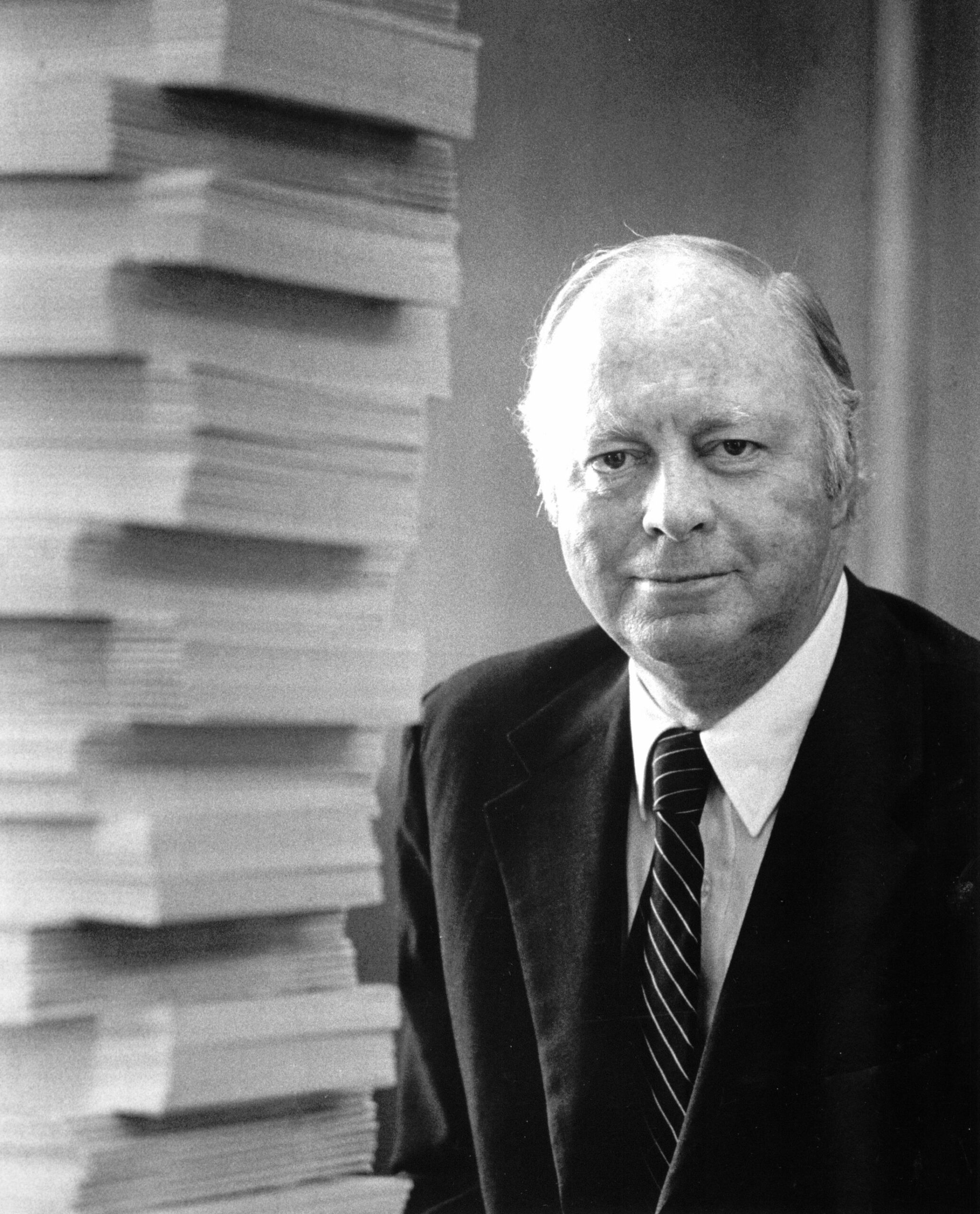
Elmer B. Staats – Source: GAO
The Government Accountability Office (GAO) just released its assessment of the Biden Administration’s “Draft Interagency Guidance Framework for Considering the Exercise of March-In Rights.” A bipartisan combination of Senators Thom Tillis (R-NC) and Chris Coons (D-DE) along with Congressmen Darrell Issa (R-CA) and Jake Auchincloss (D-MA) asked the GAO to evaluate the guidelines on three bases: what the guidelines did and how they were developed; stakeholder views on the draft; and the potential impact of the guidelines.
The report whiffs on all three.
Comptroller General Staats and the GAO
This is particularly painful given the GAO’s history. The GAO transitioned from a financial auditing body to an assessor of agency performance because of the leadership of legendary Comptroller General Elmer B. Staats. When President Johnson wondered why no drugs were being developed from National Institutes of Health (NIH) funded research, a watershed report by Staats provided the answer. When Senators Birch Bayh (D-IN) and Bob Dole (R-KS) wondered why so few government-supported inventions were being commercialized, they turned to Comptroller General Staats, who was the first witness testifying on the Bayh-Dole Act.
It’s no exaggeration to say that his seminal work helped pull the United States out of the economic doldrums of the 1970s, reclaiming our lead as the innovation leader of the world. No one is going to mistake the new GAO report as something Elmer Staats would have done.
Bayh-Dole Refresher
Before we dive into it, a little background might be helpful. The Bayh-Dole Act allows nonprofit organizations, federal laboratories and small businesses to own and license inventions they make with federal support. The thrust of the law is decentralizing the management of these inventions from the Washington bureaucracy into the hands of their creating institutions. Authorities and incentives are given to promote commercialization.
While enacting the law, Congress also provided guardrails to make sure it would function as intended. The central part of this effort is the “march-in” provision, which requires nonprofit organizations to license their inventions on reasonable terms to help bring an invention to practical application; to ensure resulting products help meet public health or safety needs; and to substantially manufacture resulting products in the United States whenever possible. If these conditions are not met, the government can “march-in,” requiring the patent owner to license others, or it can do so itself if the patent owner refuses.
March-In Misunderstandings
Twenty years after enactment, opponents of Bayh-Dole falsely claimed that the law allows agencies to march in if a resulting product isn’t reasonably priced. They touted the theory as a tool to lower drug prices. There is nothing in the statute supporting that allegation and every Administration receiving march-in petitions as a means of imposing price controls has refused to do so.
The most recent denial was by the Biden Administration, despite intense pressure from Bayh-Dole opponents. As we noted in our coverage, the denial was one of the most forceful, rejecting the flawed reasonable pricing theory. But there was a catch. When issuing its opinion, the Biden Administration announced it was tasking an interagency working group to develop a framework for agencies to use when handling march-in requests.
As the committee was proceeding, it was reportedly directed by political operatives that the guidelines must allow for a product’s price to be a factor even though that argument had just been rejected in the latest march-in decision. That’s why Congress asked the GAO to investigate how the guidelines were developed.
The resulting guidelines raised a furor. As we noted: “Despite the rhetoric, the victims won’t be big pharma. Those taking the hit are start-up companies and entrepreneurs.”
That’s because any product based on a Bayh-Dole invention could be targeted, since “reasonable pricing” is a completely arbitrary concept. Just the fact that a petition was filed could prevent a small business licensee from securing desperately needed venture capital or making a big sale. That’s an opportunity that rival companies and shake-down artists would be sure to exploit.
And that’s no small threat, as 70% of Bayh-Dole inventions are licensed to small companies. But if you only relied on the GAO report, you wouldn’t know this.
Regarding the central point of whether the law allows agencies to march in on a successfully commercialized product because someone doesn’t like its price, the report simply says:
“Whereas the Bayh-Dole Act’s provisions do not explicitly mention the price of a product commercialized from a federally funded invention as a basis for march-in, the draft guidance proposed including product price as a factor an agency could consider in deciding whether to exercise march-in rights.”
You would think the fact that the law doesn’t sanction such actions might get a little more emphasis.
Breadcrumbs and Buried Data
It was clear to those of us reading the draft guidelines that the interagency committee forced to include pricing as a means for lowering drug costs left some breadcrumbs behind indicating their dissent. But when they stumble on them, the GAO seems perplexed:
“Two of the scenarios included a discussion of price and six did not. The two scenarios—one involving a water purification technology and the other respiratory masks—discussed price as a factor for exercising march-in to alleviate health or safety needs in a public health emergency. Considering that much of the public debate about march-in rights has centered on drug prices, it is notable that none of the three drug development scenarios included in the draft guidance discussed price as a basis for march-in.”
Most likely, that was inserted as a signal that misusing march-in rights as a form of government price control could not be limited to drugs, given the scope of the law.
Even worse is the report’s analysis of the public comments on the draft guidelines:
“Among the 51,762 public comments on the draft guidance, more than 47,000 comments (about 91 percent) expressed support for the draft guidance, with the remainder expressing opposition.”
Sounds like overwhelming approval. Only those intrepid souls who go to the very end of the report, stumbling on Appendix III, will find this tidbit: of the 47,337 comments supporting the march in guidelines, 46,681 used templates repeating the same arguments. Those duplications represent 90% of the total comments submitted.
That seems like a pretty significant finding—but the GAO buries it.
While the GAO didn’t care to delve deeply into what Congress asked, it did want to question the importance of patents:
“If the implementation of the guidance reduces the licensing of patents arising from federally funded research, the potential impacts on innovation are difficult to discern because the relationship between innovation and patenting is not always clear. Research shows that patenting is not always correlated with innovation, and the intensity of patenting activity varies by industry. One researcher estimates that only 50 percent of firms doing R&D patent their innovations, and some firms avoid patenting their most important innovations at all because patents expire.[31] According to another study, more than half of product innovation is generated by firms that do not patent.[32] One economist, who studied patenting extensively, argues that in the pharmaceutical industry, known for a high level of patenting activity, there is no real correlation over time between patenting and drug innovation. According to this economist, patents may be a better indicator of R&D inputs than R&D outputs.[33]”
Elmer Staats Would Not Approve
If there are any experts touting the importance of patenting, you wouldn’t know it from reading the GAO report. Ironically, that was the viewpoint of Comptroller General Staats.
In his report to Congress on why NIH-funded discoveries weren’t being developed, he found that hundreds of potentially life-saving compounds invented with the help of NIH grants weren’t being tested because “manufacturers were unwilling to undertake the expense without some possibility of obtaining exclusive right to further development.”
“Agency officials have advised the President that a major impediment to these goals has been the patent policy which has made it extremely difficult to make use of the resources and services of the pharmaceutical industry. “
When Comptroller General Staats opened the Bayh-Dole hearings presenting his findings that agency micromanagement of patented inventions made with their funding was harming U.S. innovation, Staats had no doubts about the importance of patent rights to a successful turnaround of the American economy.
History shows he was correct.
Once, while on my way to a meeting in the Old Executive Office Building next to the White House, I walked past the “Elmer B. Staats Memorial Room.” As a former staffer to Senator Birch Bayh, I paused in tribute to a man who did so much for his country.
We live in a time when so many long-valued institutions have lost public trust. It’s painful for those of us who know its history to think that Elmer Staats’ beloved institution may be joining that list.
![[Advertisement]](https://ipwatchdog.com/wp-content/uploads/2026/02/Juristat-Feb-26-2025-sidebar-700x500-1.jpg)
![[Advertisement]](https://ipwatchdog.com/wp-content/uploads/2026/02/LIVE-2026-sidebar-regular-price-new-700x500-1.jpg)
![[Advertisement]](https://ipwatchdog.com/wp-content/uploads/2026/02/Integral-Molecular-Mar-5-2026-sidebar-700x500-1.jpg)



![[Advertisement]](https://ipwatchdog.com/wp-content/uploads/2021/12/WEBINAR-336-x-280-px.png)
![[Advertisement]](https://ipwatchdog.com/wp-content/uploads/2021/12/Ad-4-The-Invent-Patent-System™.png)




Join the Discussion
No comments yet. Add my comment.
Add Comment