![[IPWatchdog Logo]](https://ipwatchdog.com/wp-content/themes/IPWatchdog%20-%202023/assets/images/temp/logo-small@2x.png)
Posts Tagged: "Andrei Iancu"
This week in Other Barks & Bites: The Federal Circuit has asked USPTO Director Andrei Iancu to brief the appellate court on deference that should be paid to precedential PTAB opinions; China announced that it will create a credit rating mechanism for patent agents; Russ Slifer Op-Ed revives 101 debate; the FCC will approve the proposed T-Mobile/Sprint merger; amicus briefs filed at the Supreme Court support the abrogation of state sovereign immunity against copyright claims; Nintendo ramps up copyright campaign against YouTube accounts using video game music; Guns N’ Roses settles trademark dispute over craft beer brand; and copyright troll entity Malibu Media faces investor lawsuit.
On October 25, the AIPLA Annual Meeting will host a Patent Trial and Appeal Board (PTAB) Inter Partes Review (IPR) trial to determine the fate of a pair of patents issued by the U.S. Patent and Trademark Office (USPTO) to Zaxcom for a Digital Recording Wireless Microphone. Zaxcom is a U.S. manufacturer of high-end, specialized wireless microphones and recording equipment for the film and television industries. The company was founded in 1986 by Glenn Sanders, the named inventor on the challenged patents. The Zaxcom case caught my attention for several reasons. First, this was not a patent troll asserting a stack of vague, overly broad patents, but was an inventor-owned company that was producing the invention. Second, Glenn was manufacturing his invention and creating jobs in the United States. Third, the technology has won Engineering Emmy Awards and has been honored by the Academy of Motion Picture Arts and Sciences with a Technical Achievement Award. Finally, Chief Administrative Patent Judge Scott Boalick was on the panel. How could the USPTO grant a patent, the claimed invention earn Emmy and Academy awards, and then the USPTO decide the patent was likely to be invalid? Especially when Director Iancu is traveling throughout the country and testifying in Congress that it is a new day at the USPTO and that he has restored balance at the PTAB?
Last week, the House Committee on the Judiciary’s Subcommittee on Courts, Intellectual Property, and the Internet convened a hearing to perform oversight of the U.S. Patent and Trademark Office. USPTO Andrei Iancu fielded questions on Section 101 patent eligibility issues and fraudulent trademark application filings and, while several Representatives on the subcommittee noted Director Iancu’s procedural changes at the Patent Trial and Appeal Board (PTAB), much of the previous backlash to those changes seemed to have dissipated. In his opening statement, Representative Hank Johnson (D-GA), Chairman of the House IP Subcommittee, discussed the impact that issued patents have on small businesses, noting that the first patent granted to a startup results in the business both hiring an average of 16 employees and earning an average of $10.6 million in additional sales within five years. However, Johnson added that recent case law from the U.S. Supreme Court have resulted in major issues with patent eligibility under 35 U.S.C. § 101, threatening innovation in critical technology areas like medical diagnostics. He was also concerned by a rise in fraudulent trademark filings coming from China that can hurt American businesses trying to register legitimate marks.
On Monday, the International Intellectual Property Commercialization Council (IIPCC) gathered patent office and Federal Circuit experts, including current USPTO Director Andrei Iancu and former Federal Circuit Chief Judge Randall Rader, at the Capitol Building to discuss “The State of Innovation in the Union.” The panel was moderated armchair style and resulted in some poignant questions and answers from a few of the best-known players in the patent world. I attended the event, and at the end of the panel on which he participated I had the opportunity to ask Iancu what he thought about the current roundtables taking place in Congress and the efforts to reform Section 101. I reminded him that, at this time last year, he was giving speeches and testifying to Congress, saying to anyone who would listen that 101 should be something that we are all talking about and considering from a variety of angle. Then, as a newly minted Director, Iancu would tell Congress that if and when they were interested in engaging on 101 reform he and the Office would be ready to offer any assistance necessary. Congress seems to be working on the precursor to what will soon become legislative language. So, where does the Director stand on the issue today? His response was both correct, and something of a wake-up call. The final takeaway I think was that Iancu’s the only hope we’ve got, at least for the foreseeable future.“In the end, all three branches need to be rowing in the same direction on something like 101,” Iancu said. An obvious if seemingly cautious statement, but he did not stop there.
USPTO Director and Under Secretary of Commerce for Intellectual Property Andrei Iancu believes that “to a large extent … if they want to, the Federal Circuit can fix the problem” with patentable subject matter under Section 101. Speaking at the 27th Intellectual Property Law & Policy Conference at Fordham Law School on April 25, Mr. Iancu said the interpretation of Section 101 is “the most important issue of substantive patent law currently.” He added: “This issue must be addressed now in the United States.” The USPTO Director said there is consensus that the state of the law is unworkable: “Recent case law has created significant confusion in this regard.” But he added: “If you look at the Supreme Court cases by themselves, those cases are not the ones necessarily that have caused the problem. In the way those cases have been interpreted in the lower courts or at the USPTO itself, we have deviated from the core message of the Supreme Court to some extent.”
Senators Thom Tillis (R-NC) and Chris Coons (D-DE) have written U.S. Patent and Trademark Office (USPTO) Director Andrei Iancu raising a concern about what can really only fairly be characterized as the weaponization of the Patent Trial and Appeal Board (PTAB). Although the USPTO has vehemently disagreed that there is a problem over the years, everyone in the industry familiar with post grant challenges knows there is a very serious problem with serial challenges. Indeed, there appears to be a concerted effort—perhaps even collusion—to challenge the patents of certain patent owners over, and over, and over, and over again.
On Monday, April 1, the Court of Appeals for the Federal Circuit issued a decision in Cleveland Clinic Foundation v. True Health Diagnostics affirming the invalidity of patents covering medical diagnostic tests for determining a patient’s risk for cardiovascular disease. The decision, which is nonprecedential and was decided along similar lines to another 2017 decision between the two parties, is yet another depressing sign that U.S. patent law is woefully inadequate when it comes to supporting important innovations in the biotech fields. Of particular note is the Federal Circuit’s finding against Cleveland Clinic’s argument that the district court didn’t give appropriate deference to subject matter eligibility guidance published by the U.S. Patent and Trademark Office (USPTO) as required by the U.S. Supreme Court’s 1944 decision in Skidmore v. Swift & Co. Although this argument related to USPTO guidelines published in 2016, it would seem to call into question the USPTO’s more recent revised subject matter eligibility guidance issued earlier this year by USPTO Director Andrei Iancu. This gives voice to fears that the “Iancu Effect” on subject matter eligibility won’t matter much if the Federal Circuit and other courts don’t adhere to the USPTO’s views on patent eligibility under Section 101.
It is safe to say that Artificial intelligence (AI) and Machine Learning (ML) are hot topics and, as with any rapidly growing technological area on the industry side, there is also a rapidly growing number of patent applications being filed.In view of this, the European Patent Office (EPO) issued new guidance for examination for AI and ML patent applications in November 2018. Meanwhile, in January 2019, the U.S. Patent and Trademark Office (USPTO) also issued revised guidance directed to what constitutes patent eligible subject matter under 35 U.S.C. §101. Although the USPTO’s revised guidance is more generally directed to software applications, at least one of the accompanying hypothetical examples (Example 39) is directed to the AI and ML space. Therefore, while there may be lingering concerns that AI and ML inventions will face extra scrutiny toward patentability due to their software-centric nature, the extra attention that the EPO and USPTO are paying toward AI and ML will likely help swing the pendulum of patentable subject matter toward a place that is in harmony with the current state of technology. The below analysis reviews the recent developments by the EPO and the USPTO to provide specific guidance on the topic of AI and ML.
On April 15, the Supreme Court will hear oral argument in Iancu v. Brunetti, a case the International Trademark Association (INTA) has remarked raises a critical issue for all trademark owners—namely, which trademarks reliably can be expected to obtain registration under the Lanham Act. At the heart of the case, and of the amicus brief we helped file for INTA this week, is whether free speech concerns should trump the statutory bar on registration of “immoral” or “scandalous” marks. INTA says the First Amendment should win out, and the statutory bar should fall. The category of marks at issue is exemplified by the FUCT apparel mark, owned by Erik Brunetti, to which the U.S. Patent and Trademark Office (USPTO) denied federal registration. After the Federal Circuit reversed, holding that Section 2(a)’s bar on registering immoral or scandalous marks is an unconstitutional restriction of free speech, the U.S. government sought the Supreme Court’s review, and the Court granted certiorari. It must now decide whether the prohibition in Section 2(a) of the Lanham Act on the federal registration of “immoral . . . or scandalous” marks like FUCT is invalid under the Free Speech Clause of the First Amendment.
USPTO Director Andrei Iancu participated in a fireside chat, titled “The Crossroads of Technology and Innovation,” hosted by the Consumer Technology Association (CTA) at its sixth annual Innovation Policy Day on Tuesday, March 12 at SXSW in Austin, Texas. Sitting with Director Iancu was host Michael Hayes, Sr. Manager of Government Affairs for the CTA. The chat was quite short and briefly touched on topics such as celebrating the 10 millionth-issued patent, the preparedness of the patent system for the future, artificial intelligence and patent eligibility, and the availability of patenting for all peoples. Then, in what some may consider to be an unscrupulous move, Hayes introduced the narrative of patent trolls.
On the afternoon of Wednesday, March 13, the Senate Judiciary Committee’s Subcommittee on Intellectual Property held an oversight hearing of the U.S. Patent and Trademark Office featuring testimony from and questioning of USPTO Director Andrei Iancu. While this hearing was relatively short by Congressional standards, the Senate IP Subcommittee explored recent changes instituted during Iancu’s tenure as USPTO Director and also got into the debate on pharmaceutical patents—a topic that has been front and center for both houses of Congress in recent weeks.
A number of organizations, including Ericsson, Nokia, Philips, Qualcomm, the Innovation Alliance and the Licensing Executives Society, have sent two separate letters to U.S. Attorney General William Barr, USPTO Director Andrei Iancu, and Secretary of Commerce Wilbur Ross stating their support for the United States’ decision to withdraw the Department of Justice, Antitrust Division’s assent to the 2013 joint DOJ-U.S. Patent and Trademark Office “Policy Statement on Remedies for Standards-Essential Patents Subject to Voluntary F/RAND Commitments” (the 2013 Joint Policy Statement). The letter sent by Ericsson, Nokia, Philips, and Qualcomm begins by explaining that those signing the letters collectively spend many billions of dollars annually to “the development of cutting-edge that substantially contribute to the social welfare and quality of life of U.S. consumers,” and “and employ tens of thousands of people in the U.S.” The letter goes on to explain that injunctions are necessary to address the widespread patent infringement that has occurred in recent years; infringement that risks innovators’ ability to continue to innovate and create next generation technologies. Without property protections it is economically irrational to invest the billions of dollars required to create cutting-edge technologies.
In September 2018, the United States Patent and Trademark Office (USPTO) announced the substantial revision of Standard Operating Procedures (SOPs) for the paneling of matters before the Patent Trial and Appeal Board (PTAB) (SOP1) and precedential and informative decisions (SOP2), based upon feedback the Office received from stakeholders, courts, legislators, and six years of experience with America Invents Act (AIA) trial proceedings. Now, the USPTO’s Precedential Opinion Panel (POP)—which includes USPTO Director Andrei Iancu, Commissioner for Patents Drew Hirshfeld, and Acting Chief Administrative Patent Judge Scott Boalick—has issued its first ever decision, holding that a petitioner may be joined to a proceeding in which it is already a party; that the Board has discretion to allow joinder of new issues in an existing proceeding; and that the existence of a time bar under 35 U.S.C. § 315(b) is one of several factors to consider when exercising this discretion. Despite that guidance, the POP emphasized that such discretion should be used only in limited circumstances, “namely, where fairness requires it and to avoid undue prejudice to a party.” Because the instant request for joinder was filed as a result of Petitioner’s errors, the Board dismissed the IPR petition, noting that “there are no fairness or undue prejudice concerns implicated, and the Petition is otherwise time-barred under § 315(b).”
The Electronic Frontier Foundation (EFF) is at it again, this time with what they refer to as a Save Alice campaign. The EFF does not like the Revised Patent Eligibility Guidance published by the United States Patent and Trademark Office (USPTO) in January 2019 and is charging USPTO Director Andrei Iancu with attempting to subvert the United States Supreme Court and essentially ignore Alice v. CLS Bank. These assertions are bogus, and truthfully, they are hardly worth the consideration of thoughtful individuals interested in a meaningful dialogue about the state of the U.S. patent system. Director Iancu has issued guidance that strictly follows exactly what the Supreme Court ruled in Alice, period. Over the years patent examiners, Administrative Patent Judges, district courts, and the Federal Circuit have dramatically expanded Alice. It was admitted in Alice that the “invention” could be coded over a weekend by a second-year college student, which means it was extremely trivial and not innovative.
I hold nine U.S. computer security device recovery and communication patents relating to Findmyphone technology, which helps owners display return or recovery information before or with the lock screen to help get their smartphone, tablet, computer or laptop back. In February, I was notified that my latest U.S. application overcame a 35 USC 101 objection following an amendment that explicitly referenced Director Andrei Iancu’s Section 101 Guidance. My story should provide some hope that the guidance can provide a clearer path for inventors on how to adjust their claims to meet the USPTO’s new high standards to achieve success and satisfy the requirements that Iancu is looking for to ensure stronger U.S. software patents.
Varsity Sponsors
![[Advertisement]](https://ipwatchdog.com/wp-content/uploads/2024/04/UnitedLex-May-2-2024-sidebar-700x500-1.jpg)
![[Advertisement]](https://ipwatchdog.com/wp-content/uploads/2024/05/Quartz-IP-May-9-2024-sidebar-700x500-1.jpg)
![[Advertisement]](https://ipwatchdog.com/wp-content/uploads/2024/04/Patent-Litigation-Masters-2024-sidebar-700x500-1.jpg)

Latest IPW Posts
Tips for Using AI Tools After the USPTO’s Recent Guidance for Practitioners
May 2, 2024 @ 08:15 amUSPTO Proposes National Strategy to Incentivize Inclusive Innovation
May 1, 2024 @ 02:15 pmThe SEP Couch: Shogo Matsunaga on SEPs and the Law in Japan
May 1, 2024 @ 07:15 amWitnesses Tell Senate IP Subcommittee They Must Get NO FAKES Act Right
April 30, 2024 @ 05:15 pm
IPWatchdog Events
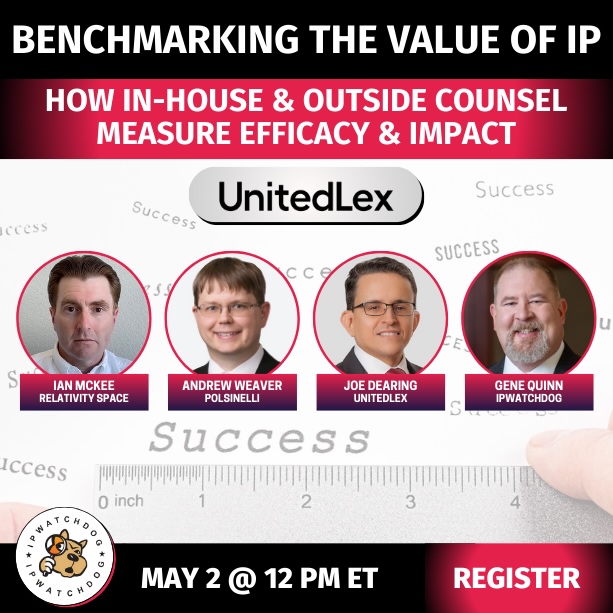
Webinar: Benchmarking the Value of IP – How In-house and Outside Counsel Measure Efficacy and Impact
May 2 @ 12:00 pm - 1:00 pm EDTWebinar: Don’t Be Blindsided – How a Competitive IP Intelligence Program Can Protect Your Company
May 16 @ 10:00 am - 11:00 am EDTFrom IPWatchdog
![[Advertisement]](https://ipwatchdog.com/wp-content/uploads/2021/12/WEBINAR-336-x-280-px.png)
![[Advertisement]](https://ipwatchdog.com/wp-content/uploads/2021/12/2021-Patent-Practice-on-Demand-recorded-Feb-2021-336-x-280.jpg)
![[Advertisement]](https://ipwatchdog.com/wp-content/uploads/2021/12/Ad-4-The-Invent-Patent-System™.png)