

Recent Episodes
November 20, 2025
Patently Strategic Podcast: European Patent Practice
 Play Episode
In a globalized economy, it’s essential to understand that patents are still nationalized documents. For example, a U.S. patent only grants the right to exclude others from making, using, selling, and importing the claimed invention within the United States. It has no bearing on activities in Europe, Canada, Mexico, China, or anywhere else in the world. To restrict activities there, you will typically need a patent granted in each relevant country. This can boil down to filing and prosecution on a per-country basis. However, those seeking protection in Europe do have some additional options for a single application granting protection in multiple nations!
Play Episode
September 29, 2025
Patently Strategic Podcast: Why Patent Marking is So Important
Play Episode
If you look closely enough, you’ll find patent numbers on most of the physical products around you. Much like their copyright and trademark cousins, these designations are far from cosmetic. Instead, they serve a statutory requirement to provide public notice about your protected intellectual property. In the case of patent marking, not only does it reduce the risk of infringement because you are informing potential infringers of the patent’s existence, but the notice also marks the point in time to which you can go back for collecting on awarded damages.
Play Episode
May 29, 2025
Patently Strategic Podcast: International Patents
Play Episode
In today’s global economy, the importance of international patent protection cannot be overstated. Your invention could be conceived of with a workforce distributed across several continents. Your manufacturing could occur in Asia or India, while your products are shipped into and distributed from ports in the target markets of the world’s largest economies. Competitors and infringers could be next-door neighbors or perhaps across the pond. But as you’ll learn today, there is no such thing as an International Patent – no one global patent that protects you everywhere. If you want to protect your rights in a particular country or jurisdiction, you need to get a patent in that particular country or jurisdiction.
Play Episode
April 24, 2025
Patently Strategic Podcast: Protecting Cannabis Patents
Play Episode
As more and more states relax restrictions on both medical and recreational uses of marijuana and hemp, the U.S. cannabis industry is projected to reach $50 billion in sales this year and over $74.6 billion by 2032. This rapid growth is occurring despite immense challenges posed by a complex and conflicting web of legal disparities between federal and state laws. These legal challenges include limited access to financial institutions and the inability to transport products across state lines, but what about patents?
Play Episode
March 18, 2025
ParkerVision v. Rule 36 | Patently Strategic Podcast
Play Episode
If a court stripped away your property rights, wouldn’t you at least want an explanation? In this month’s episode of Patently Strategic, we discuss the Federal Circuit’s practice of applying rule 36 at an alarming rate to revoke inventors’ patent rights on appeal without explanation and ParkerVisions attempt to get the Supreme Court to take the case to hopefully stop this innovation-crippling practice.
Play Episode
February 12, 2025
Patently Strategic Podcast: Dealing with Rejection
Play Episode
So, your patent application got rejected. Now what? In this month’s episode of Patently Strategic, we’re talking about rejection. Specifically, the type that comes from the patent office in the form of an intimidating-sounding three-digit number when your application gets denied by an examiner.
Play Episode
December 9, 2024
Patently Strategic Podcast: Obviousness Case Law Review
Play Episode
An invention cannot be patented if the differences between a claimed invention and the prior art are such that the claimed invention as a whole would have been obvious to a person having ordinary skill in the art at the time the invention was made. Determining obviousness – and the validity of your patent – is more than simply establishing that the invention doesn’t already exist and that it isn’t documented elsewhere. Its conception must also not have otherwise been obvious to those in the field at the time.
Play Episode
November 7, 2024
Patently Strategic Podcast: Petition Practice
Play Episode
Patent examiners can make mistakes. Patent office clerks can misfile paperwork and cause procedural errors. The software tools, document formats like DOCX, and the IT systems your application passes through can have bugs. What recourse do you have when quality issues creep in at this stage? This is where petition practice, fortunately, comes to the rescue.
Play Episode
October 4, 2024
Patently Strategic Podcast: ITC Proofing Portfolios
Play Episode
For inventors, the promise of the patent system is the right to exclude others from making, using, importing, and selling their patented innovations for a limited period. But how do patent holders actually enforce those rights, particularly when the infringing product is being manufactured outside of the United States? In an otherwise challenging time for rights assertion, the ITC – or International Trade Commission – can be one of the most impactful long-range weapons an inventor has in their arsenal for stopping patent pirates.
Play Episode
September 11, 2024
Patently Strategic Podcast: Continuation Practice
Play Episode
Void of pursuing continuations, the language of your patent is frozen in time at issuance. The specifics of the enforceable boundaries of your protection are forever fixed to the claims you chose to pursue with your initial application – but not necessarily with the full breadth of your invention as conceived. For many reasons, practitioners and inventors will often choose to limit how much of an invention is claimed in an initial application. But then the future happens.
Play Episode
August 6, 2024
Patently Strategic Podcast: PTAB Survival Guide
Play Episode
The most terrifying thing that can happen to a patent owner is receiving an inter partes review (IPR) petition. This is a tool that accused infringers can use to invalidate patents. And they have … to alarming effect. As we’ve discussed, the kill rate at the Patent Trial and Appeal Board (PTAB) is staggering. The PTAB – or, as regular listeners of this audience more commonly know it, the “Patent Death Squad” – has racked up a claim execution rate north of 84% and the death of thousands of valid patents at the hands of infringers looking to profit from innovations they didn’t invest in to create. This is an institution that is clearly out of balance and screaming for reform.
Play Episode
July 8, 2024
Patently Strategic Podcast: Crafting Quality Patents
Play Episode
Is your patent application only good enough to get through the examination process? Or has it been crafted to stand the tests of time and varied audiences if you later need to assert that document against an infringer, find yourself litigating with it in an Article 3 Court at the hands of a judge and jury, God forbid, end up having to defend its validity at the Patent Trial and Appeal Board (PTAB), or even needing to use it to block pirated imports at the International Trade Commission (ITC)? The difference is often quality.
Play Episode
June 6, 2024
Patently Strategic Podcast: Robert Cameron and the Power of Perseverance
Play Episode
We’ve seen few entrepreneurial success stories that haven’t involved heavy doses of perseverance, grit, observation, and creative problem-solving. Today’s guest possesses these qualities in spades. And while I can’t necessarily recommend some of the more death-defying specifics of his approach … at least not without a lot of “don’t try this at home” fine print … I do think that most inventors and aspiring entrepreneurs will benefit immensely from studying our guest’s thoughtfully crafted, time-tested, and wildly inventive approaches to innovation and business.
Play Episode
May 9, 2024
Patently Strategic Podcast: CAFC Chronicles
Play Episode
The difference between getting claim construction right and getting it wrong is the difference between a valid patent and an invalid patent – and potentially the difference between millions of dollars awarded from infringement decisions vs. ending up with a worthless piece of paper. In this month’s podcast episode, we’re talking about costly tales of claim construction fails. This is the final episode in a three-part series focused on the fundamentals of patent claims and claim construction.
Play Episode
March 26, 2024
Patently Strategic Podcast: Patents and AI
Play Episode
For decades, conventional wisdom had most of us believing that automation and the inevitable rise of the machines would upend blue-collar industries first. But then AI had something to say about all of that. From passing medical licensing exams to writing code to even acing the Uniform Bar Examination, AI has become society’s latest (and perhaps most capable!) change agent in the professional workplace. At an astonishing pace, it’s erasing all assumptions as to what industries will be most impacted. With the most recent advancements centering around the understanding and generation of text and images – the core ingredients to patents – it’s becoming abundantly clear that patent practitioners and inventors are far from immune to AI’s effects and reach.
Play Episode
About This Podcast
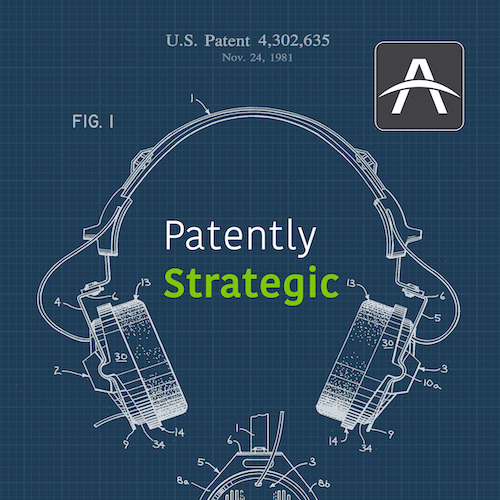
Aurora’s Patently Strategic is a patent-focused podcast for inventors, founders, and IP professionals, covering the finer points, sharp edges, and nuances of startup patent strategy. Each monthly episode features a round-table style discussion amongst experts in the field of patenting and is hosted by Dr. Ashley Sloat, Aurora’s President and Director of Patent Strategy. Patently Strategic is brought to you by Aurora Consulting, a patent strategy boutique that specializes in working with early stage life science, medical device, digital health, and software companies to develop valuable patent portfolios through highly tailored, comprehensive strategies. Aurora’s scalable, value-oriented patent portfolio services include strategy, drafting, filing, prosecution, and searching.
Varsity Sponsors
![[Advertisement]](https://ipwatchdog.com/wp-content/uploads/2026/10/BlackBox-IP-Oct-20-2026-sidebar-700x500-1.jpg)
![[Advertisement]](https://ipwatchdog.com/wp-content/uploads/2026/10/Questel-Oct-22-2026-sidebar-700x500-1.jpg)
![[Advertisement]](https://ipwatchdog.com/wp-content/uploads/2026/09/Life-Sciences-2026-sidebar-early-bird-ends-Oct-25-700x500-1.jpg)
![[Advertisement]](https://ipwatchdog.com/wp-content/uploads/2026/09/WE-BUY-PATENTS-SIM-IP-Ad-1-revised-on-Sep-28-2026-700x500-1.jpg)
From the IPWatchdog Institute
![[Advertisement]](https://ipwatchdog.com/wp-content/uploads/2024/09/Patent-Prosecution-Training-sidebar-700x500-2025-03-27.jpg)

Latest IPW Posts
Abandoning Bayh-Dole Endangers U.S. Innovation
October 15, 2026 @ 01:47 pmInnovation Alliance Pushes for Trump Admin to Finalize Proposed PTAB Changes
October 15, 2026 @ 12:15 pmJudge Says Amazon Must Face Direct and Vicarious Copyright Claims Over Merch on Demand Products
October 15, 2026 @ 09:15 amCAFC Affirms Win for Hulu Due to Ineligibility of Digital Ad Tech Claims
October 14, 2026 @ 03:15 pm
Latest Podcasts



IPWatchdog Events
Webinar: Leveraging AI for Patent Administration – Expanding Capacity Without Expanding Headcount
October 20 @ 12:00 pm - 1:00 pm EDTWebinar: Patent Search in the AI Era – Separating Hype from Real Productivity Gains
October 22 @ 12:00 pm - 1:00 pm EDTWebinar: AI for Patent Licensing – Beyond Statistical Triage to Evidence-Grounded Product Analysis
October 28 @ 12:00 pm - 1:00 pm EDTWebinar: Building Verifiable AI Intelligence – Connecting Tools, Data and Workflows with MCP
October 29 @ 12:00 pm - 1:00 pm EDT
Industry Events
From IPWatchdog
![[Advertisement]](https://ipwatchdog.com/wp-content/uploads/2021/12/WEBINAR-336-x-280-px.png)
![[Advertisement]](https://ipwatchdog.com/wp-content/uploads/2021/12/Ad-4-The-Invent-Patent-System™.png)